Fungal Conservation in Europe: Evidence to Action
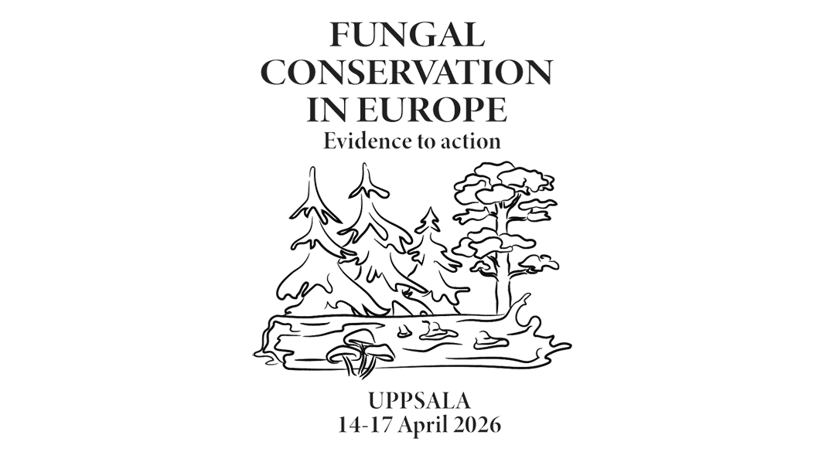
We are delighted to invite you to the upcoming meeting: Fungal Conservation in Europe: Evidence to Action which will take place in Uppsala, Sweden 14-17 April 2026.
In this meeting we will bring together researchers, conservation professionals, policymakers, citizen scientists, and students to explore how scientific knowledge of fungi – from red-list assessments and metabarcoding – can be effectively implemented in conservation practice and policy. Two pre-meeting sessions will be devoted to hands-on-red listing on a global scale.
The meeting focuses on how we move from evidence to action: how research, monitoring and red-listing can inform site protection, management, and national strategies for fungal biodiversity.
We particularly welcome participation from early-career scientists, non-professional mycologists, and anyone involved in mapping, assessing, or conserving fungal species and habitats.
Location:
Swedish University of Agricultural Sciences, Campus Ultuna, Uppsala, Sweden
The programme includes:
- Case studies on how red-listed fungi have led to concrete conservation measures
- Sessions on fungal mapping, habitat protection, and monitoring
- Sessions on using metabarcoding for mapping and conservation
- A citizen science session to share ideas and experiences
- Discussions on policy integration and red-listing practices across Europe
- Field excursions, exhibitions and networking opportunities
Programme
Registration
On registration you will get an automatically generated e-mail acknowledging that we have received your registration. You will then receive a personal confirmation e-mail with details of payments of registration fee.
Registration period: 15 January – 25 February 2026
Registration fee
SEK 2000 (includes meetingactivities, field excursion, lunches and joint dinner) to be paid to the Swedish Mycological Society once you have received a confirmation e-mail from the organising committee.
Call for Abstracts
We warmly invite submissions focusing on translating scientific research into practical conservation action for fungi. The meeting brings together researchers, practitioners, policymakers, and citizen scientists to explore advances in fungal ecology, monitoring, and fungal conservation in practice.
Abstract submission is open: 15 January - 25 February 2026
Notification of acceptance: 27 February 2026
Types of contributions
Participants are welcome to submit abstracts for:
- Oral presentations (15 minutes)
- Poster presentation
- Exhibition stand
During the submission process, authors will be asked to indicate their preferred presentation type and the thematic track that is most relevant to their contribution. An abstract should be submitted at the latest 25 February 2026.
Submission Guidelines
Abstracts should:
- be 250–300 words, excluding title and author information
- be written in English
- follow a clear structure including background, aim, methods, main results or expected outcome, and relevance for fungal conservation
- include title, authors, affiliations, and corresponding author contact information
- indicate the primary thematic track
Review Process
All submissions will be evaluated by the Scientific Committee according to
- relevance to the meeting theme scientific quality
- clarity of objectives and results
- potential contribution to conservation practice
Themes for oral presentations and posters
The four-day programme offers a rich combination of scientific sessions, workshops, and hands-on experiences. As a contributor, you can choose to present within the following themes:
Fungal Conservation in Practice
The session invites work that presents the activities and the outcomes of both EU-funded, national, regional and NGO initiated conservation projects. We specifically encourage both research and practical studies, especially those that share activities, lessons learned, and practical knowledge to advance efficient fungal conservation.
Indicator Species and Fungal Mapping for Protection
The use of indicator species has a long history in conservation mycology. In this session we will explore how indicator species can be used in practice, and what they really do indicate, apart from their own presence. We will also consider other approaches to bring fungal biodiversity on the conservation map, including spatial analyses of current conservation status of red-listed species in Europe.
Citizen Science Engagement in Fungal Monitoring
Citizen science is becoming an integral part of mycological research, with public participants contributing valuable data on fungal occurrences, increasingly supported by molecular identification tools. Many initiatives also raise awareness of fungal diversity and conservation needs. This session will highlight ongoing fungal citizen science projects and explore their potential role in monitoring and conservation efforts of fungi.
Metabarcoding for Fungal Conservation
Work that explores how DNA metabarcoding can be used to support fungal conservation, highlighting both opportunities and challenges. Contributions are encouraged that combine academic research with applied conservation practice, and that draw on existing knowledge, data, and tools available through online resources and public databases. Topics may include method harmonization, fungal identification and taxonomy, data quality and accessibility, and how metabarcoding results can be translated into information useful for conservation planning, management, and policy.
Fungal red-listing
Work on fungal red-listing, experiences and lessons learned, and how we move forward from red-list assessments.
Contact
For questions about the abstract submission or the scientific programme, please contact:
Elisabet Ottosson: elisabet.ottosson@slu.se
Mikael Jeppson: jeppson@svampar.se
Red-listing workshops
When: Monday 13 April 9.00–17.00
Instructors: Anders Dahlberg and Greg Mueller
Where: Meeting rooms at the Swedish Species Information Centre, SLU campus, Uppsala. See location.
During registration, indicate which workshop you want to participate in.
Participants will need to either bring their own lunch or indicate in the registration form whether they would like to reserve lunch at a restaurant on campus. Coffee and tea is available.
1. Introduction to fungal red-listing (Meeting room Artedi, ground floor)
This will give an introduction to the philosophy and theory behind red-listing of species, the criteria used and their interpretation for fungi. The day will consist of interactive lectures, discussions and hands-on exercises, including national to global assessments. To prepare for the workshop, the participants will be asked to study the guidelines for fungal red-listing and instructional videos.
Maximum 20 participants.
2. Accomplish and finalize red-listing of European fungi – with a species you are keen about (Meeting room Wahlberg, 1st floor)
This workshop is aimed at those who have earlier experience of fungal red-listing and are eager to conduct or finalize global red-list assessments of threatened European fungi. The setup is that every participant must select at least one fungus mainly occurring in Europe they are keen about and eager to have globally red-listed. It could either be a species where a new assessment is initiated or where it already has started at the global fungal red list initiative website. For this workshop, the species documentation needs to be prepared and ready before the workshop. One start-up and one follow- up digital meeting during March will be arranged. The goal is to have the assessed species ready during the workshop in order to be included in the IUCN Red List during 2026.
Maximum 20 participants
Travel grants
To promote broad and inclusive participation, a limited number of travel grants will be available for early-career researchers, conservation practitioners, and citizen scientists who may lack institutional funding. The grants are intended to support attendance at FCE26 and will cover the meeting registration fee and reasonable travel costs.
Applicants will be selected on a competitive basis, taking into account relevance to fungal conservation, motivation to participate, and potential benefit from attending the meeting. Priority will be given to applicants who would otherwise be unable to attend.
We are looking forward to seeing you in Uppsala.
FCE scientific and organizing committee:
Elisabet Ottosson, SLU Swedish Species Information Centre
Mikael Jeppson, Swedish Mycological Society
Susana C. Gonçalves, European Council for the Conservation of Fungi
Irmgard Greilhuber, European Mycological Association
Jacob Heilmann-Clausen, FunDive
Julia Pawlowska, FunDive
Anders Dahlberg, Swedish University of Agricultural Sciences
Francesca Floccia, JONEF
Cátia Canteiro, SPUN