How to cite images, tables and maps
When writing an academic text, you need to cite the illustrations you use in your work. You must also comply with copyright laws. On this page, you will find examples of how to cite images, tables and maps using the SLU Harvard reference style.
Summary
- All images and tables should have a brief description that explains their content and indicates the source. For images, place the description below the illustration (figure caption); for tables, place it above (table caption).
- The image or table must also include a full reference. This reference may be provided in one of the following ways:
- in the figure or table caption,
- in a separate list of figures or tables, or
- in the reference list.
- You must refer to the image or table in the running text so that the reader can follow your reasoning, for example: "As shown in Figure 1 ..."
There are many different reference styles. If you are unsure which one to use or what applies to your work, ask your teacher or supervisor.
Your own image or table
If you have created the image or table yourself, you must clearly state that you are the author. This should be either in the caption for each figure or table, or stated on the title page. Examples:
In the figure or table caption:
- Photographer: First name Surname
On the title page:
- The illustrations in this work are the author’s own unless otherwise stated.
If the image or table has been published previously, for example in a student thesis, you must cite the original publication.
Copyright
Images, tables and maps are often protected by copyright. When using such material, you must respect the copyright. You can also choose material that is free to use, such as works where the copyright has expired or works licensed under Creative Commons.
Links
Use persistent links (e.g. DOI, URN, Handle ID) whenever possible, as they are more reliable over time. If you use a regular URL, or if you are uncertain if the link is persistent or not, include the date you accessed the page.
Examples for different types of sources
Images must have a figure caption placed below the image. The figure caption contains:
- An explanatory text describing the image, and
- a citation (author and year) or a full reference to the source.
In the examples below, the source is cited in the figure caption, while the full reference is located in the reference list or list of figures. The source is not cited in the running text, however, the image itself should be referred to in the text to provide context.
The full reference should include, to the extent that the information is available:
- author/organisation
- year
- title
- type of illustration, e.g. [photo]
- persistent link, or alternatively a regular URL and the date when the image was retrieved
- licence
The reference is written as follows:
Author (Year). Title. [type of illustration]. Link [Date] Licence
Example 1: Image that is free to use
The image in this example is old enough that the copyright has expired, and it is therefore free to use. As the exact year is unknown, n.d. (no date) is used in place of a year.

Figure 1. Bird on a beach (Åkerberg n.d.).
The full reference to Figure 1 is as follows:
Åkerberg, N.P. (n.d.). Spotted Lapwing. : Vanellus Squatarola. Young bird in autumn. [drawing]. http://urn.kb.se/resolve?urn=urn:nbn:se:alvin:portal:record-94108
Example 2: Image under a Creative Commons licence
Figure 2 shows an image under a Creative Commons (CC) licence. When using an image with a CC licence, you must state the licence type in both the figure caption and the full reference. You also need to include a link to the licence type in the full reference. Different licences allow different types of use, for example whether the image may be modified. Make sure the licence permits your intended use.

Figure 2. A collection of fungi (ONeal 2009) (CC BY-NC-ND 2.0).
The full reference to Figure 2 is as follows:
ONeal, C. (2009). Mushrooms. [photo]. https://flic.kr/p/7susWa [2020-02-13] CC BY-NC-ND 2.0 https://creativecommons.org/licenses/by-nc-nd/2.0/
Example 3: Image used with the copyright holder's permission
Figure 3 shows an example of an image used with permission from the copyright holder. You must state that permission has been obtained. This can be indicated in at least one of the following:
- in the figure caption (preferred),
- in the list of figures,
- in the reference list, or
- as a general statement on the title page.

Figure 3. Ragdoll with blue eyes (Persson 2022). Used with permission.
The full reference to Figure 2 is as follows:
Persson, M. (2022). Frasse. [photo]. https://flic.kr/p/2nnoXci [2022-05-25] Used with permission.
If you use an image from another work, you must cite the original source and include the page number where the image appears.
All images should have a figure description placed below the image. The figure description should include:
- An explanatory text describing the image, and
- a citation (author, year and page number) or a full reference to the source.
The format of the full reference depends on the type of source. For examples of how to reference different types of material, see:
You must respect the copyright when using images from other works.
In the examples below, the source is cited in the figure caption, while the full reference is located in the reference list or list of figures. The source is not cited in the running text, however, the image itself should be referred to in the text to provide context.
Example 1: Same author for the image and the source
Figure 1 shows an image illustrating cell division. The image is taken from a book, and the creator of the image is the same as the author of the book.

Figure 1. Cell division in simple steps (Burkett 1914:10).
In the full reference, the source is given in full according to the relevant publication type. In this case, the source is a book:
Burkett, C.W. (1914). The Farmer's Veterinarian. New York: Orange Judd Company https://www.gutenberg.org/files/55366/55366-h/55366-h.htm [2022-05-30]
Example 2: Different authors for the image and the work
Figure 2 shows an image of a tree swallow taken from a book. In this case, the creator of the image is different from the author of the book. In such cases, cite the image creator in the figure caption.

Figure 2. Tree swallow (Singer 1977:61).
The full reference is formatted according to the publication type of the source. Since the image is taken from a book in which the author differs from the creator of the image, the reference is formatted as a book chapter:
Singer, A. (1977). Tree swallow [drawing]. In: Scott, V.E., Evans, K.E., Patton, D.R. & Stone, C.P. (eds.) Cavity-Nesting Birds of North American Forests. Washington: Forest Service U.S. Department of Agriculture https://www.gutenberg.org/files/49172/49172-h/49172-h.htm [2022-05-30]
You may create images using generative artificial intelligence (genAI) tools. However, you must ensure that this use of AI is permitted in your course or assignment. For AI-generated images, the figure caption should include a description of the image, and in parentheses:
- The tool used to create the image,
- the prompt used, and
- the year the image was created.
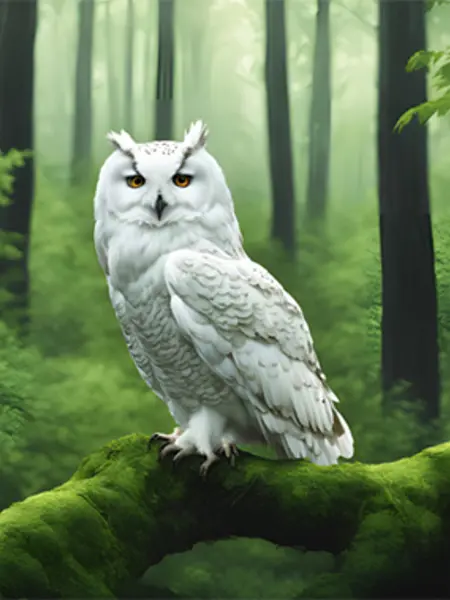
Figure 1. A white owl has settled on a branch. (Image created with Canva from the prompt "A white owl in a green forest", 2024).
No full reference is required for AI-generated images, as the images cannot be retrieved.
If a table meets the requirement of originality (see About copyright), it is protected by copyright and must be used in accordance with copyright law. Not all tables are considered sufficiently original to qualify for copyright protection. If you are unsure, it is safest to assume that the table is protected and follow copyright rules. If you use only the data from a table and create your own version, it is sufficient to cite the source.
All tables should have a table caption placed above the table. The caption should include:
- An explanatory text describing the table, and
- a citation (author, year and page number) or a full reference to the source.
In the example below, the source is cited in the table caption, while the full reference is located in the reference list or list of tables. The source is not cited in the running text, however, the table itself should be referred to in the text to provide context.
Example:
Table 1. Detailed scores for each company in the case study, on a scale of 0–1000 points. The scores are calculated based on two models: the 7E model and the Triple Bottom Line (TBL) model (Silva et al. 2024:9) CC BY 4.0.
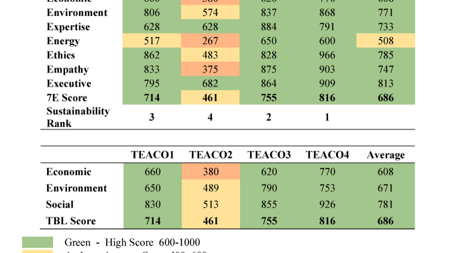
The full reference is formatted according to the publication type of the source. In this example, the table is taken from a scientific article:
Silva, D.N., Wehrmeyer, W. & Murphy, R. (2024). Development of a holistic framework for sustainability measurement: A case study of the tea sector. Cleaner Production Letters, 7, 100072. https://doi.org/10.1016/j.clpl.2024.100072 CC-BY 4.0 https://creativecommons.org/licenses/by/4.0/
For examples of how to reference different types of material, see: