
Tracking climate shocks to build future resilience
What can past climate extremes teach us about resilience? Researchers at SLU’s Interdisciplinary Academy (IDA) are studying long-term data on climate, farming, soils, and society to uncover patterns that could help us adapt to future challenges.
There were two main inspirations: the 2018 drought in Sweden and the large amount of research available. One important paper on climate-agriculture interactions was especially inspring, as well as the available databases on Skåne.
– We want to find out if there are there visible patterns in the impacts of past climate extremes and if we can learn from this to prepare better for the future, says Matthew Jacobson.
A collaborative team tackling complex climate questions
SLU Interdisciplinary Academy (IDA) is an initiative aimed at strengthening interdisciplinary competence across SLU. This interdisciplinary project brings together expertise from across SLU to explore the long-term interactions between climate variability, food production, soils, ecosystems, and socio-economic systems. The group consists of Matthew Jacobson, Parisa Norouzitallab, Katharina Meurer, Erika Cristina Francisco and Bengt-Ove Rustas.
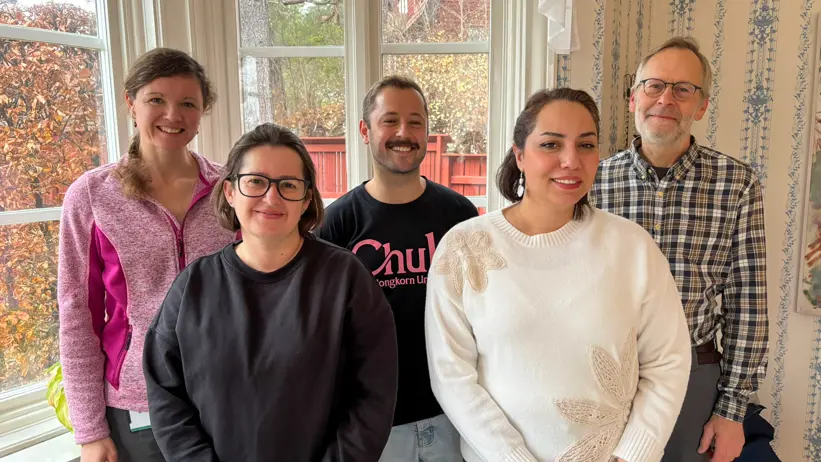
– Doing this project within IDA enables us to bring in interdisciplinary perspectives and get the time to adequately discuss the data and project in a relaxed environment. We will be able to separate this time out from other obligations without having to justify time-prioritisation, says Erika Cristina Francisco.
– We also appreciate the chance to approach a broader question than our individual niches, resulting in something applicable to wider disciplines and audiences. We also see ourselves developing academically and personally through going outside of our comfort zone, something that would not be possible without the opportunities IDA provides, adds Katharina Meurer.
Climate, food, and society – how does it all connect?
Over the course of eight months, the group will assess the impacts of climate shocks in Sweden by examining both historical and contemporary datasets, with Skåne as a case study.
– The project focuses on compiling and analyzing data to map and understand the interactions between climate variables, food production, humans and society, and the environment, says Bengt-Ove Rustas.
– Our project has two parts: compiling data and building a framework to understand it. This means we spend a lot of time discussing how different factors interact, using datasets from a range of fields, says Parisa Norouzitallab.
Creating space for interdisciplinary thinking
What made the researchers apply to IDA?
– We were all interested in working tangentially to our own discipline and combine the knowledge from multiple disciplines through communication and collaboration. We wanted a project that was a bit different where we were allowed to thinkoutside the box. We also appreciated the opportunity to work on a project that requires thinking time, and separating out this time would be impossible without funding, says Bent-Ove.
Three of the researchers found each other during an IDA matchmaking event in January 2025 where they collected ideas for projects, another joined through an IDA Teams advertisement posted based on this discussion and the last one was headhunted to get the right knowledge profile for the project.
– I came with a vague idea for a project on looking at climate-agriculture interactions through long-time perspectives and then through many discussions in separate groups we sculpted a more specific and well-defined project plan, says Matthew.
– We look forward to have the time required to develop ideas and to provide an environment that facilitates discussion and collaboration. IDA makes it possible to dedicate time to writing applications without taking resources from other projects. We are having lots of fun with the opportunity to work on something different together, concludes Erika.
Fact box: The Interdisciplinary Academy (IDA)
Project name:
Climate shock impact assessment in the longue durée: agriculture, soils, and society
Participants:
- · Matthew Jacobson, Department of Urban and Rural Development
- · Parisa Norouzitallab, Department of Applied Animal Science and Welfare
- · Katharina Meurer, Department of Soil and Environment
- · Erika Cristina Francisco, Department of Energy and Technology
- · Bengt-Ove Rustas, Department of Applied Animal Science and Welfare
The Interdisciplinary Academy (IDA) at SLU was established 2022 by the NJ Faculty and SLU Future Food with the aim of building a long-term organisation for the development of cross-disciplinary research at SLU. The hope is that the programme will lead to increasing knowledge of, and interest in, cross-disciplinary research work, strengthen the ability to process research questions from a cross-disciplinary perspective, and facilitate cross-disciplinary research collaborations between different departments at SLU. During 2025–2026 IDA is jointy run by SLU Future Food and SLU Urban Futures. The future development of IDA is managed in dialogue with SLU's other future platforms and SLU Global.