Support for soil health pioneers
From wanting to dare and being able – how can we better support agricultural entrepreneurs to promote the long-term sustainability of farmland?
Improved soil health requires new agricultural methods and is important in three ways:
- secure food supply in a new climate,
- use of arable land as a carbon sink and
- protecting biodiversity in arable land.
The IPCC report in 2018 highlighted carbon sequestration in soil as the cheapest method with the greatest potential for reducing carbon dioxide levels in the atmosphere. As a result, interest in new business models that include carbon sequestration has increased in the food industry.
At a political level, soil health is at the core of both the EU's Green Deal and the UN's global goals for sustainable development. In 2020, the EU Commission presented the report "Caring for soil is caring for life", where soil health is one of five focus areas to be prioritized for 2021–2027. Improved soil health in arable land is therefore of great importance to society, but it requires commitment, innovative thinking, risk-taking and learning on the part of agricultural entrepreneurs. This project will support them in this important work.
Support to farmers
The project is about supporting farmers, so-called "soil health entrepreneurs", who want to use new cultivation methods to improve soil health.
Soil health is defined as the long-term sustainability of arable land, its ability to deliver ecosystem services and promote biodiversity both above and below ground. Better soil health contributes to increased food security, by making the soil better able to withstand both drought and heavy rainfall, but it also contributes to increased carbon storage. The project is a combined development and research project.
The project is a collaborative project between three different departments at SLU:
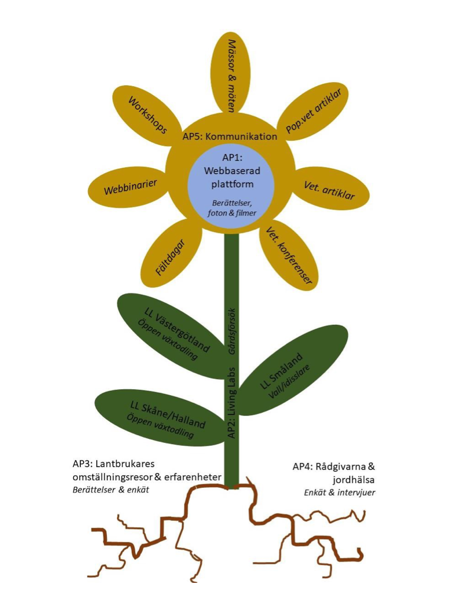
The Department of Human and Society, the Department of Soil and Environment and the Department of Plant Production Ecology, but is also based on collaboration between academics and practitioners. A central part of the project is the establishment and development of three Living Labs 5 farmers, where the research will be carried out through so-called On-Farm Research. Other companies, authorities and organizations will also be invited to webinars and workshops, organized via the web platform (Soil Health Hub).
Reference group
To ensure the long-term survival of the knowledge platform, the project has established a reference group with key people in the industry. The reference group consists of representatives from Greppa Näringen/The Swedish Board of Agriculture, LRF and KSLA.
Funding: The Kamprad Family Foundation.
Main applicant: Jenny Höckert, SLU Competence Center for Advisory Services
Project duration: 2022–2025.