
Citizen Research
The Citizen Research project aims to evaluate pollinators' access to nectar and pollen plants in a landscape. In order to stimulate activities that are good for bee health, practical measurement tools with clear indicators are needed to assess the amount of food required for viable bees.
The project title is "Citizen research for the evaluation of pollinator access to nectar and pollen plants in a landscape perspective. Voluntary involvement and the driving force for local change work".
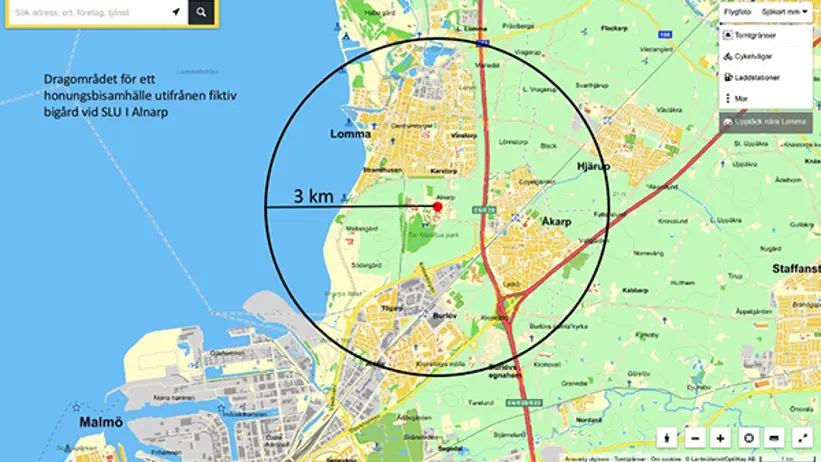
In order for honeybees to develop into viable units, the surrounding landscape needs to meet the bee colonies' needs for nectar and pollen.
The beekeeper's goal is to choose suitable locations to keep the bee colonies healthy.
Today, there is a lack of tools to evaluate the ability of the migration area to meet the needs of the bee colonies (approximately 28 square meters). This usually involves testing and evaluating survival in a practical way.
In order to stimulate activities in the surrounding landscape area, a practical measurement tool with clear indicators could serve as an incentive for supporting measures from other actors in the area. In addition to creating good conditions for honeybees' food supply throughout the season, it can also provide a picture of the situation for other pollinators' conditions in the same area.
In the project, we want to evaluate the possibility of correlating bee pollen collection by beekeepers in selected areas with the total flowering flora supply throughout the season, through synchronized flora inventory in the same areas.
The project is run as a citizen research initiative. In this way, relevant competence is created among participating actors and commitment and participation at the local level.
Project goals
Develop a methodology with the aim of engaging local beekeepers and other actors in data collection and local measures.
Build a collaboration platform between actors from a territorial perspective.
Integrate beekeeping/pollination in discussions about green infrastructure and sustainable land use.
The scientific goal is to find a practical method for evaluating the fertility of a landscape area with regard to the availability of nectar and pollen plants for honeybees and other pollinators.
Create commitment to pollination for increased bee health.
Pilot areas
The areas selected for testing are two areas in Skåne and two areas in Västra Götaland that represent a more uniform landscape and a more varied landscape.
Background
The Swedish Environmental Protection Agency will coordinate and guide the authorities that have activities that directly or indirectly affect the conditions for wild pollinators.
By promoting the food supply for wild pollinators, honeybees are also benefited. In order to concretize activities to a local practical proximity, citizens' observations are important because in traditional research it is impossible to achieve the same resolution, presence or scope in data collection. Furthermore, researchers normally lack the local knowledge that is often required to know where something is (compare, for example, with the landscape floras that have been produced through non-profit initiatives, but which are of central importance for research). Quality assurance is carried out by developing the reporting systems. This creates increased participation and a deeper understanding of what measures are needed to strengthen the quality of an area.
Manual for reporting during flora inventory
Click on the link and you will receive a manual in PDF format for how to proceed when reporting your observations.
Contact
-
PersonLotta Fabricius Kristiansen, PhD StudentDepartment of People and Society