
Science Policy Interface for food systems transformation
The SASi-SPi initiative applies a methodological approach that combines proven tools and guidelines with participatory processes to facilitate the transformation towards more sustainable food systems in partner countries.
The work in the partner countries Colombia, Sierra Leone and Bhutan focuses on transition challenges and on identifying solutions through multistakeholder participatory processes. The initiative targets primarily food system stakeholders, including government institutions, research organizations, and implementation partners.
Transition challenges
Transition challenges (TC) can be defined as obstacles that must be overcome to achieve the goals of a sustainable food system.
With the support of Agrinatura and the FAO Investment Center, TCs have been identified by the governments and national authorities of the three EU partner countries, based on their policy agendas and aligned with the National Pathways developed within the framework of the United Nations Food Systems Summit.
In Colombia and Sierra Leone, the identification of TCs played a key role in building a shared understanding of what “food systems” entail – a concept that is often perceived as broad and abstract by many stakeholders at both national and territorial levels. Locally defined, TCs developed serve to mobilize stakeholders around a common, concrete, and well-defined project.
Adopting a multi-sector approach
Adopting a multi-sector approach is essential to address the complexity, interconnectedness, and systemic nature of food system challenges.
By bringing together diverse perspectives, expertise, and resources, multi-sectoral approaches allow to develop integrated strategies that promote sustainability, resilience, and equity in food systems.
Food systems governance and decision-making processes often occur at multiple levels, including local, regional, and national. Different scales of governance and decision-making may have varying levels of representation and inclusivity.
Ensuring that all scales are considered allows for the involvement of diverse stakeholders, including marginalized groups and under-represented communities, promoting equity, and social justice.
Including under-represented stakeholders empowers them to actively shape their own food systems, fostering ownership and accountability while proposing more sustainable and culturally appropriate solutions.
Socio-cultural contexts play a key role when addressing food systems transitions. Indeed, not only may socio-cultural contexts shape dietary preferences and consumption patterns, but they also determine traditional knowledge and practices related to food.
As food is deeply intertwined with cultural heritage and identity, considering socio-cultural conditions in food systems transitions helps promote respect for diverse cultural values and identities.
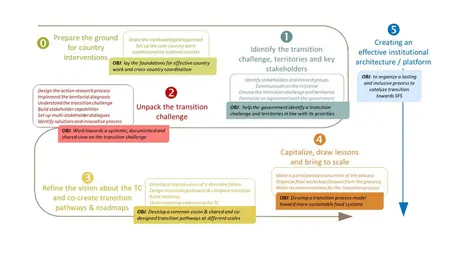
The methodological itinerary
The methodological itinerary is made of five successive steps: (0 to 4) and one transversal step (5) summarizing all the steps.
In Colombia, Transition Challenges have been identified following consultation processes carried out at the national, departmental, municipal, and local levels in four regions (Narino, Montes de Maria, Altiplano Cundiboyacense, and Palmira Sur). Local workshops for example, involved 30 to 50 participants and helped refine a shared understanding of local food systems. They also identified priority research topics—such as food consumption patterns, bio-input production, small-scale agro-industry, and family farming—that will inform science–policy dialogues in 2026.
– We’re thrilled by the great engagement from all the stakeholders and looking forward to the co-creation of transition pathways and roadmaps together with all the stakeholders, says Isabelle Vagneron, economist from the French development research Institute Cirad, who is leading the work on the SASi-SPi transition support model.

For more information contact Isabelle Vagneron, isabelle.vagneron@cirad.fr
Fact box
The methodology used by the SASi-SPi workstream 3 in Colombia, Sierra Leone and Bhutan is based on three main principles:
1. A strong science-policy interface that actively engages governments in identifying challenges, participating in and supporting dialogues, and implementing and scaling up country-specific solutions.
2. The design of participatory approaches with all relevant stakeholders and particularly the under-represented, to ensure a shared vision of situations and to co-construct realistic and adapted solutions.
3. Science-based support, with scientific studies, data and evidence dedicated to serving all stakeholders and providing them with scientific support to underpin more rational, evidence-based decisions.