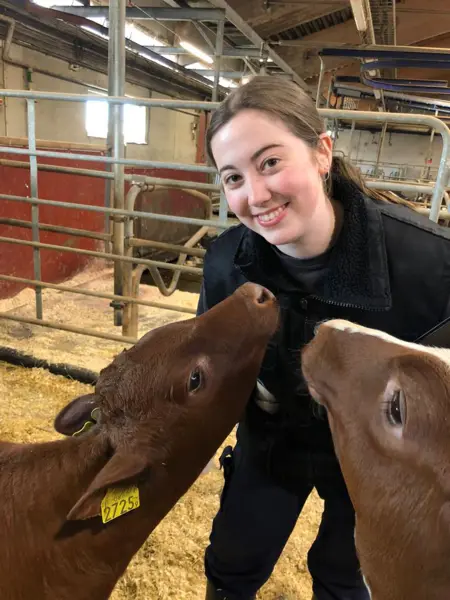
New doctoral thesis: Cow and calf together in automatic milking systems
Claire has studied how contact between cows and calves can be managed in loose housing barns with automatic milking.
Dairy calves are commonly separated from their mothers soon after birth and fed milk or milk replacer artificially. Cow-calf contact (CCC) systems offer an alternative approach, where calves stay with their mothers or adult cows and drink milk through suckling. These systems allow calves to express natural suckling behaviours and form strong social bonds, and they can often drink larger amounts of milk compared to calves that are raised artificially. In this thesis, dairy calves were kept with their mothers for three to six months, and their behaviour, growth, fertility, and milk yield were studied, both during the time together with the cows and afterwards as they themselves grew into adults.
Five different batches
Five separate experimental trials were run, during which the cow barn was modified to accommodate the calves. This included the installation of gates, to prevent calves from entering areas intended only for cows, and the construction of an exclusive calf area known as a “calf creep”. In two of these trials, calf behaviour was observed, first during the three-to-six months when they were with their mothers, and additionally when they were weaned and integrated into the regular herd. To allow for comparisons of productionbased outcomes, each mother-reared calf was matched with an artificially reared calf from the research farm that was of similar age and background; for these outcomes, female calves from all five trials were used.
During the contact period, calves showed differing patterns of suckling behaviour, depending on how contact was managed. In the “calf-driven” system, where calves decided when to seek their mothers, the calves suckled less frequently but for a longer duration on each occasion as they grew older. In contrast, in the “cow-driven” system, where the mothers most often determined when contact occurred, suckling behaviour remained more consistent. However, in both systems, calves suckled from cows other than their own mothers—a behaviour known as allosuckling—and this became more common as calves aged, especially in the cow-driven system.
Weaning of calves
It was then tested in one of the experimental trials how the calves reacted when weaned and partly separated from their mothers at either four or six months of age. At both ages, calves vocalised, spent less time lying down, and increased their movement—all signs of distress often seen during weaning. The calves also grew more slowly during the weeks following weaning. Younger calves responded slightly stronger than older calves, 78 particularly during the first few days after weaning, although neither group seemed prepared for the transition to solid food and reduced mother contact.
Calves raised in CCC systems grew at high rates (1.1–1.4 kg per day) until weaning. This was much higher compared to artificially-reared calves, who grew an average of 0.9 kg per day, likely due to their having greater access to milk. The artificially-reared calves were only offered 6–9 litres of milk per day, while mother-reared calves were not restricted in their milk intake. After weaning, this pattern reversed; artificially-reared calves continued to grow at the same rate, while mother-reared calves grew slightly slower (0.8 kg per day) until their first insemination. In the long term, fertility was similar between mother-reared and artificially-reared animals, both as heifers and during first lactation.
As adults, cows that were previously raised by their mothers produced, on average, less milk during their first lactation compared to those reared artificially. However, there was a large variation in milk yield between mother-reared cows. Those with the highest milk yields performed equally well as the highest-producing artificially-reared cows. Yet among the lowest-yielding cows, mother-reared cows produced 1400 kg less milk, on average, compared to artificially-reared cows. Lactation persistency, which is a measure of how quickly the milk production declines during lactation, was also on average poorer for mother-reared cows. Many of the CCC cows with the lowest milk yields appeared to have been raised in the same experimental trial, which suggests that milk production may be influenced by differences in how CCC is managed
Conclusion
In summary, allowing calves to remain with their mothers for up to six months appears to benefit their early growth, but this early advantage might come at the expense of milk production in later life. Moreover, calves appeared unprepared for the loss of milk and mother contact even at six months of age, which is considerably older than when calves in CCC systems are normally weaned. This thesis provides practical advice for farmers who may be interested in starting with CCC, and acts as a basis for further research, particularly on the long-term effects of mother rearing.
Learn more
Read the doctoral thesis:
Learn more about the project: