The right flower can attract more beneficial organisms – above and below ground
News published:
29/01/2026
Not all flowers deliver the same benefits. A new study from SLU shows that choosing the right plant species for flower strips can simultaneously support pollinators, natural enemies to pests, and soil life – while poor choices may have the opposite effect.
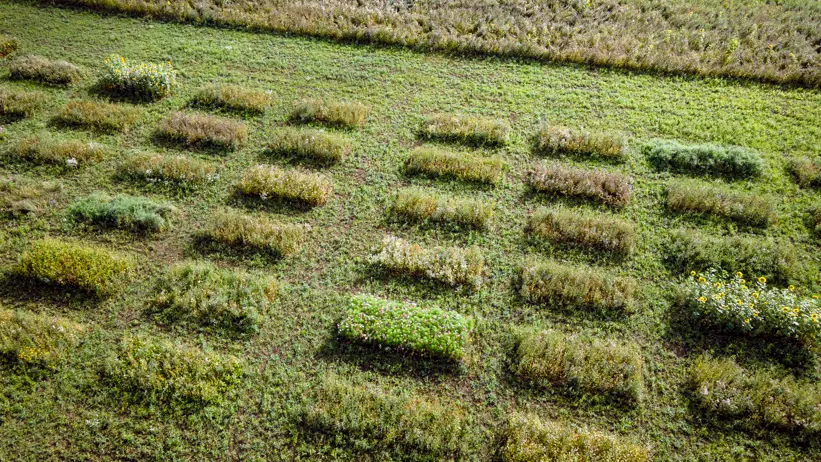
Flowering field margins and flower strips have become an important tool for increasing biodiversity in agricultural landscapes. However, not all flowering plants contribute in the same way, and some may even benefit species that risk becoming pests. In a new study, researchers at SLU investigated how 27 different flowering plant species affect the abundance of pollinators, natural enemies, herbivores, and soil-dwelling organisms. The results show that plant choice determines which insects and soil organisms thrive nearby.
– It is easy to assume that more flowers automatically lead to more beneficial organisms, but it is not that simple. Different plant species function as habitats for completely different communities of organisms, says Neus Rodríguez-Gasol.
Annual plants favoured more beneficial organisms
The researchers analysed organism groups both above and below ground. The results were then linked to various plant traits, such as flowering period, flower size, ground cover, and whether the plant was annual or perennial. One clear result was that annual plants, on average, supported higher abundances of beneficial organisms than perennial plants, both above and below the soil surface. This included pollinators, natural enemies of pests, and soil-dwelling decomposers such as nematodes.
– This shows that a plant’s life cycle can be crucial for how effective a flower strip is at delivering multiple ecosystem services at the same time, says Maria Viketoft.
The experiment with different species grown in squares in a field outside Uppsala. Photo: Cajsa Lithell.Plant cover important for hoverflies
The study also found that high plant cover was positively associated with hoverfly abundance. Hoverflies are an important group because their larvae often feed on aphids in cropping systems.
– Hoverflies benefit not only from nectar and pollen, but also from dense, protective vegetation, showing that effective flower strips are about more than simply which flowers are planted, says Mattias Jonsson.
Soil life is also affected
Unlike many previous studies, the researchers also included organisms in the soil. Nematodes and other decomposers play a central role in nutrient cycling and soil health but are rarely considered when evaluating flower strips.
Some plant species supported several groups of beneficial organisms, for example, plants that supported pollinators also tended to support natural enemies and soil organisms. However, these relationships could not be fully explained by plant traits alone.
– This shows that plant identity itself matters greatly, not just individual traits. This is why the choice of plant species plays a crucial role when establishing flower strips, says Maria Viketoft
A basis for smarter flower strips
The researchers believe the results can help farmers and advisors make more informed choices when designing flower strips. With the right plant species, a single planting can benefit multiple beneficial organisms without simultaneously attracting pests that threaten crops.
– With thoughtful plant selection, we can strengthen pollination, biological pest control, and soil functioning at the same time. This makes habitat management both more cost-effective and ecologically precise, says Mattias Jonsson
The study also highlights the importance of including both above and below ground biodiversity in future research and advisory work.
– Soil life is a crucial but often invisible part of the ecosystem. To fully understand the effects of flower strips, we need to include the entire system in our research, ends Neus Rodríguez-Gasol.