
He wants to lay the foundation for tomorrow's resistant spruce trees
How does spruce defend itself against pathogenic fungi? And can this information contribute to future breeding programmes? Isak Ingerholt, a doctoral student at SLU Forest Damage Centre's research school, aims to find answers to these questions.
One of the spruce tree's main enemies is the pathogenic fungus root rot. In Sweden, this fungus causes extensive damage to forest every year, particularly to spruce trees, by breaking down the roots and trunk of the host tree. In his doctoral project, Isak is trying to understand how spruce trees defend themselves against such attacks by studying which genes in spruce trees control important protective mechanisms and how they can contribute to the tree's resistance.
He is a biotechnology engineer, but his interest in biology is very broad. While studying plant biotechnology at Umeå University, his interest in molecular biology deepened. A tip from a friend and a series of coincidences led him to studying spruce and root rot.
‒ I applied and now I'm here, says Isak Ingerholt, continuing:
‒ I thought it would be exciting to try to understand how the ancient interaction between spruce and root rot works. The project is mainly basic research, but it has direct potential to be useful in spruce breeding programmes.
How does this contribute to breeding programs?
By studying how spruce trees defend themselves, we increase our understanding of which genes and gene variants contribute to increased resistance. Identified genetic characteristics enable a more controlled and effective selection of resistant trees. The results of my study, together with other research, can therefore contribute to the development of future spruce trees.
Revealing the spruce's defence strategy
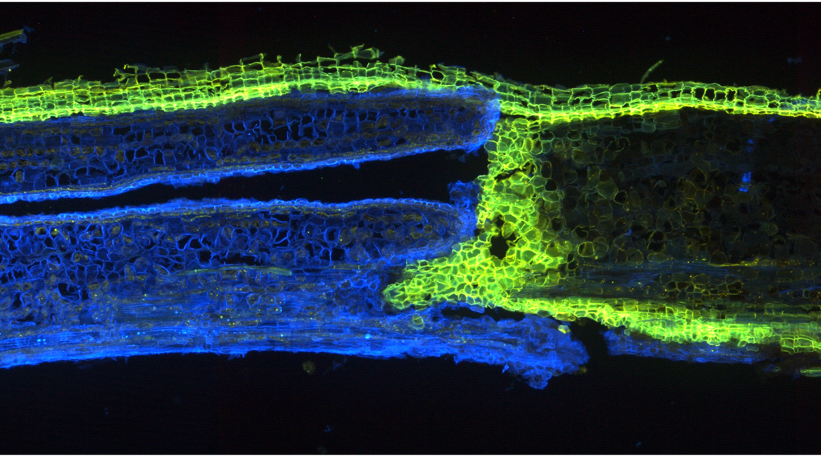
To study the spruce's defence, Isak infects spruce trees with root rot fungus and then uses microscopy to observe how the tree forms barriers in its tissue to limit the spread of the fungus. He then takes samples to analyse which genes are activated and which molecules (metabolites) are formed. This creates a picture of the biological process behind the tree's defence.
‒ At the same time, I am studying a small number of genes that have previously been identified as important for spruce resistance.
To find out whether the genetic difference leads to altered resistance to root rot, Isak is now studying spruce trees that have natural variants of these resistance genes. At the same time, genetically modified spruce trees with increased activity of the same genes are being used to better understand their function and role in defence.
The preliminary results point to interesting conclusions. When the inner bark (phloem) of the spruce is attacked, two defence barriers are formed, in simplified terms. One forms quickly and is a preliminary barrier, and one forms more slowly and is a more permanent barrier. The strength of the early barrier appears to be crucial to how effectively the spruce can limit the fungal attack.
Isak is currently working on investigating specific genes, the significance of differences in proteins and variations in chemical profiles, and how this is reflected in resistance.
Contact
-
Person
-
PersonTheres Svensson, communikation officer for The Forest Damage CentreFaculty of Forest Sciences