
How the environment is affected by antimicrobial resistance in sewage
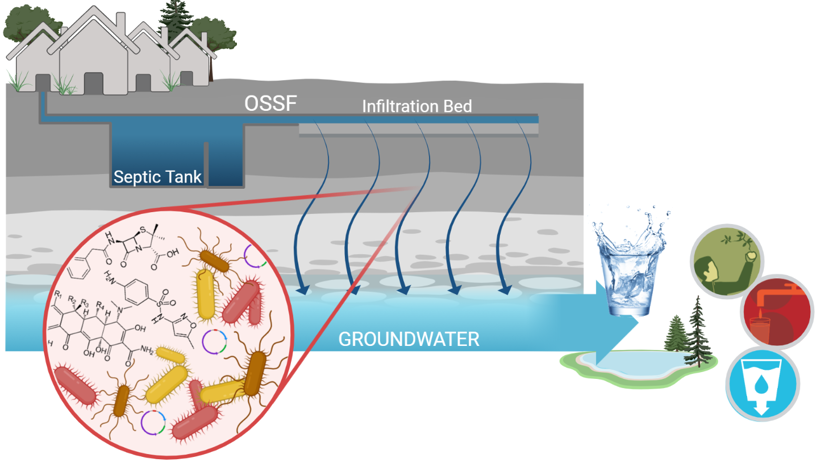
Medicines designed to treat infections can affect our surroundings even after use. In her thesis, Valentina Ugolini examines how these medicines disseminate from on-site sewage facilities into the environment and explores potential strategies to limit this spread.
Antimicrobial resistance is a growing threat to global health, driven by the overuse and misuse of antimicrobial agents. Research into antimicrobial resistance in decentralized wastewater systems and aquatic environments is of critical importance, as this pathway has been underexplored. Advancing knowledge in this field offers substantial opportunities to mitigate its spread.
Results show how dissemination can be mitigated
Effective wastewater treatment is a key factor in slowing the spread of antimicrobial resistance into the environment. Valentina Ugolini presents results that clarify how a combination of different types of biochar can mitigate resistance.
Biochar
Biochar is used to adsorb contaminants physically or chemically. It is an environmentally friendly material obtained from pyrolysis (heating in an oxygen-free environment) of organic waste, for example garden waste. Among other factors (heating temperature, waste type), the specific surface area of the obtained biochar, consisting of the external and microporous surface area, affects its physio-chemical properties and thus how it can be used.
Decentralised on-site sewage treatment systems
The type of sewage treatment system that Valentina has focused on is a decentralised system typical for rural and sub-urban areas. Usually, it is designed with a septic tank followed by an infiltration bed before the water reaches the environment. Since the primary treatment occurring in the septic tanks is not enough for the complete removal of micropollutants, including chemicals and genes linked to antimicrobial resistance, the soil in the infiltration fields is the last barrier before discharge into the aquatic environment, and the soil properties (e.g., texture and pH) can largely drive the removal of these contaminants.
Interactions of antimicrobial and high-use chemicals
Antimicrobial resistance is a complex phenomenon, with several factors involved. While antimicrobial chemicals directly act on dissemination and development of AMR, other chemicals may also be responsible. We know that for some metals and biocides but the role of other chemicals highly-used in our daily life is not well understood. In Valentina´s research, positive correlations between highly-used chemicals (e.g., acesulfame and caffeine) and genetic elements linked to AMR were observed, meaning that they could be used as indicators for AMR dissemination in the environment.
A global problem
Although antimicrobial resistance is considered a major global problem, few studies have investigated the link to wastewater treatment in small waterworks. In Sweden, 13% of the households are connected to the type of decentralised on-site sewage treatment plants that Valentina has studied. Globally, the UN estimates that 24% of households are connected to small waterworks.
Field study in Kalmar County
The field study was conducted at an on-site sewage facility in Kalmar County. Valentina collected water samples from the facility and the surrounding environment to investigate the dissemination of pollutants to the groundwater. She also collected samples during different seasons to detect any seasonal variations.
The thesis
Ugolini, V. (2025). Antimicrobial resistance in on-site sewage facilities: Environmental impact on receiving waters and mitigation strategies (Acta Universitatis Agriculturae Sueciae 2025:16) [Doctoral thesis, Swedish University of Agricultural Sciences]. Swedish University of Agricultural Sciences. https://doi.org/10.54612/a.36r7l3u2m6
Main supervisor: Foon Yin Lai