
Scots pine blister rust is increasing in the north – here are the factors that associate with the risk
Scots pine blister rust is spreading in the pine forests of northern Sweden and Finland. Researchers now see a link between the disease and climate factors such as temperature, precipitation, soil moisture and fertility—and that the disease may increase further in a warmer climate.
Scots pine blister rust is caused by a rust fungus, Cronartium pini, and attacks Scots pine trees in both Sweden and Finland. Outbreaks of Scots pine blister rust in recent decades have caused significant damage, mainly to young pine stands. The cause of the outbreaks is still unknown. It is the most serious tree disease in this region, causing annual growth decline, reduced timber quality, and significant economic losses.
A serious illness
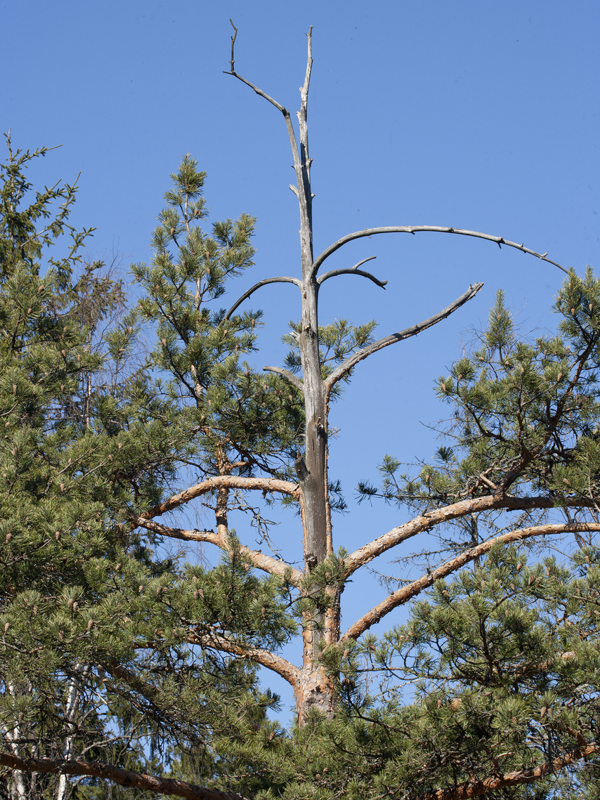
There are two forms of Scots pine blister rust disease. One form spread directly from pine tree to pine tree. The other form spreads from pine to an alternative host then back to pine again. In the northern boreal forests, one of the most important intermediate hosts for the disease is the small cow-wheat plant (Melampyrum sylvaticum). For both forms, the infection starts in the needles and then spreads toward the trunk. Infected trees can develop swellings on branches and trunks with spore-bearing cankers. Severe infections that encircle the entire tree trunk can cut off the supply of nutrients and thus kill the top or the entire tree.
In northern Sweden, the Forestry Research Institute of Sweden conducted surveys in young pine stands in 2021 and 2022 to assess the occurrence of Scots pine blister rust disease and at the same time collected information on geography, topography, and vegetation. In Norrbotten, the incidence was highest, with 87.1% of the stands, compared to 59.5% in Västerbotten and 33.6% in Jämtland and Västernorrland. According to the Finnish study conducted on stands used in National Forest Inventory conducted in Lapland found that probability for blister rust increased in fertile stands where one also could find the small cow-wheat plant (M. sylvaticum.). Studies have also shown that the highest incidence of Scots pine blister rust in Lapland is in the Tornionjoki river valley near the Swedish border.
It is crucial to understand ongoing outbreaks and the environmental factors that influence the occurrence of Scots pine blister rust to ensure sustainable forest management.
European project aims to strengthen knowledge
In parts of Europe, climate-related disturbances are having a major impact on forest growth. The EU project “ClimateForest – Climate Change Adaptation of Northern Forest: Risk and Prevention of Damaging Agents” aims to create new tools and risk management methods to prevent forest damage in the Aurora region. The project is generating new knowledge to promote sustainable ecological, social, and economic development. The project is a collaboration between universities, research institutes and authorities in Sweden and Finland, where researchers are looking at fungal diseases such as Scots pine blister rust and damage caused by wildlife grazing, among other things.
Parallel studies in Sweden and Finland
To investigate the impact of environmental factors on the occurrence of Scots pine blister rust (C. pini), Swedish researchers have collected both historical and future climate data to supplement the information from surveys conducted by the Forestry Research Institute of Sweden. The researchers have then modelled and analysed the information to identify risk factors linked to the disease and to assess the impact of future climate on its occurrence.
In Finland, researchers have modelled factors that affect the occurrence of Scots pine blister rust based on information collected in stands monitored in the Finnish National Forest Inventory in northern Finland. The information includes tree and stand-characteristics, including the occurrence of Scots pine blister rust disease. The hope is that this will help forest owners to control diseased stands and reduce future damage from Scots pine blister rust disease.
Several factors influence the likelihood of disease
Researchers in Sweden and Finland were able to link the occurrence of Scots pine blister rust to several different factors, including a positive correlation with older forest stands. In Sweden, stands at higher altitudes and northern latitudes also had a positive correlation.
The presence of small cow-wheat (Melampyrum sylvaticum) in stands is a proven risk factor for Scots pine blister rust, with frequent occurrence showing a strong link to disease cases. This confirms the role of small cow-wheat in the outbreak of Scots pine blister rust. In Finland, the risk of attack increased by nearly 50% in stands with high growth over five years that also had forest small cow-wheat present.
Soil moisture proved to be a strong factor in predicting the occurrence of Scots pine blister rust disease. Researchers observed that drier soil was associated with a lower probability of disease in Sweden, which may be related to the fact that pine trees close their stomata during drought stress, reducing the risk of spores infecting the trees. In Finland, moist and fertile soil was clearly linked to a higher probability.
One factor that was found to reduce the risk of infection in the Finnish study was the proportion of deciduous trees. As the proportion of deciduous trees increased, the risk of infection decreased. Early warm June weather with high precipitation was shown in the Swedish study to be associated with a higher number of cases of the disease. This is in line with the life cycle of the disease, which develops best at temperatures around +25 degrees Celsius.
When the Swedish researchers looked at different climate scenarios, they saw a modest increase in incidence in a climate scenario with medium emission levels until the end of the century, compared to a scenario with high emission levels where incidence could increase by as much as 20% in some stands.
Need for management strategies
The increase seen in the various climate scenarios motivates the need for effective management methods, such as breeding pine trees with better resistance and avoiding regeneration with pine in regions with a high incidence of Scots pine blister rust.
Here you find more to read
Publication - Multivariate analysis of risk factors associated with Scots pine blister rust in Northern Sweden, Ke Zhang and Henrik Svennerstam
Contact
-
Person
-
Pasi Rautio, researcher at Natural Resources Institute Finland (Luke)
-
PersonTheres Svensson, communikation officer for The Forest Damage CentreFaculty of Forest Sciences