
Northern Swedish rivers cause female bears to hesitate – but males swim across
The large rivers that flow through northern Sweden affect how brown bears move through the landscape. When bears reach the riverbank, males and females act differently. This is shown by a study conducted by researchers at the Swedish University of Agricultural Sciences (SLU).
The researchers analysed DNA in faecal samples from over 500 individual bears collected in Västerbotten County. The researchers identified close relatives, such as parents and cubs or full siblings. By comparing how far apart closely related bears faecal samples were found, the researchers could estimate how far bears had moved on average from the areas where they were born to establish their territories.
The results show clear differences between the sexes. Males establish themselves more than twice as far away from their birthplace as females. On average, males were found about 56 kilometres from their close relatives, while the corresponding figure for females was 23 kilometres. When a rushing river appeared as an obstacle, the males were more likely to swim across. 41 per cent of the males crossed at least one river, some even crossing two or three rivers. Only 11 per cent of the females crossed a river.
– Females travel shorter distances and have smaller territories than males, but when we simulated how females would move if the direction was random, the proportion of river crossings was significantly higher. This suggests that females actively avoid crossing rivers, says Robert Spitzer, researcher and first author.
Since males are not restricted by rivers and move across large areas, genes are effectively mixed.
New knowledge – thanks to the public
The brown bear has gone from being on the brink of extinction to having an estimated population of 2,500 animals in Sweden today. The landscape they live in is affected by both roads and natural barriers such as rivers. Other large predators can cross rivers on the ice during winter, but bears hibernate at that time of year. It is therefore important to understand how these barriers affect bears.
– The study shows that the same barriers in the landscape can affect females and males in different ways. In order to preserve a genetically coherent bear population, we need to take this into account when planning nature conservation and infrastructure, says Robert Spitzer.
The study is based on the County Administrative Board's bear inventory, to which hunters, berry pickers and others who spend time in the forest have contributed by collecting bear droppings.
– Thanks to the fact that we have received faecal samples from across the county, we can see the kinship of the majority of the bears. It is the ambitious collection efforts of the general public that make studies like this possible, says Göran Spong, researcher and project manager.
Scientific article
Scientific reports: Rivers constrain female but not male dispersal and genetic structure in brown bears https://www.nature.com/articles/s41598-026-38870-4
Robert Spitzer, Anita J. Norman, Michael Schneider, Ellinor Sahlén & Göran Spong
The study has been funded by the County Administrative Board of Västerbotten.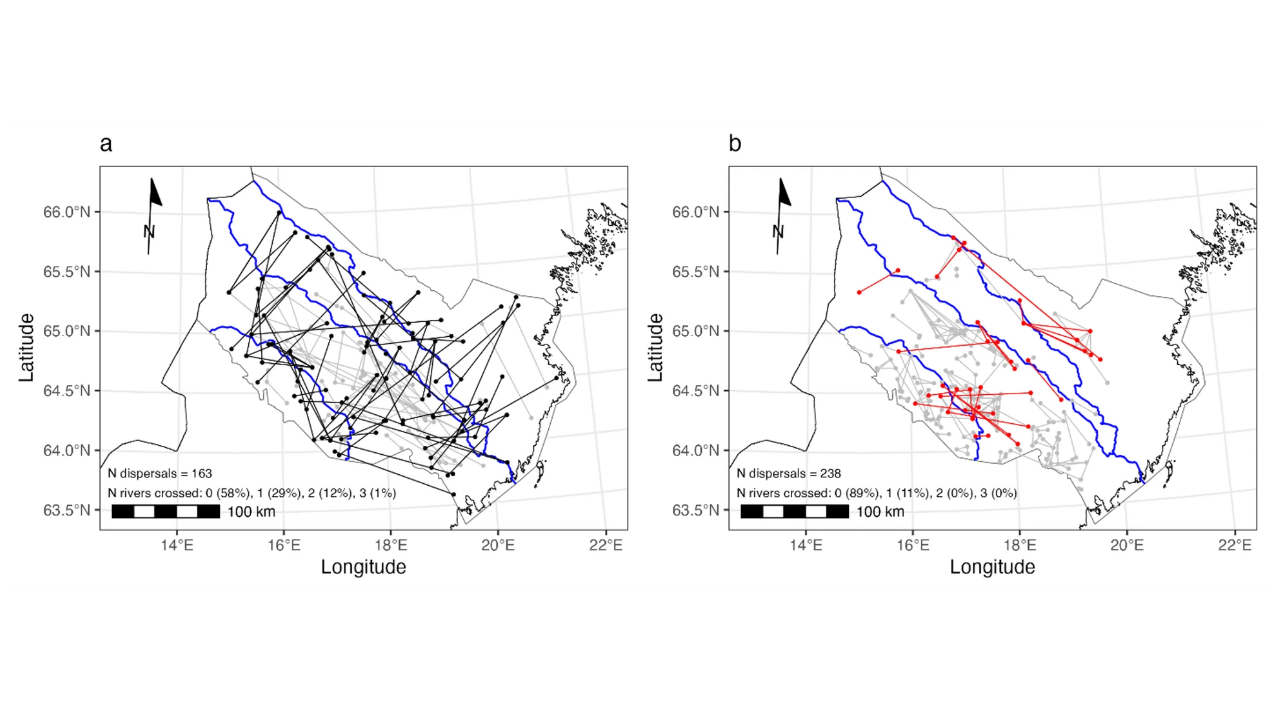

Contact
-
PersonRobert Spitzer, researcherDepartment of Wildlife, Fish and Environmental Studies
-
PersonGöran Spong, researcherDepartment of Wildlife, Fish and Environmental Studies
-
PersonFrida Wengberg, Communications Officer