
Sustainable on paper, but not in the sea: new study examines fisheries in the Northeast Atlantic
Fishing pressure in the Northeast Atlantic has decreased and fish stocks are recovering. However, a new study shows that the reference level used in fisheries advice gives an overly optimistic assessment of stock status. We risk fishing too intensively before stocks reach a sustainable biomass.
"Developments are going in the right direction, but many fish stocks are still far from the level that is considered sustainable. We act as if we have reached the goal, but in reality, we are barely halfway there," says Massimiliano Cardinale, researcher at the Department of Aquatic Resources at SLU and co-author of the study recently published in the scientific journal Fish and Fisheries.
The study analyses 73 commercially important fish stocks in the Northeast Atlantic* and examines how well they have recovered from previous overfishing.
The wrong reference level makes us overoptimistic…
To assess the health of a fish stock, researchers use different reference levels, which are central to both the scientific advice on future catch from the International Council for the Exploration of the Sea, ICES, and in European fisheries policy.
One reference level indicates when fishing must be reduced to avoid stocks becoming too small and collapsing: the safety limit MSY Btrigger*. Another indicates how large the stock needs to be to produce the largest possible catches over time; the target level BMSY*.
When the researchers assessed the stocks in the Northeast Atlantic based on the safety margin, 70% were classified as biologically safe. In comparison, when the target level is used, not even half of them reached the requirements. Many fish stocks simply don’t have the biomass they need.
“On average, MSY Btrigger only corresponds to around 60 percent of BMSY, and this mismatch can cause big problems when it comes to determining whether stocks are sustainable or not” says Massimiliano Cardinale.
For example, the sprat stock in the Baltic Sea is just above the safety limit. This is interpreted as positive and that management has worked, but the stock is still too small to be able to produce the maximum number of new fish each year. In fact, the biomass would need to increase by another 40% to reach the target level.
“By using MSY Btrigger, we have systematically overestimated the sustainability of fish stocks. They look sustainable on paper, but they are still recovering,” says Massimiliano Cardinale.
… and this makes us fish too much too fast
This also has direct consequences for the amount of fish that can be fished (fishing quotas).
Until the late 1990s, stocks in the Northeast Atlantic were overfished. Since then, fishing pressure has steadily decreased, and now that there are signs of recovery, there are also high expectations that fishing will be allowed to increase.
According to current ICES advice, fishing can return to the maximum sustainable level (FMSY*) once a stock exceeds the safe limit. However, if the difference between the safe limit and the biomass required to sustain such fishing over time (BMSY) is large, the stock risks rapid decline again.
“If we start fishing too intensively on stocks that are not fully recovered, the light we now sense at the end of the tunnel could quickly go out,” says Christopher Griffiths, co-author of the study and researcher at the Department of Aquatic Resources at SLU.
Recovery requires more than just more fish
The study also shows that recovery is not just about how many fish there are in a stock. The age structure of the stock recovers more slowly than the total biomass.
“Only a little over a third of the stocks have an age distribution that we expect in sustainable fishing. Many stocks are severely missing older and larger individuals,” says Christopher Griffiths.
This is important because large and old fish produce more eggs and make stocks more resilient to environmental changes. Therefore, stocks may still be vulnerable even if the biomass has increased.
For sustainability, a different yardstick is needed
Although the study shows that half of the stocks in the Northeast Atlantic are still being fished more intensively than is sustainable in the long-term (above FMSY), the researchers' modelling shows that it is possible to reach sustainable stocks by 2030.
“To achieve our goals, we must stop considering the safety margin as the finishing line, and let the stocks recover before we step on the gas. Management and advice must be based on BMSY, not MSY Btrigger”, says Massimiliano Cardinale.
“By reducing fishing pressure overall, we enable stocks to grow and have a better age structure. This will strengthen their resilience to environmental change. More careful fishing now will also benefit fisheries in the medium and long term”.
The study “Assessing the Progress of Stock Rebuilding in the Northeast Atlantic Against Levels That Can Produce Maximum Sustainable Yield” has been published in the scientific journal Fish and Fisheries.
Variation in the safety threshold relative to the target level
The figure shows how large the safety margin (MSY Btrigger) is in relation to the target level for long-term sustainable catches (BMSY) for 73 commercially important fish stocks in the Northeast Atlantic.
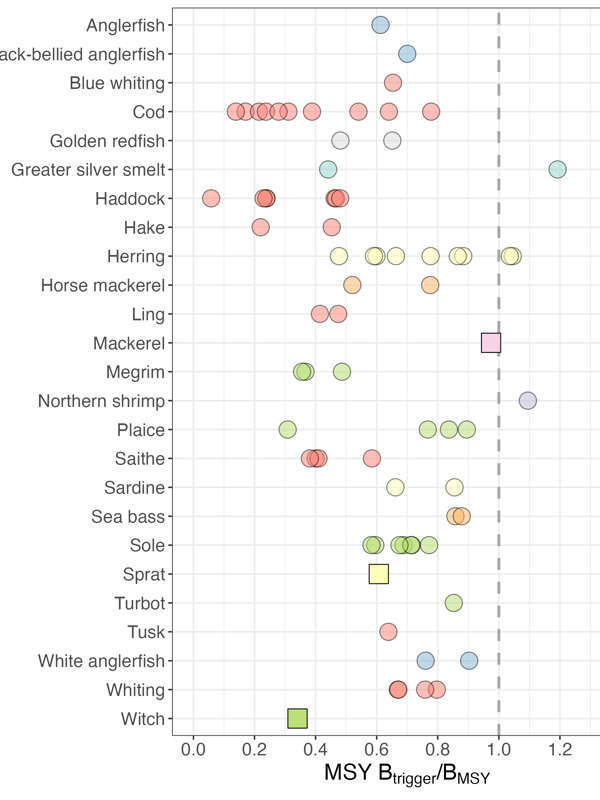
Each point corresponds to an individual fish stock. The dashed line at 1 means that the levels are equal. If the point is to the left of the line, the safety margin is lower than the target level, meaning that a stock can be classified as biologically safe even though it is significantly smaller than the size required for stable and maximum catches.
On average, the safety margin corresponds to approximately 60% of the target level. Therefore, points below 0.60 indicate stocks where the difference is even greater than the average.
The three highlighted stocks (shown as squares) are chosen to illustrate different situations. Baltic sprat (mentioned in the news text) is close to the average, with the safety margin corresponding to around 60% of the target level. Witch flounder in the North Sea and Skagerrak is an example where the difference is large (the safety margin corresponds to 34% of the target level), while mackerel in the Northeast Atlantic shows the opposite, with the levels almost coinciding (97%).
Key definitions: MSY, BMSY and FMSY
The study refers to stocks managed within the ICES area in the Northeast Atlantic, from the Bay of Biscay and the North Sea up to the Norwegian Sea and the Barents Sea.
MSY – Maximum Sustainable Yield
The European fisheries policy has an overarching goal; we should be able to fish as much as possible without risking the long-term viability of fish stocks. Therefore, fishing should follow the principle of MSY, which stands for Maximum Sustainable Yield.
To achieve MSY, both a sufficiently large stock (biomass) and a sustainable fishing pressure are required.
BMSY – the target level for stock size
BMSY indicates how large a fish stock needs to be to produce maximum sustainable catches over time. When a stock is around BMSY, it produces a lot of new fish each year and can tolerate variations in the environment better.
MSY Btrigger – a safety limit
MSY Btrigger is a lower level than BMSY and acts as a warning light. If the stock falls below it, fishing should be reduced quickly to avoid collapse.
FMSY – how hard you can fish
FMSY indicates how intensive fishing can be without the stock declining in the long term. It is therefore the fishing mortality (amount of fishing) that corresponds to a sustainable harvest. However, it should be pointed out that we do not have to fish at FMSY. You can fish below FMSY with only small losses in catches in the long term and at the same time achieve a larger spawning biomass and less risk of stock collapse.
Contact
-
PersonMassimiliano Cardinale, researcherInstitute of Marine Research, joint staff
-
PersonChristopher Griffiths, ResearcherInstitute of Marine Research, joint staff