Academic Exchange Strengthens Collaboration in Doctoral Training and Research between SLU and UPWr
On Monday, April 13, 2026, researchers and academic staff from SLU and Wrocław University of Environmental and Life Sciences (UPWr) gathered at BioCenter in Uppsala for a day of conversation around doctoral training and interdisciplinary research.
The meeting was informal in spirit, the kind of exchange where people actually talk to each other rather than just present at each other.
Professor Vadim Kessler gave an overview of ongoing activities at the Department of Molecular Sciences. Then, Małgorzata Korzeniowska from UPWr provided an overview of doctoral training at her institution. Further information on the programmes presented by Małgorzata Korzeniowska, Paweł Dąbek, Katarzyna Pawęska and Agnieszka Śmieszek is available through the SPINAKER initiative of the Polish National Agency for Academic Exchange (NAWA), which supports intensive international education programmes such as summer schools designed to attract international students and strengthen doctoral pathways https://upwr.edu.pl/en/research/projects/polish-national-agency-for-academic-exchange/spinaker-intensywne-miedzynarodowe-programy-ksztalcenia/summer-school. At UPWr, these programmes take the form of short, intensive summer schools combining online lectures and on-site workshops, aimed primarily at international doctoral studies, and offering both academic training and practical experience in natural sciences.
An open discussion then took place, focusing on the structure of PhD programmes, shared challenges, and the realities of interdisciplinary research in practice. The exchange also addressed opportunities for student and staff mobility, joint training initiatives, and the potential for shared research infrastructure.
“Our group already has established long-term collaborations with several Polish research groups, focusing on metal–organic precursor chemistry, sol–gel processes, and the development of nanostructured metal oxides. Our joint research spans applications in biomedical materials, environmental remediation, and functional inorganic materials”, said Vadim.
Gulaim Seisenbaeva noted possible future collaboration with UPWr in water purification treatment, nanoparticle-based materials, and encapsulation technologies.
Galia Zamaratskaia also referred to previous collaboration with Małgorzata Korzeniowska within the SusPlant project (the project leader and grant holder Saeid Karkehabadi), focusing on plant-based meat analogues and related research in food science.
The day concluded with a dedicated discussion session, alongside a separate meeting with postdoctoral researcher Abhijeet Singh, offering additional perspective on research and working conditions within the department.
The meeting marked a productive start, with both sides identifying common areas of interest and several concrete directions for future collaboration.
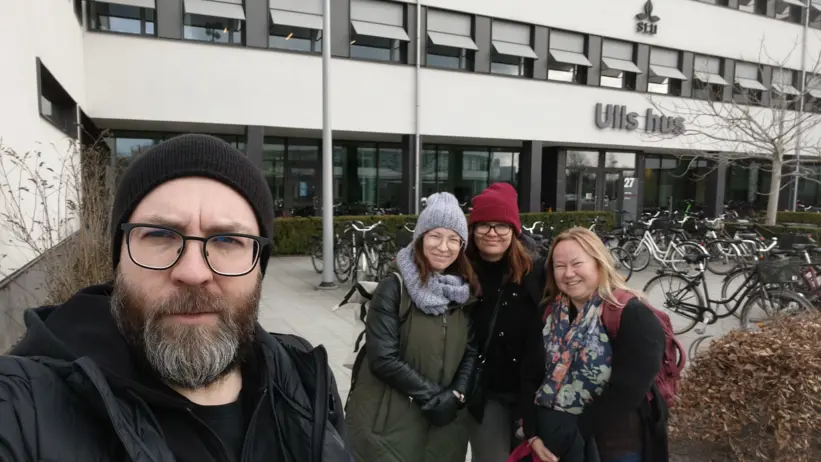
Delegation from UPWr at SLU. From left: Paweł Dąbek, Katarzyna Pawęska, Agnieszka Śmieszek and Małgorzata Korzeniowska.