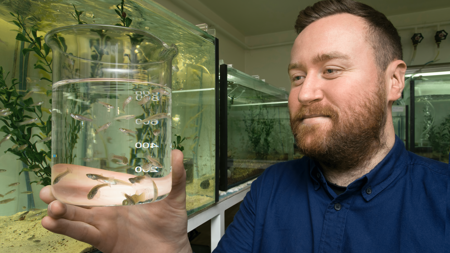
Cocaine pollution alters salmon movement in the wild
News published:
21/04/2026
Cocaine pollution alters the behaviour and movement patterns of juvenile Atlantic salmon in a large lake. Exposed fish swam up to 1.9 times further per week and travelled up to 12.3 kilometres further across the lake, according to a new study from the Swedish University of Agricultural Sciences.
Researchers at SLU have investigated how cocaine pollution affects the behaviour and movement of aquatic animals. The study, published in the journal Current Biology, shows that cocaine-related substances can alter both the movement patterns and dispersal of juvenile Atlantic salmon in the wild.
– Cocaine and other illicit drug pollutants are a growing environmental concern worldwide. Many of these substances are excreted after use and pass through wastewater treatment plants that are not designed to fully remove them, says Dr Jack Brand, researcher at SLU and first author of the study.
Cocaine and its breakdown products are now regularly detected in lakes, rivers and coastal waters around the world. They have also been found in aquatic wildlife.
– These substances are particularly problematic because they affect the brain even at low concentrations. This gives them strong potential to alter animal behaviour, says Associate Professor Michael Bertram, SLU.
A rare field study in a natural ecosystem
Unlike most previous research, which has been conducted under simplified laboratory conditions that do not capture the complexity of real-world environments, this study was carried out in a natural ecosystem. The researchers exposed juvenile salmon to dilute, environmentally relevant concentrations of cocaine and its main metabolite, benzoylecgonine, and tracked their movements throughout Lake Vättern, Sweden’s second largest lake.
– We found that benzoylecgonine, which is the main breakdown product of cocaine and is commonly found in aquatic environments, had particularly strong effects. Exposed fish were more active, swimming up to 1.9 times further per week and dispersing up to 12.3 kilometres further across the lake compared to control fish. Interestingly, the metabolite had a greater impact than cocaine itself, says Dr Brand.
In humans, cocaine is rapidly broken down into benzoylecgonine, which often persists for longer in the body and is found at higher concentrations in the environment.
– Our results suggest that risk assessments focusing only on cocaine may underestimate the ecological effects of its breakdown products, says Professor Tomas Brodin, SLU.
Because movement is crucial to how animals use habitats, find food, avoid predators and maintain populations, even small changes may have significant consequences.
– If contaminants alter how animals move, this could ultimately affect habitat use, predator–prey interactions and even population connectivity, says Dr Brand.
The researchers emphasise that addressing the problem will require multiple approaches, including improved wastewater treatment, increased monitoring of both drugs and their breakdown products in the environment, and updated environmental risk assessments.
– Our study shows that drugs are not only a societal issue, but also a concrete environmental challenge, says Associate Professor Bertram.