Find out everything there is to know about beavers in the film available on SLU’s YouTube channel.
New film will raise awareness about beavers: “Our key nature conservationist”
News published:
07/04/2026
Beavers can be a troublesome neighbour, but they play a vital role in nature. A film from SLU and the Swedish Forest Agency now offers us unique insights into the life of the beaver. The film presents a smorgasbord from the latest research to the role a royal hat played in the beavers' extinction.
– The film brings together knowledge about beavers in Sweden and highlights the far-reaching impact the beaver has on the environment, for better or worse, says Frauke Ecke, Senior Lecturer at SLU and Professor at the University of Helsinki.
She is one of the researchers studying how our largest rodent affects its environment. The beaver is a keystone species, as it despite its small size controls the entire ecosystem by felling trees, building dams and altering the entire landscape. Changes that create favourable conditions for many other species.
– For example, beavers constantly support the supply of dead wood that is crucial for many endangered species. The beaver is our key nature conservationist, and one who does the job for free, says Frauke Ecke.
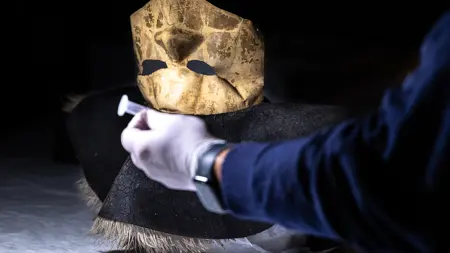
For many years, there were no beavers in Sweden. The film describes how they were extirpated in the late 19th century after being hunted for their fur and castoreum, the substance beavers use to mark their territory. Castoreum was used for medicinal purposes, and in the 18th century, luxurious hats made of felted beaver fur were high fashion. King Gustav III was wearing a so-called castor hat when he was shot at the masquerade ball in 1792.
King Gustav III’s castor hat. Photo: Elin Fries.
Ecosystem engineer – and vandal
The beaver was reintroduced to Sweden just over 100 years ago, and today there are likely more than 100,000 beavers. What happens when a species reclaims its place in nature? The film explains how beaver dams affect fish migration and whether the beavers' unique ecosystems support the spread of diseases such as tularemia.
Occasionally, beavers are considered as vandals, causing problems for individual forest owners. Locally, beavers can cause sever damage to forests, infrastructure and property.
– When the damage is economically significant, landowners have the option of demolishing the dams or taking other measures. Information and advice are available on the County Administrative Board’s website. In most cases, beavers make an important contribution to a rich flora and fauna by creating wetlands and increasing the amount of light entering the forest, says Daniel Thorell, project manager at the Swedish Forest Agency.
The film is available to watch on SLU’s YouTube channel, premiering on 7 April, the International Beaver Day.
The film is part of the Horizon Europe projects MERLIN and BEPREP. MERLIN focuses on freshwater restoration in Sweden and Europe. In BEPREP, researchers are studying how we can prevent future pandemics and are using MERLIN sites in their work. The project involves collaboration between researchers at SLU and the Swedish Forest Agency.
The film was produced by Bitzer Productions.
Contact:
Frauke Ecke, Senior Lecturer, Department of Wildlife, Fish, and Environmental Studies.