
In search of the eel’s secrets in the middle of the Sargasso Sea
An international expedition is currently underway in the Sargasso Sea, aiming to provide new insights into the early life stages of the European eel. By collecting larvae directly in the eel’s spawning area, researchers, including from SLU, hope to better understand changes in the population.
The Sargasso Sea is located in the western North Atlantic and is the only sea without any land boundaries. It is not a major tourist destination and attracts few visitors, but for eel researchers it may be one of the most fascinating places in the world. Here, far from land and thousands of meters above the ocean floor, researchers collect data on the distribution and abundance of eel larvae, as this is an important piece of the puzzle for managing the stock.
For SLU researcher Josefin Sundin, this year’s expedition was an opportunity to return to this unique environment.
– It is incredibly exciting to collect samples out here, especially as an eel researcher. There are probably no reasons not to want to come here, says Josefin Sundin, a researcher at the Department of Aquatic Resources at SLU, who is participating in the expedition for the second time.
A unique expedition tracking the eel’s earliest life stages
The research vessel Walther Herwig III left Bermuda on March 17 with 36 people on board (24 crew members and 12 researchers, PhD students, and laboratory assistants). After approximately 16 hours at sea, sampling began in the Sargasso Sea. The purpose of the expedition is to investigate the distribution and abundance of European eel larvae (leptocephali) in their spawning area.
So far, eel populations have mainly been monitored by measuring how many glass eels and young eels reach the coasts of Europe and North Africa after their migration. However, by studying the very youngest larvae directly in their area of origin, researchers can gain additional important insights.
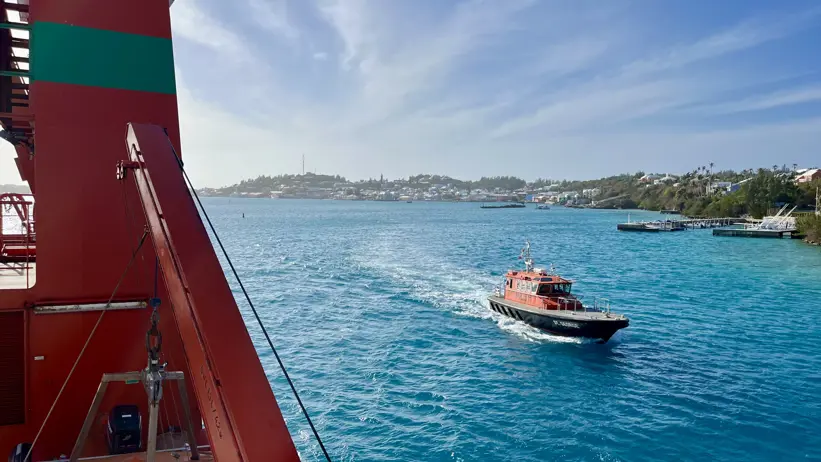
The expedition is unique of its kind and represents the only long-term time series of eel larvae in the Sargasso Sea. The results are important for understanding and estimating the European eel stock. Since all European eels reproduce in the Sargasso Sea, this means that all genes are mixed there. Genetic studies, including those conducted by researchers at SLU, show that there are no separate populations of eel, but rather a single stock across the entire distribution range.
– Because all European eels belong to one single global stock, this type of data becomes especially important. It gives us a comprehensive picture that we cannot obtain anywhere else, says Josefin Sundin.
Despite more than 100 years of research, no one has ever observed adult eels spawning in the Sargasso Sea. Nevertheless, all available evidence points to this being where it occurs. As early as the 1920s, the Danish researcher Johannes Schmidt concluded that eels spawn here, based on findings of the smallest larvae in the area. Later studies, including satellite tagging, have reinforced this view.
– All evidence suggests that this is where they reproduce, even though we have not yet observed it directly, says Josefin Sundin.
A working day in the middle of the Sargasso Sea
Work on board the research vessel continues around the clock. Twelve researchers are divided into two shifts. Josefin works the night shift, which runs from 1 a.m. to 1 p.m. The work involves systematically sampling the ocean along a predetermined route. At each station, water samples are collected first, after which a plankton trawl is lowered to a depth of 300 meters, where the sought-after eel larvae are found. The catch is then analyzed directly on board.
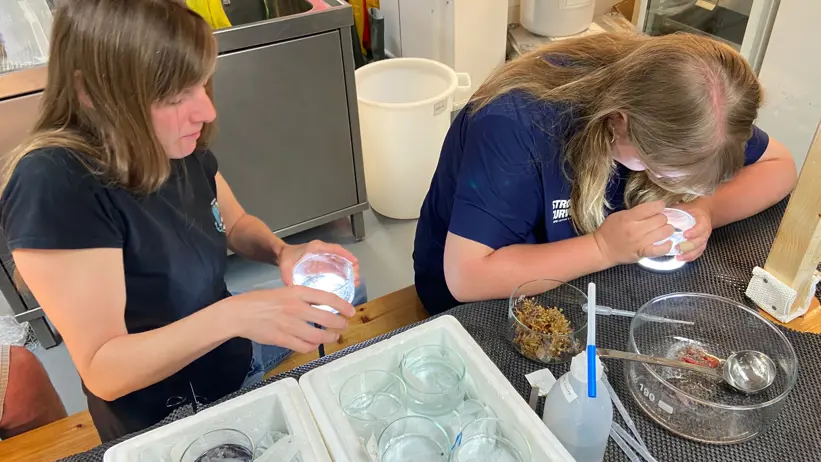
– We sort the samples very carefully and look for transparent eel larvae, so-called leptocephali. They are small, but you can actually see them with the naked eye, says Josefin Sundin.
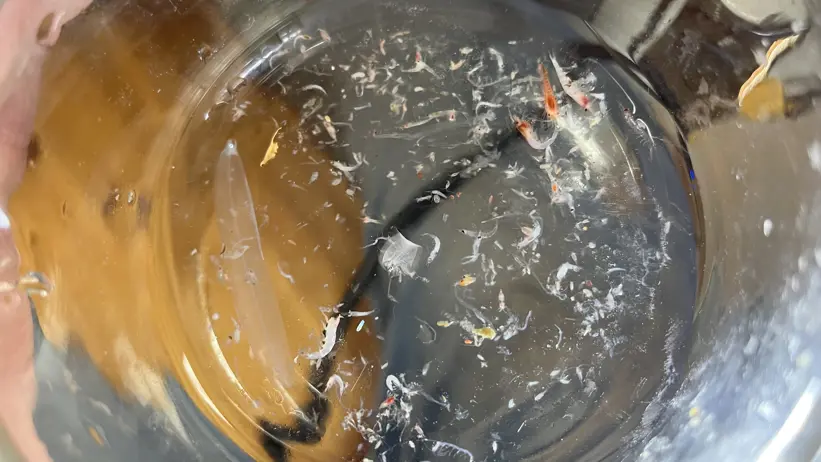
The eel larvae that are not caught in the trawl drift with ocean currents across the Atlantic. After one to two years, they can reach the coasts of Europe, and in some cases Sweden. There, they continue their lives in freshwater or coastal environments for several decades before returning to the Sargasso Sea to spawn.
Working in the Sargasso Sea also means being in one of the most isolated environments in the world. During the expedition, the crew sees no land—only ocean and sky.
– The water has a deep blue color that is very beautiful and almost hypnotic. It’s ocean, ocean, ocean, and sky, as far as the eye can see, every day, says Josefin Sundin.
The work is intensive - 12 hours a day - but there is also time to unwind. After their shifts, the researchers socialize, exercise, or simply gaze out over the sea.
– We are doing very well out here. Although the other day we ran out of black tea. I always drink black tea in the morning, and being without it is like others being without coffee, concludes Josefin Sundin.
Contact
Josefin Sundin, researcher at the Department of Acquatic Resources at SLU.
Mail: Josefin Sundin
Telephone: 010-478 42 24, 076-131 79 08
Josefin will be available to answer questions by phone from the 16th of April.