
She wants to find out how forest management affects nature’s own defences
What impact does human activity, such as forest management, have on the natural control of insect pests? Fredrika Wrethling, a PhD student at the SLU Forest Damage Centre’s research school, has been looking into this in the first part of her project.
Pest insects can cause major problems in our forests during outbreaks, and in Europe an increasing number of trees are dying as a result of infestations. At the same time, there are many predatory insects in the forest that play a vital role in the ecosystem by regulating the population of insect pests.
As a graduate of forestry with a great interest in biology, Fredrika wants to investigate how human activities, such as forest management, affect the interactions between predators, insect pests and their environment.
‒ Forests are complex networks of organisms that interact with one another and their surroundings. I want to understand how our choices and activities affect these interactions, says Fredrika, continuing:
‒ Interactions between predators and prey are important for the natural regulation of insect pests and their outbreaks, and thereby for the health of trees and the forest. If we understand these interactions, we can help manage forests that are better able to defend themselves through natural regulation.
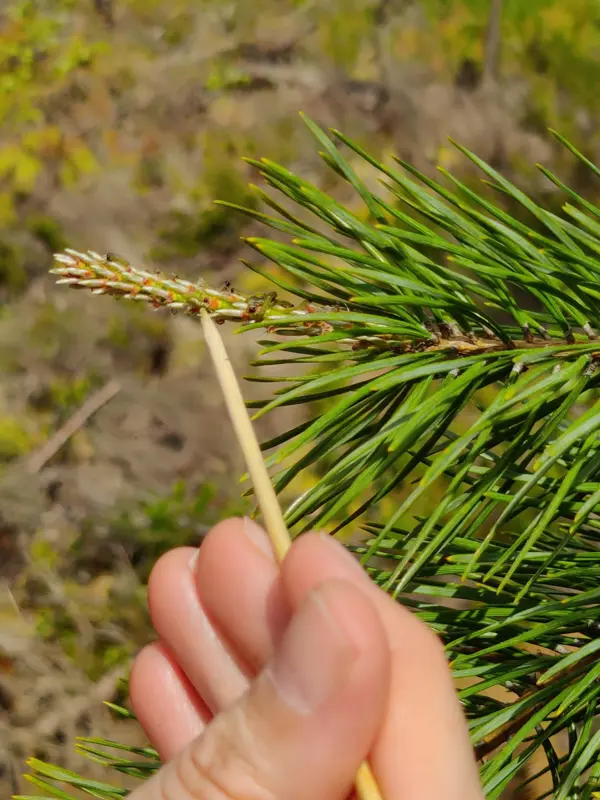
In part of her project, Fredrika has investigated what influences the extent to which the European pine sawfly is consumed by predators. The European pine sawfly is a forest insect that feeds on pine needles and is considered a pest in forestry. In the study, they compared whether predators hunted the sawflies more frequently in mixed forests or pine-dominated forests, or whether other forest factors were more significant.

How the study was conducted
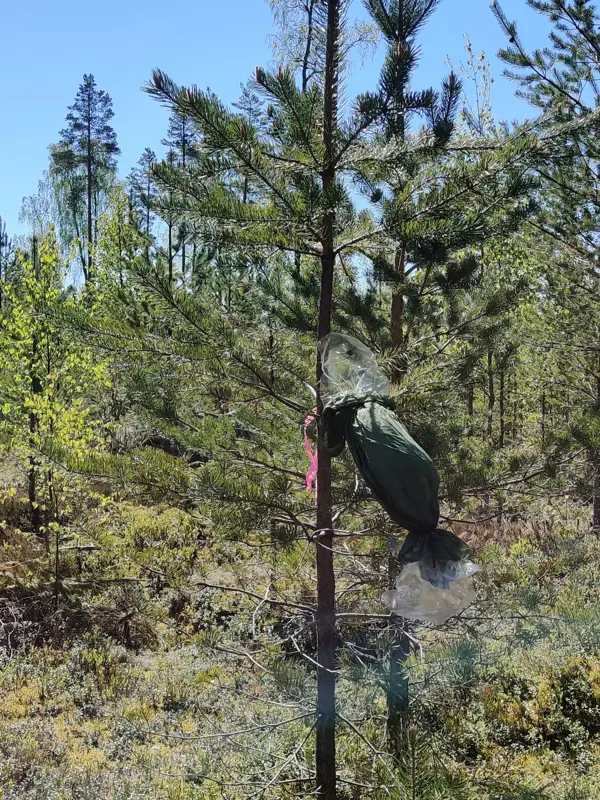
To investigate the relationship, 12 forest stands were selected outside Uppsala. Half were pine-dominated and half were mixed forests containing pine, birch and spruce. All stands were around 10 years old, and the trees were between two and four metres tall.
In the stands, nearly 4,000 larvae of the European pine sawfly were placed on a total of 60 pine trees. The researchers then monitored how many larvae disappeared over time. The local environment around each tree was also examined, for example the variation and density of the tree and shrub layers, the variation and height of the ground vegetation, and the presence of dead wood and large stones.
The forest’s local structure is more important
The results showed that predators’ hunting for the sawflies was no higher in mixed forest than in pine-dominated forest. Instead, the local structure of the forest was of greater significance. Where ants were present, the impact of predators was greater. The presence of ants could in turn be linked to a more varied ground layer and grass-dominated ground vegetation. The density of the shrub layer and the presence of large stones also had positive effects.
In the next stage, a more controlled field trial has been set up in collaboration with Sveaskog, to better distinguish the direct impact of the trees from other factors. By comparing mixed forests and stands with only pine trees, the researchers can see more clearly how different tree species affect insect life, predator hunting and soil organisms.
Contact
-
Person
-
PersonTheres Svensson, Communicator, SLU Forest Damage CentreFaculty of Forest Sciences