
Visiting pupils get an insight into the future of agriculture
Pupils from Rosendalsgymnasiet visited the Department of Crop Production Ecology in Ultuna. "We hope they will return as university students," says researcher Marcos Lana.
“Come on, let’s get started!”
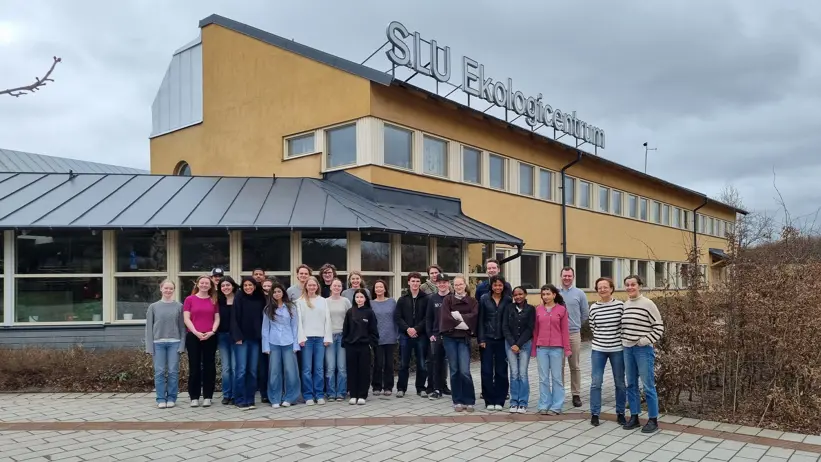
Three pupils hurry through the glass doors of the Ecology Centre in Ultuna and take their seats in the lecture hall alongside their classmates. The 22 pupils, accompanied by two teachers, are visiting from Rosendalsgymnasiet, an upper secondary school in Uppsala.
Robert Glinwood, Head of the Department of Crop Production Ecology, welcomes them before handing over to researchers Ola Lundin and Marcos Lana, who are leading the day’s activities.
Facts are interspersed with questions, and the pupils are quick to engage as Ola Lundin opens the first discussion.
“What is biodiversity?” Ola asks.
“When there are many species?” one pupil suggests.
“Yes, and it can also refer to diversity at other levels, such as genetic variation within a species or variation between different ecosystems.”
Globally, around 50 percent of the land surface is used for agriculture. In Sweden, the figure is only eight percent.
“Why do we need to talk so much about just eight percent of Sweden’s land area?”
The discussion that follows focuses on agriculture’s impact on the environment and biodiversity. Can food be produced more sustainably than it is today?
Disturbances that benefit biodiversity
Semi-natural grasslands (meadows and pastures) have very high levels of biodiversity and can be compared to tropical rainforests. Why is that?
“The disturbance principle,” one pupil replies.
Yes, that is correct. A moderate level of disturbance, for example from grazing animals, creates variation in the environment.
We go outside into the yard to take a group photo. It is the first day after the Easter break. Cold winds are blowing and the sky is grey, typical April weather. We quickly head back inside.
Marcos Lana hands out an exercise and talks about the principles of agroecology. He is the one who initiated this day, as a continuation of a lecture on cropping systems he gave at Rosendalsgymnasiet. The pupils discuss everything from how the distance between farmers and consumers can be reduced, to how political decisions can promote more locally produced food. The conversation also moves to the individual level, such as letting grass grow in the garden or keeping a beehive.
The pupils are in their final year of upper secondary school and will soon graduate. Marcos Lana hopes the visit will spark their interest in sustainable food production.
“We may see some of them as students at SLU in the future,” he says.
”Suddenly, they understand and become engaged”
This is not the first time that biology teacher Lena Wellhagen has brought her students to SLU.
“These particular students are taking an elective course in the science programme focused on sustainable development. It is rewarding to see, year after year, how interested this group becomes in the subject. Several students have said that they want to continue exploring sustainability issues in greater depth,” she says.
Lena Wellhagen believes that contact between upper secondary school and university helps make research and science feel more accessible and easier for students to understand.
“They can be quiet at first and feel that everything is complicated and difficult, but then suddenly they understand what it is about and become very engaged,” she says.
As a teacher, she also gains valuable tools to use in her teaching.
“The course is home-made and not based on any textbooks. That is why it is very valuable for us to get input from researchers; it raises the quality of our teaching another notch,” Lena Wellhagen says.
Contact
-
PersonMarcos LanaDept. of Crop Production Ecology, Agricultural cropping systems