
Lichens Reveal Biodiversity Potential in Fast-growing Tree Stands
Can fast-growing production-oriented forests also contribute to biodiversity? A new study from SLU, led by PhD student Jaime Luna, suggests that stands of fast-growing broadleaved trees (FGB) may be more relevant than previously recognized.
Unexpected Diversity in Production Systems
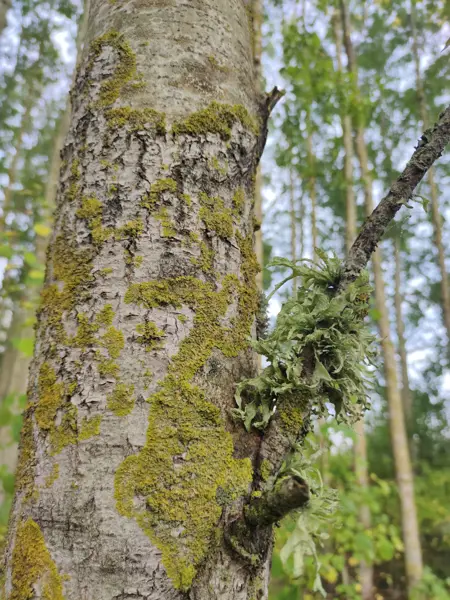
The study, “Habitat suitability and management pathways for epiphytic lichens in Sweden’s fast growing broadleaf stands”, examines how fast-growing broadleaves (FGB) contribute to lichen diversity and how their habitat value can be improved.
These FGB systems are typically managed as short-rotation, even-aged stands of trees of native or non-native origin to maximise biomass production. While often associated with simplified forest structures, the results show that they can host a rich lichen flora.
“We found that some stands can be very rich in epiphytic lichen species,” says Luna.
The study also recorded red-listed and indicator species, showing that these environments can provide habitat for species of conservation interest.
Tree choice matters
A key finding is that the different tree species support distinct lichen communities. The study compared native birch, and the non-native Populus tree species hybrid aspen and hybrid poplar, and found clear differences in lichen species composition.
This indicates that a mix of broadleaved species can support a wider range of lichen communities in forest landscapes.
“What surprised me most was the number of species found on non-native hybrid aspen and poplar,” says Luna. “It suggests that, under suitable management, these FGB stands may provide a more suitable habitat for lichen species than previously assumed.”
From results to practical measures
The study also identifies concrete management actions that can improve habitat conditions for lichens. These include:
- retaining older trees with varying bark characteristics
- increasing light availability within stands
- maintaining structural diversity
Such measures can be integrated into existing forest management and help balance production with biodiversity goals.
Part of a broader solution
Fast-growing broadleaved systems are not a complete solution to biodiversity loss, but they may form part of a broader strategy for more sustainable forestry. In order to have a better understanding of the FGB contribution to biodiversity, further research encompassing additional taxa and land uses is required.
“Diversifying forests, both in terms of tree species and structure, is key to supporting biodiversity,” says Luna.
Contact
-
Person