
Mission: Reviving extinct species and improving the welfare of Swedish chickens
Research is currently being conducted into the possibility of bringing extinct animal species back to life. How? Well, by first successfully reintroducing already domesticated animals into the wild. Could this be a way to correct human mistakes and help our planet? That remains to be seen.
For thousands of years, humans have domesticated various animal species, fundamentally changing their behaviour, appearance and genetic traits.
These domesticated animals have been shaped through generations of selective breeding, where humans have chosen which individuals are allowed to reproduce – in order to reinforce desired traits. Shaping animals according to human needs has brought both major advantages and disadvantages.
The benefits are clear: human needs have been met. However, for the animals this has sometimes come at a cost, such as more fragile bodies, reduced resistance to certain diseases, or lower tolerance to stress.
At the same time, there are cases where animals, for various reasons, have had the opportunity to return to their original wild state - what is called feralization. This has raised a number of intriguing questions.
So is it then possible to reverse the negative aspects of domestication? And how is this connected to the possibility of reviving extinct species?
Let’s take a closer look behind the scenes!
From wild → domesticated → feral
In the autumn of 1992, the most powerful hurricane ever to hit Hawaii – Hurricane Iniki – struck the islands. The eye of the storm passed directly over the island of Kauai, destroying 90% of its buildings, including countless chicken coops.
This marked the beginning of a feralization process that, on the other side of the Pacific, has turned domesticated chickens into wild survivors.
The process of feralization has been studied by researchers to understand whether domesticated animals can survive in the wild, and how they change when once again shaped by nature – returning to a life without human support or control.
The feral chickens on the island of Kauai have therefore become an ideal study system for understanding how the transition from domesticated to feral occurs, and what actually changes when animals themselves drive their own evolutionary development for survival.
The results from this research may pave the way both for recreating extinct species and for improving the lives of domesticated chickens in Sweden..
Back to the wild – how far can we go?
As an unintended consequence of many years of breeding chickens to meet the high demand for eggs, modern laying hens have in many cases become more fragile, both physically and mentally. At the same time, the world is facing a growing challenge: antibiotics, including antiparasitic treatments, are losing their effectiveness. For chickens that cannot resist parasitic infections on their own, such as many Swedish laying hens, this could in the near future have fatal consequences.
Reviving extinct species
This brings us to the question of “reviving” extinct species. Is it possible? And if so, how?
The species that Dominic Wright and his colleagues are currently working to revive is the passenger pigeon, which was driven to extinction by humans just over a hundred years ago.
If researchers succeed in reviving the species, the positive environmental effects it once had could also return.
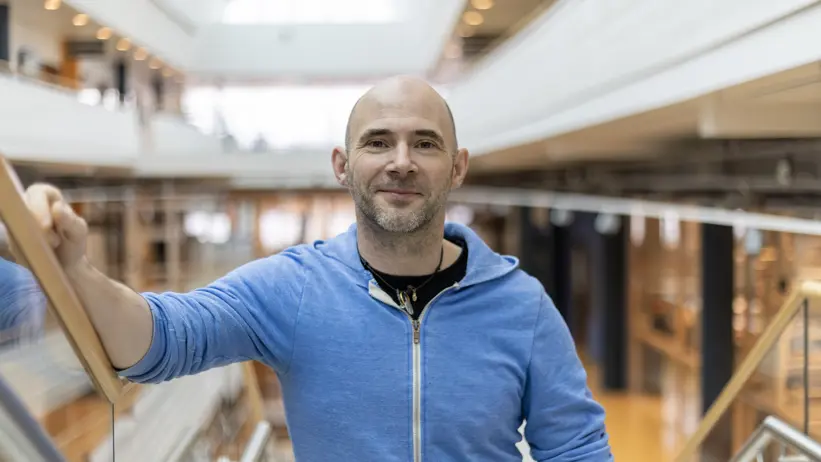
Three questions for the expert: Dominic Wright
Fact Box
Dominic Wright is originally trained in animal genetics and, since 2026, is Professor of Molecular Animal Genetics. You can read more about him and his ongoing research below.
Key concepts
Domestication = The process by which wild animals are adapted to life with humans through selective breeding over many generations.
Feralisation = When domesticated animals, over generations in the wild, return towards a wild state.
Resilience = The ability to withstand disease, stress and environmental changes.
De-extinction = Attempts to recreate extinct species using DNA and closely related living species.
Contact
-
PersonDominic Wright, ProfessorHBIO, Molecular Genetics and Bioinformatics