How recreational fishing can be measured and understood better – new thesis shows the way forward
Despite large annual catches, reliable knowledge about the scale and impact of recreational fishing remains limited. A new thesis from SLU shows how improved data and collaboration can contribute to more sustainable management of recreational fisheries – and why fishers can be part of the solution.
Recreational fishing is extensive, yet knowledge about who fishes, which methods are used, how much fish is caught, and how fish stocks are affected remains limited. In her thesis The ones that didn’t get away: assessing recreational fisheries and biological impacts in coastal ecosystems, Hege Sande, a PhD student at the Department of Aquatic Resources at SLU, investigates how data collection and understanding of recreational fishing can be improved, and what biological effects it has on coastal ecosystems.
On-site sampling provides better knowledge
A key challenge in data collection is that recreational fishers are dispersed over large areas, fish at different times, and are rarely included in systematic surveys. This makes it difficult to collect reliable data on catches and fishing effort. In her work, Hege applied and further developed a method to estimate recreational catches, even in situations where available information is limited. By sampling fishers at access points, she produced the first reliable estimate of Swedish recreational cod catches in the western Baltic Sea.
– We started from where fishing actually takes place. By mapping launching sites and randomly selecting when and where to sample, we were able to meet fishers directly after they finished fishing. This allows us to collect statistically representative data and obtain estimates that are both comparable and reliable, even when we initially know very little about the fishery, says Hege Sande.
A new framework for better decision-making
In her thesis, Hege highlights how different types of data collection can be combined to provide a more accurate picture of recreational fishing. She proposes a framework to help decision-makers choose the most suitable method depending on purpose and needs.
– There is no single method that is best in all situations. The framework helps balance different aspects of data quality, such as accuracy, relevance, and comparability. This allows decision-makers to select the method that truly fits the purpose, while also making clear the trade-offs involved - for example between precision and coverage. It also contributes to a more transparent decision-making process, where criteria and priorities are clarified and more clearly linked to management goals, says Hege Sande.
New data – directly from recreational fishers
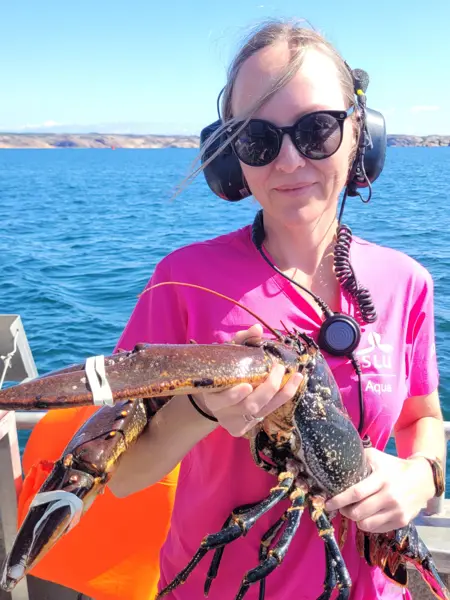
Hege also examined whether recreational fishers themselves can contribute to scientific data collection. In a citizen science project on lobster fishing (Lobserve), experienced fishers followed a standardized protocol and collected data on their catches. The results show that this method can produce data comparable to traditional surveys, while covering much larger areas.
– My experience from Lobserve is that engagement among volunteer fishers is very high. They span all age groups and are driven by a desire to contribute knowledge and preserve the resource for the future. When the setup is clear and standardized, they can collect data of very high quality. This makes citizen science a strong complement to traditional surveys, says Hege Sande.
Selective fishing affects fish stocks
Hege’s studies also show that fish stocks change over time. By analysing long-term data series, she identified clear changes in an already heavily exploited cod stock.
– Cod have become smaller, are in poorer condition, and mature earlier than before. We also see that both commercial and recreational fishing selectively target the largest individuals, which can affect the structure and dynamics of fish populations over time, says Hege Sande.
Recreational fishing as part of the solution
Hege further emphasizes that recreational fishing has important social and cultural values and should therefore be seen as both a resource and part of the solution in future fisheries management. With well-designed programs, it can contribute to improved monitoring and increased engagement.
– Recreational fishing is not only a pressure on ecosystems, but also a potential source of new data and knowledge. That is precisely why it needs to be seen as an integrated part of fisheries management, says Hege Sande.
Looking ahead, the challenge is not only to collect more data, but to ensure that the data collected is relevant and can be used effectively.
– Recreational fishing is part of a complex system that we still know very little about. To improve management, we need better and more coordinated data collection - and for that knowledge to actually be used effectively in decision-making, says Hege Sande.
Read the full thesis: The ones that didn’t get away: assessing recreational fisheries and biological impacts in coastal ecosystems
Contact
-
PersonHege Sande, PhD studentInstitute of Marine Research, joint staff