
Could lake sediments reveal a hidden carbon sink?
When forests burn, large amounts of carbon are released into the atmosphere. But not all of that carbon disappears into the air. Some is transformed into a stable material known as pyrogenic carbon, which can remain stored in sediments for hundreds or even thousands of years.
This long-term carbon storage is the focus of a new PhD project at SLU. PhD student Wint Wah Phoo is investigating how pyrogenic carbon is transported and deposited in soils and lake sediments following prescribed burns in Swedish forests.
“Some forms of pyrogenic carbon break down very slowly and can remain in the environment for hundreds to thousands of years, making it an important long-term carbon sink,” says Phoo.
The project, Pyrogenic carbon as a missing sink in the global carbon cycle: calibrating the sediment records to historical fire regimes, aims to improve understanding of a potentially overlooked part of the global carbon cycle.
Lakes preserve the history of fires
After a wildfire or prescribed burn, pyrogenic carbon can be carried from forests into lakes by wind, rainfall and surface runoff. Once it reaches a lake, it settles to the bottom and becomes part of the sediment.
These sediments act as natural archives, preserving evidence of environmental change over long periods of time.
“By analysing lake sediments, we can reconstruct past fire activity and, hopefully, assess how much of pyrogenic carbon has been stored in sediments.,” says Phoo.
By comparing sediment records with independently established fire chronologies, the project will also investigate how accurately lake sediments reflect historical fire activity.
Measuring carbon after prescribed burns
The research is being carried out in Sweden, where prescribed burns are actively used in forest reserves for biodiversity conservation, ecological restoration and fire management.
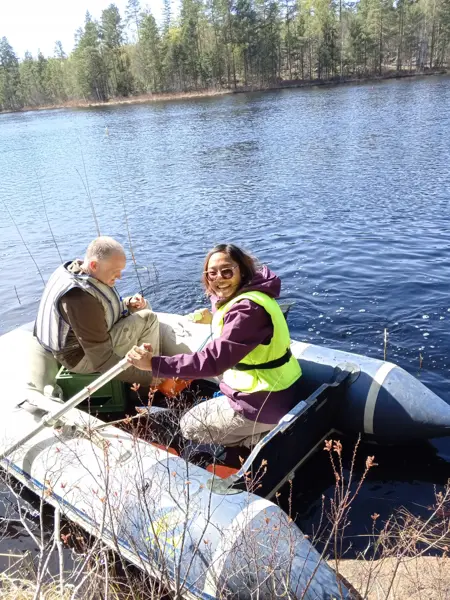
As part of the project, sediment traps have been deployed in lakes adjacent to burn sites. The traps will collect material settling through the water column and help researchers quantify how much pyrogenic carbon ends up in lake sediments, following fires that happend within the same watershed.
Although previous studies have improved understanding of pyrogenic carbon in Swedish forests, important questions remain about how it is transported through landscapes and where it ultimately ends up.
Improving our understanding of the carbon cycle
The findings could contribute to improved climate models and carbon accounting by providing better estimates of how much pyrogenic carbon is produced, transported and stored in lakes and soils.
The research is particularly relevant as climate change is expected to increase the frequency and severity of fires in northern regions. By linking modern measurements with historical sediment records, the project aims to determine whether pyrogenic carbon represents an overlooked long-term carbon sink.
“If successful, our project will provide new quantitative insights into how fire activity influences pyrogenic carbon transport and deposition in lake sediments,” says Phoo.
Fact box: What is pyrogenic carbon?
- Pyrogenic carbon (PyC) is formed during incomplete combustion of biomass and fossil fuels.
- Common forms include charcoal and black carbon.
- It is more resistant to decomposition than most organic matter.
- Some pyrogenic carbon can remain stored in soils and sediments for hundreds to thousands of years.
- Researchers consider it a potentially important, but still poorly quantified, long-term carbon sink.
Contact
-
Person