
Early detection of infestations – confirmed by tests across Europe
Previous research has shown that drones can detect spruce bark beetle infestations before the trees show visible symptoms. Now, an SLU-led study involving several European countries confirms that the method works in different types of forest and under various conditions.
This is an important step towards practical application.
In recent years, the spruce bark beetle has caused extensive damage to Europe’s forests. At the same time, the pressures on forests are increasing as the climate changes. It is therefore important to be able to detect disturbances at an early stage and with a high degree of reliability.
Previous research at SLU has successfully developed methods using drone technology that can detect small changes in tree canopies before the next generation of bark beetles emerges from the bark. But one important question remained: does it also work in forests and situations other than the ones studied?
In a new SLU-led study, researchers have therefore tested the method in various European forests. The results confirm that damage can be detected before visible symptoms appear, in different types of forests and under different conditions. The study also explains why accuracy varies between different types of sensors and measurement methods.
‒ Over the past years, we have shown in individual studies that drones can detect bark beetle damage, but the detectability has varied strongly between sites, sensors, and methods. We wanted to understand what is really transferable across regions, and what depends on local outbreak conditions, says Langning Huo, researcher at SLU and lead author of the studies.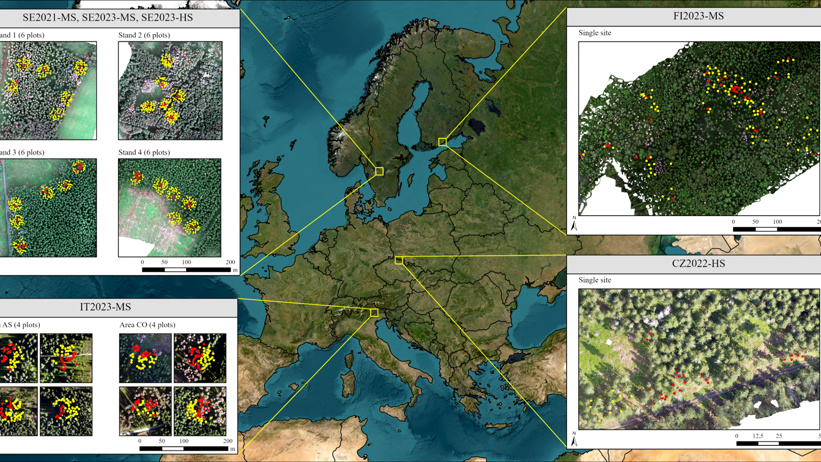
Detecting attacks before they become visible
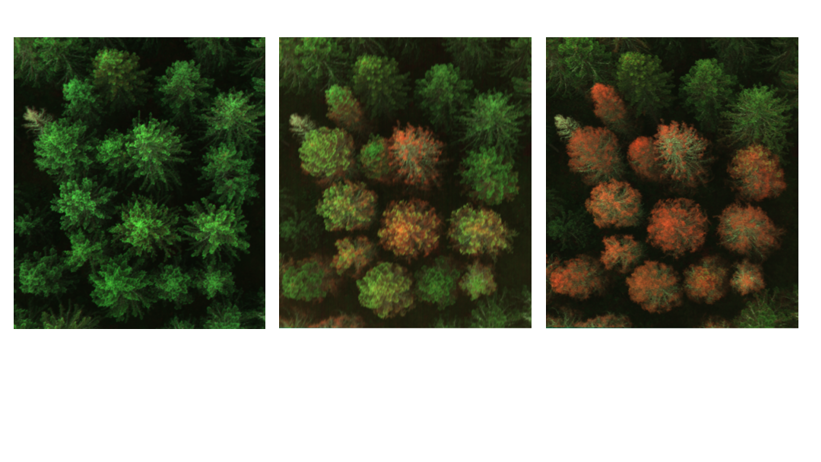
The spruce bark beetle reproduces beneath the bark of spruce trees, and once the new beetles have hatched, measures such as felling infested trees are significantly less effective. For an effective forest protection, it is therefore crucial that the infestation can be detected before the larvae have developed into adult beetles. However, this is not so easily done, as the tree crown may still appear green for some time after the bark beetles have first attacked the tree. By the time an infested tree looks brown to the human eye, the beetles have often already completed their development and left the tree.
Field surveys can certainly identify entrance holes and bore dust on the bark, but such inspections are labour-intensive and difficult to apply over large forest areas. Hyperspectral drone imagery offers a way to monitor many individual tree crowns with high-resolution imaging as the infestation develops.
The study shows that drone imagery can help locate infestation patches several weeks before new beetles emerge. The number of infestations that can be detected depends largely on timing of the measurements and threshold choice. There is therefore a practical trade-off between detecting more infestations in good time and an increased risk of false alarms, which can lead to unnecessary field inspections.
‒ We also need to bear in mind that most of the data we have is from 2023, during the post-outbreak phase. The comparison between 2021 and 2023 showed that trees declined much faster during the outbreak phase, resulting in much more promising detectability. We can be optimistic that the developed techniques can help during outbreaks, while we still need to verify their actual detectability in the next outbreak, says Langning.
One wavelength range outperformed the others
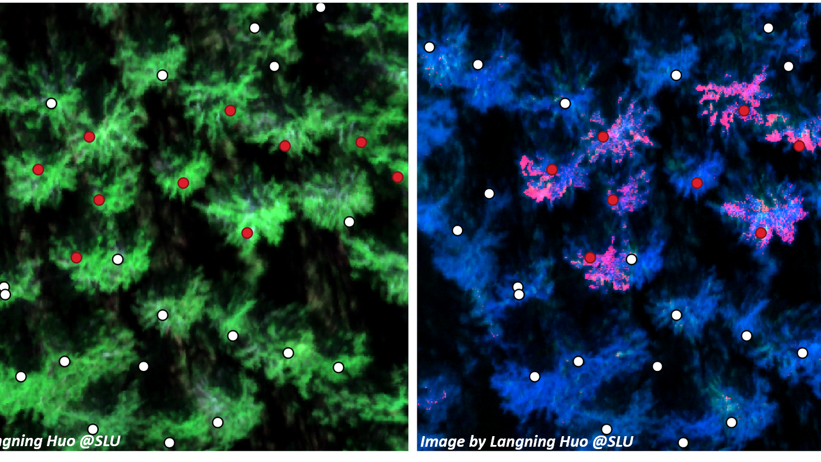
In the new study, the researchers compared different drone sensors, light wavelengths and analysis methods using data from several European countries. The researchers found that the green wavelength range (530 nm), known as the ‘green shoulder’, works particularly well for distinguishing between healthy and infested trees when using hyperspectral sensors. Up to twice as many infested trees were detected compared with the next best wavelength range (710 nm so-called red-edge band).
‒ This is important because many commonly used multispectral drone cameras do not include this part of the spectrum. Our results suggest that the green-shoulder region contains highly useful information for early stress detection in spruce, says Langning.
Most multispectral drone sensors include a red-edge band within 680–750 nm, but the exact wavelength matters greatly for early-stress detection. Bands around 705–712 nm were two to four times more sensitive to early tree stress than bands around 730–740 nm, although both are often labelled simply as “red-edge” bands. Therefore, the study provides practical guidance for users in selecting drone sensors with wavelengths that are more suitable for early forest-stress detection.
Local conditions remain important
The choice of sensor is only part of the answer. On some forest plots, the researchers were able to detect early, subtle changes in light reflectance in many of the affected trees, whilst neighbouring forest plots showed a much slower decline. This means that results from one location cannot automatically be applied to another without taking local conditions into account.
‒ Our study shows that early detection is not only a remote sensing problem. It is also a biological and ecological problem. How fast trees decline after attack can be highly local, and this strongly affects what drones can detect, says Luiz Henrique Elias Cosimo, PhD student at SLU and the second author of the study.
Towards effective operational forest protection
The study represents an important step towards enabling the early detection of infestations in practice, but further work is needed to develop and refine the method into practical tools for forest owners.
So far, the researchers have tested the method by analysing previous outbreaks. The next step is to use this knowledge to develop workflows that can provide support during ongoing outbreaks.
A key objective is to simplify the methods so that they are not limited to expensive drone technology. The researchers are therefore also looking at how cheaper drones and simpler sensors can better utilise the beneficial green wavelength range (530 nm).
The data provided by the drones can also help to develop satellite monitoring methods that make it possible to cover even larger areas. Together, drones and satellites can both detect damage at an early stage and track the progression of the infestation.
From groundbreaking case studies to open European comparative data
The study, which builds on several years of SLU research into drone-based detection of bark beetles, is taking the step from groundbreaking case studies to an open resource containing drone data. The initiative, named DroneNet4Beetles, currently has eight research groups from Sweden, Finland, Italy, the Czech Republic and Slovakia contributing to the shared database.

More about the research and the technology
The study included:
• harmonised drone data from Sweden, Finland, Italy and the Czech Republic
• 12 study areas
• 26 multispectral image series
• 16 hyperspectral image series
• 14,000 individual trees
Hyperspectral and multispectral sensors measure light across several different parts of the light spectrum simultaneously, including beyond the visible light spectrum.
Multispectral sensors divide the light into 5–9 bands, providing a good overview.
Hyperspectral sensors divide the light into hundreds of very narrow bands, providing more detailed information.
Publication
A cross-European assessment on the pre-emergence detection of trees attacked by spruce bark beetle using UAV imagery, is published in Remote Sensing of Environment.
DOI: https://doi.org/10.1016/j.rse.2026.115445
Previous articles on the research
New discovery: How spruce bark beetle infestations can be detected early from the air
New hyperspectral drone pushes forest stress monitoring to a new frontier
Knowledge bank: a research timeline towards operational bark beetle early detection
· 2021 – First spectral early-warning index from satellite imagery at landscape scale
DOI: 10.1016/j.rse.2020.112240
· 2023 – Satellite-based mapping to understand bark beetle outbreak patterns in Sweden
DOI: 10.1016/j.foreco.2023.121255
· 2023 – First time-series multispectral drone monitoring of early-infested trees
DOI: 10.1016/j.rse.2023.113484
· 2024 – Green-shoulder breakthrough using hyperspectral drone imagery
DOI: 10.1016/j.isprsjprs.2024.07.027
· 2025 – Testing green-shoulder robustness and sensitivity
DOI: 10.1080/01431161.2025.2482747
DOI: 10.5194/isprs-archives-XLVIII-2-W11-2025-73-2025
· 2025 – Linking early stress signals with carotenoids
DOI: 10.1109/IGARSS55030.2025.11242690
· 2025 – Bark beetles and forest microclimate effects
DOI: 10.1016/j.agrformet.2025.110796
· 2026 – First direct link between early spectral stress signals and tree hydraulic functioning
DOI: 10.1016/j.isprsjprs.2026.04.038
· 2026 – First cross-European verification of drone-based pre-emergence detection
DOI: 10.1016/j.rse.2026.115445
· Open benchmark data – DroneNet4Beetles
DOI: 10.5281/zenodo.19736597
The project is partly funded by The SLU Forest Damage Centre.
Contact
-
PersonLangning Huo, ResearcherDivision of Forest Remote Sensing
-
PersonTheres Svensson, Communicator, SLU Forest Damage CentreFaculty of Forest Sciences