
Can assisted migration help Swedish forests adapt to climate change?
Researchers at SLU are planting tree seedlings across Sweden to answer a question that could shape the future of forestry: can helping trees move north make forests more resilient to climate change?
Climate change is happening faster than many tree species can naturally adapt. As temperatures rise and extreme weather becomes more common, researchers are investigating whether assisted migration could become an important tool for adapting Swedish forests to a changing climate.
This is the focus of ANAFOR (Assisting Natural Adaptation of Forests to Climate Change), a new research project at SLU, that PhD student Samuel Aspalter is working on. The project combines ecological research with months of hands-on fieldwork across the country.
"Our question is essentially: can we move broadleaved tree species from Central Europe and southern Sweden further north to help forests adapt to climate change?" Aspalter says.
Helping trees move faster
Trees have always responded to changing climates by gradually expanding into new areas. The problem today is that climate change is happening much faster than trees can naturally migrate.
Assisted migration is the active movement of species from their current range to areas that are expected to become suitable in the future. Unlike introducing exotic tree species from other continents, the aim is to help native European species establish themselves in places they might eventually reach on their own if they had enough time.
The stakes are high. Forests provide timber, carbon storage, clean water, habitats for biodiversity and places for recreation. If forests cannot adapt quickly enough, many of these values may be affected.
A climate experiment across Sweden
To investigate whether assisted migration can work in practice, the ANAFOR team is establishing 20 experimental plots across 10 locations, stretching from Eslöv in southern Sweden to Vindeln in Västerbotten. Together, the sites span a broad temperature gradient, from around 8°C to 2°C mean annual temperature, allowing researchers to study how eight broadleaved tree species respond to different climatic conditions.
Rather than relying on models alone, the researchers are testing the idea in the field.
“We wanted a wide climatic gradient so we can see how the trees perform under both current and more extreme conditions,” says Aspalter.
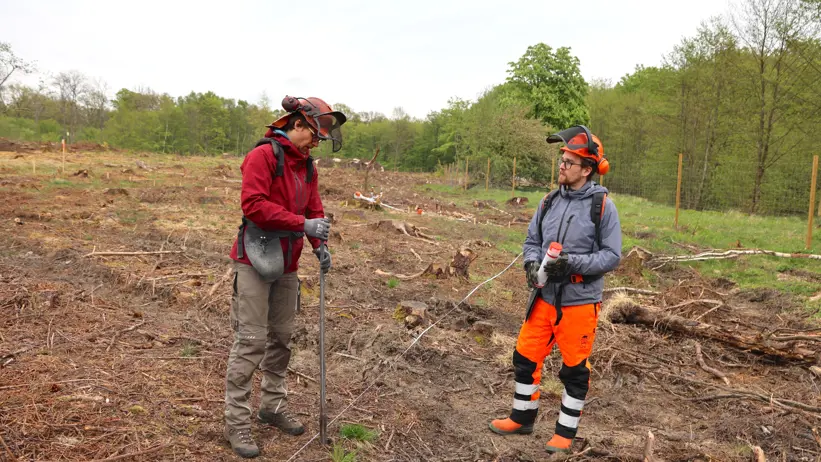
For Aspalter, the contrast between the sites has already been striking. In Vindeln, broadleaved trees are much less common, and the landscape is dominated by spruce, pine, birch and aspen. The colder conditions also make the purpose of the experiment tangible: the researchers are testing how far different broadleaved species can be moved before climate becomes a limiting factor.
“When planting in the cold wind, I remember thinking that I wouldn’t want to be a seedling growing here,” he says.
At each site, the seedlings are planted, measured and protected before being monitored over the coming years. Early observations already show how quickly they respond to their new environment. Just two weeks after planting, many seedlings had developed leaves and new shoots.
“It is very promising to see that the establishment went well. However, the coming years will show the fuller picture!” he remarks.
A promising idea with open questions
Assisted migration has attracted growing international interest, but it also raises important questions. Could some species become invasive? Could trees appear healthy at first but struggle later during drought, frost or other extreme weather events?
To address these uncertainties, ANAFOR combines ecological research with legal and social perspectives. Researchers from Uppsala University and Södertörn University are investigating how forest owners and other stakeholders view assisted migration, and how legislation could influence its future use.
Knowledge for future forests
The goal is to provide practical guidance for forest owners, authorities and decision-makers. The project aims to determine where different broadleaved tree species can establish successfully, how they respond to drought and browsing, and what role assisted migration could play in future forest management.
For Aspalter, the project is not about proving that assisted migration is the solution.
"If assisted migration works, I would like to see people diversify forests for future generations. If it does not work under certain conditions, that is equally valuable knowledge. Then we know we need to look for other ways to help forests adapt."
As Sweden's climate continues to change, the seedlings growing across ANAFOR's research sites could provide valuable insights into what tomorrow's forests might look like, and whether assisted migration could become one tool for helping them adapt.
Contact
-
Person