
The mystery of the small crayfish: SLU launches major mark–recapture study of signal crayfish
Signal crayfish are becoming increasingly abundant in several of Sweden’s large lakes – but small individuals account for most of the increase. SLU researchers are now marking and tracking thousands of crayfish in Lake Hjälmaren to find out why.
The changing size structure of signal crayfish populations has consequences for both commercial and recreational fisheries, as large crayfish are the most sought-after. Together with professional fishers around Lake Hjälmaren, SLU researchers have individually marked thousands of signal crayfish over the summer and released them back into the lake.
The extensive project is one of Europe’s largest mark–recapture studies of signal crayfish. The first fishing effort to recapture marked crayfish will take place in September and will be repeated over several years. By monitoring crayfish as they are recaptured, researchers can study their survival, individual growth rates and movement patterns, as well as how fishing affects the size structure of the populations.
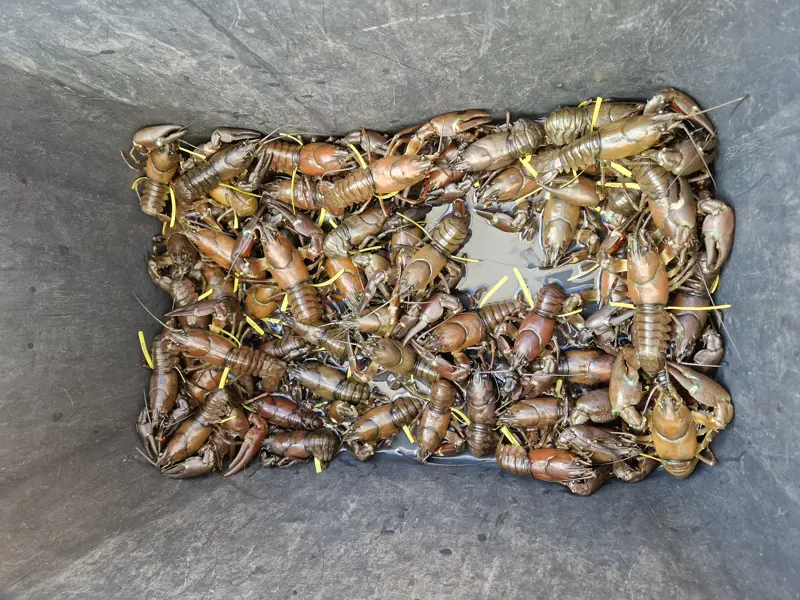
– We want to find out whether crayfish populations have become so dense that competition for food slows their growth, or whether long-term fishing has altered the population structure by selectively removing the largest individuals. The answer is crucial for the future management of Sweden’s crayfish fisheries, says Patrik Bohman, Environmental Assessment Specialist at the Department of Aquatic Resources at SLU.
The study builds on more than 20 years of monitoring signal crayfish populations in Swedish lakes. The results show that populations have increased rapidly since around 2015, but that the increase has been driven mainly by smaller crayfish. Although the number of large crayfish has also increased, it has done so much more slowly.
– More crayfish do not necessarily mean better crayfish fisheries. As small individuals make up an increasing proportion of the population, large crayfish – the ones most valued by both commercial and recreational fisheries – become relatively less common, says Patrik Bohman.
Could food be the key?
To better understand what is happening, the researchers will also study crayfish from Lakes Hjälmaren and Vättern. Are crayfish populations becoming so dense that food resources are running short? Do crayfish feed on different food sources in different parts of the lakes? And could nutritional stress explain why an increasing proportion of crayfish remain small?
To answer these questions, crayfish from Lakes Hjälmaren and Vättern will be analysed in collaboration with American universities. Using fatty acid profiles and compound-specific stable isotope analyses, researchers can investigate crayfish diets and nutritional status.
– We know that crayfish populations are changing, but we still do not know exactly why. By combining long-term monitoring, mark–recapture studies and advanced analyses, we hope to solve the mystery of the small crayfish, says Patrik Bohman.
International collaboration strengthens the research
The long-term monitoring of signal crayfish on which the project is based was recently presented at the world’s largest scientific conference on freshwater crayfish, organised by the International Association of Astacology in New Orleans, USA.
– Most invasive freshwater crayfish species currently established in Europe originate from North America. Working together with American researchers gives us valuable opportunities to compare the ecology of these species in their native and introduced ranges, says Patrik Bohman.
At the conference, SLU researchers also presented results showing that signal crayfish can grow across a wide range of temperatures, suggesting that climate is unlikely to limit the species’ continued northward expansion.
– Signal crayfish are highly adaptable. That makes it even more important to understand how the species develops and affects freshwater ecosystems in Sweden, says Björn Rogell, researcher at the Department of Aquatic Resources at SLU.
The tagging study will run from 2026 to 2029 and is funded by the Swedish Agency for Marine and Water Management (tagging and test fishing in Lake Hjälmaren), the County Administrative Board of Örebro (funding for stable isotope and fatty acid analyses), the County Administrative Board of Jönköping (collection of crayfish from Lake Vättern), and Purdue University (fatty acid analyses).
Read more
About signal crayfish, noble crayfish, and how to tell them apart
Contact
Patrik Bohman, Environmental Assessment Analyst at the Department of Aquatic Resources, SLU
Telephone: +46104784217
Facts about signal crayfish
Sweden has two species of freshwater crayfish: the native noble crayfish (Astacus astacus) and the introduced signal crayfish (Pacifastacus leniusculus).
Signal crayfish are native to North America and were introduced to Sweden in the 1960s, after crayfish plague had wiped out many populations of noble crayfish. Signal crayfish were subsequently introduced into many Swedish waters and today support important commercial and recreational fisheries, particularly in Lakes Hjälmaren and Vättern.
However, their introduction also had serious consequences for the native noble crayfish. Signal crayfish are more resistant to crayfish plague and can carry and spread the disease, while infected noble crayfish die rapidly. The introduction of signal crayfish into new waters has been prohibited in Sweden since 1994, but illegal introductions have continued to spread both signal crayfish and crayfish plague. Since 2016, the signal crayfish has been classified as an invasive alien species.