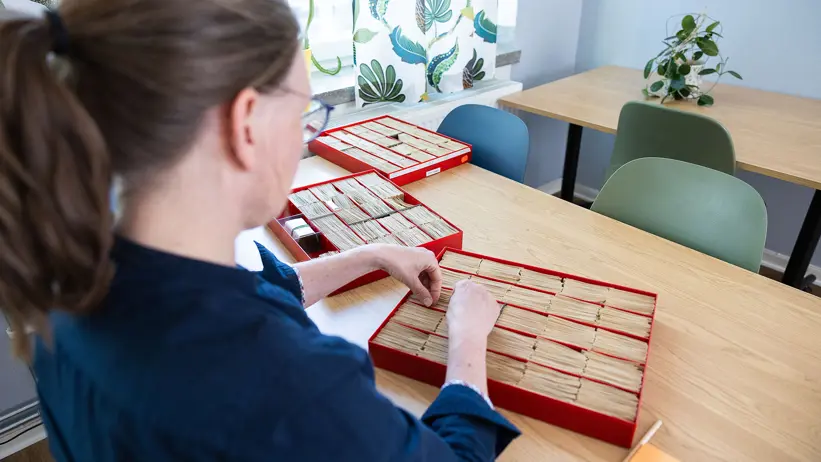
These sample bags hold gill lids and other bony structures from fish caught several decades ago. Using modern DNA methods, these old samples help bring new knowledge on long-term changes in the genetic variation in fish. Photo: Josefine Karlsson
Future discoveries hide in old fish bones
News published:
16/09/2026
What can a gill lid from a perch caught nearly 50 years ago tell us? More than we think, according to a new study from SLU. Thanks to modern DNA methods, old samples in biological archives can help researchers answer new questions.
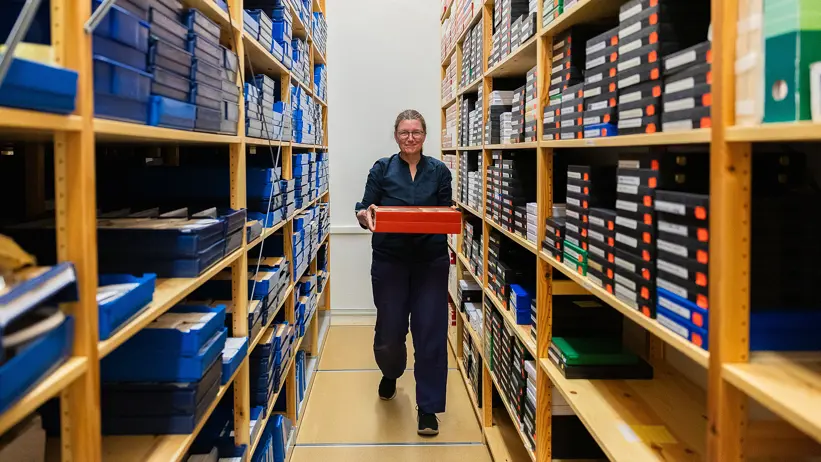
The shelves reach up to the ceiling and are filled with flat plastic boxes. In each box there are hundreds of brown paper bags. “ABBO, 199, 85, 78-04-07” the writing says. Inside the bag there are gill lids and scales from a perch, 199 millimeter long and weighing 85 gram, that was caught in monitoring fishing on April 7th, 47 years ago.
In the biological archive at the Department of Aquatic resources at SLU in Öregrund there are hundreds of thousands of samples from fish caught in the long-term coastal monitoring. Bony structures, including gill lids*, scales and otoliths (ear stones) are stored here, once collected to, for example, determine the age of fish and monitor changes in fish stocks and the coastal environment.
Anna Gårdmark, professor at SLU, in the biological archive at the Department of Aquatic resources in Öregrund. The shelves hold material from several decades of Swedish coastal fish monitoring and research. Foto: Josefine Karlsson
From age determination to DNA analyses
Can we extract DNA of high enough quality from fish gill lids that have been boiled and stored in an archive for decades? That is the question that Jingyao Niu, then PhD-student at the Department of Aquatic resources at SLU, set out to study.
– The gill lids were originally collected to determine fish age, not for genetic analyses. They had therefore been cleaned of soft parts in boiling water, and as these parts commonly contain most DNA, it was not obvious that the samples would still contain enough genomic material, says Jingyao Niu.
Jingyao analysed gill lids from perch caught between 1977 and 2002. The results, published in a scientific journal, show that DNA from the old gill lids was of surprisingly high quality. The researchers could sequence the whole genome from the fish, and the quality was comparable to DNA from fresh fish tissues.
During her time as PhD-student at SLU, Jingyao Niu studied whether gill lids stored in the archive for decades still could be used for genetic analyses. Photo: Josefine Karlsson
Method opens new possibilities
The study also shows that the method is comparatively simple to use. With only smaller adjustments to existing laboratory methods for fresh tissues, DNA can be extracted from archived samples that have been collected for completely different purposes.
– Universities, museums and research institutes around the world hold biological collections with samples stored long before the current methods for genomic analyses existed. Our study shows that they can become an invaluable resource when analyses methods continue to develop, says Jingyao Niu.
The next step is to use the method to answer new questions.
– By comparing DNA from different time periods, we can study long-term changes in the genetics of fish populations. This can, for example, generate new knowledge on how populations have been affected by fishing and environmental changes. We are now using this method to study if perch have adapted to increasingly warmer waters, which helps us understand the consequences of climate change, says Anna Gårdmark, professor at the Department of Aquatic resources and co-author of the study.
What is saved, and what can it be used for? When new methods develop, researchers can return to the archive and look at old samples with new eyes. Photo: Josefine Karlsson
*A gill lid is a bony plate protecting the gills (breathing organs) of the fish. When the fish grows, annual rings are formed in the gill lid, showing how old the fish is.