
Moose personality in the spotlight for new SLU research
Moose can be more or less dominant, social or tolerant. This is shown by a study in which researchers at SLU observed moose in a Swedish moose park. The study is a first step towards increasing our understanding of moose personality, a previously unexplored topic in Sweden.
– Traditionally we expect all wild animals to behave in a similar, average way. But just like humans, moose also have different personalities that influence an individual’s behaviour, says Bruno Esattore, researcher at SLU and the study’s lead author.
There is a great deal of research describing animal personality and behaviour. But although the ‘king of the forest in Sweden’ has fascinated humans for thousands of years, moose’s personality has received limited attention in research. Until now.
Dominance linked to tolerance of humans
In the study, Bruno Esattore and his colleagues spent ten weeks over the summer at the moose farm, "Älgens hus", outside Bjurholm investigating whether it was possible to quantify individual differences to start investigating moose personalities. They made observations and then carried out assessments based on measurable behavioural scales for different traits, ranging from active to curious, to sociable and dominant. The researchers found clear evidence of differences in dominance and sociability between individuals and in how tolerant different moose were when interacting with humans.
– Human-moose interactions occurred mainly during feeding time, when access to food also required approaching humans and tolerating or displacing other moose. We saw that dominant individuals tended to prevail at feeding time, were able to push away more submissive moose, and seemed more comfortable in proximity to visitors, says Bruno Esattore.
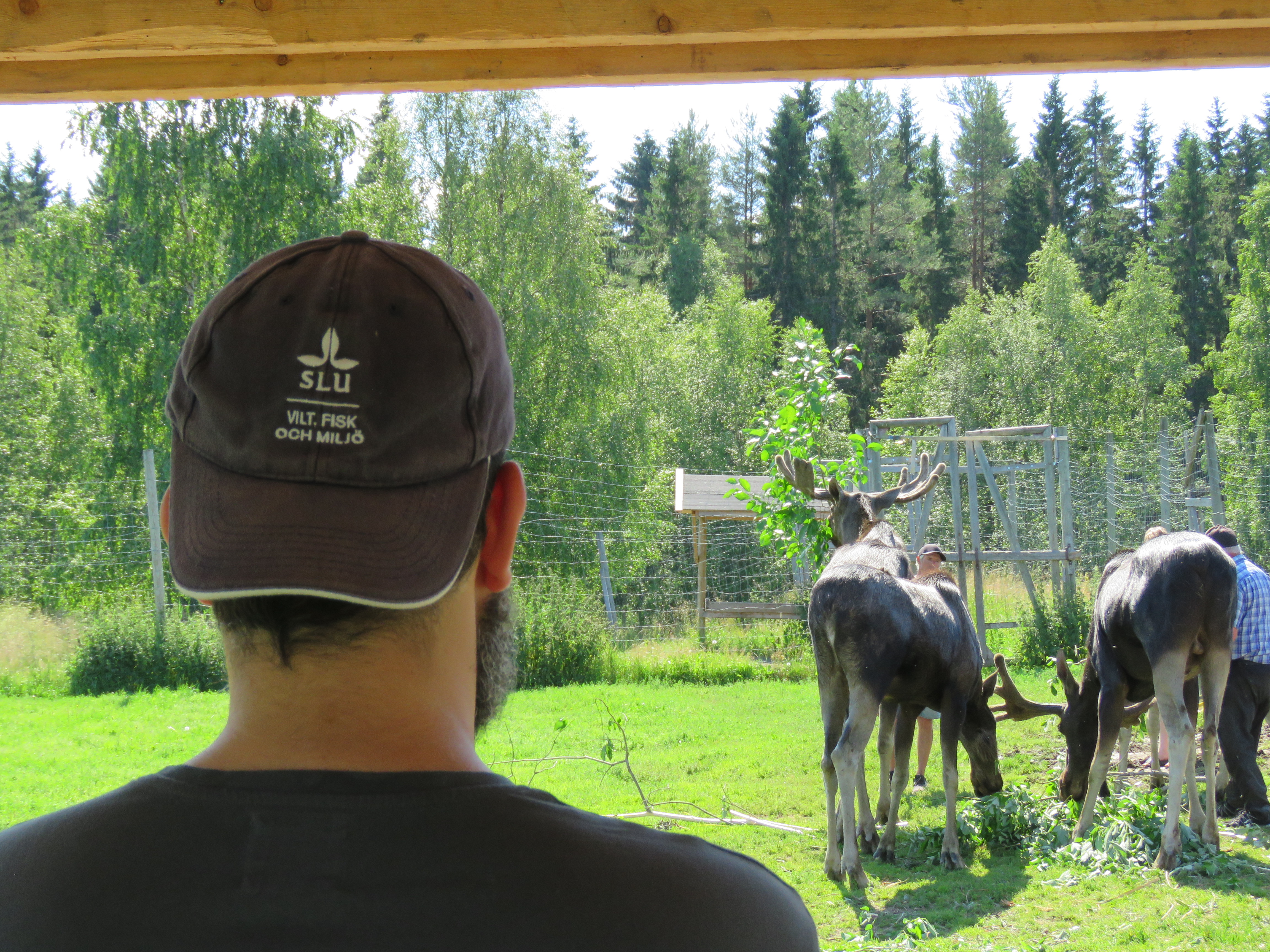
There are circa 30 moose parks in Sweden, where visitors can interact with animals at different degrees of contact. The knowledge of the moose’s personalities can be used to adapt the activities to suit different individuals, ensuring both the welfare of the animals and human safety.
– Although the study is preliminary, it shows the potential to assess personality traits in moose in captivity. This is an important first step towards a better understanding of how different individuals react to both conspecifics and humans, says Bruno Esattore.
New project on personality of wild moose
The researchers have now taken on a new challenge by investigating the personalities of wild moose for the first time. They are using movement data from GPS-tagged moose.
– Personality influences various aspects of a wild animal’s life. It can determine why it prefers to live in a particular area, or why it moves around more than other individuals. We are investigating whether moose exhibit recurring behaviours and ways of using the landscape that could be ascribed to personality, and whether this has any significance for management, says Bruno Esattore.
Scientific article
Applied Animal Behaviour Science: From misunderstanding to moose-understanding: Short-term behavioural variation assessed through trait rating in a small group of captive moose Bruno Esattore, Desirée Guidobaldi Stenbacka, Amelia Munson, Laura Saggiomo.
Read more about the new project on the personality of wild moose.
Animal personality
The definition of animal personality in research is individual behavioral differences among individuals of the same species, which are consistent over time and across different situations.
Researchers commonly study animal personality along several behavioral dimensions, including:
- Boldness: the tendency of an animal to take risks, for example, exposing itself to predators or unknown dangers.
- Exploration: the tendency of an animal to investigate new situations, objects, or environments.
- Aggressiveness: the tendency to engage in antagonistic interactions with individuals of the same species.
- Activity: an individual’s general level of movement and activity in its everyday environment.
- Sociability: How much the animal seeks out or tolerates being near other members of its species.
Contact
Bruno Esattore, Postdoc
Department of Wildlife, Fish, and Environmental Studies, SLU in Umeå.
bruno.esattore@slu.se +46(0)793551694.
Frida Wengberg, Communications officer
Department of Wildlife, Fish, and Environmental Studies, SLU in Umeå.
frida.wengberg@slu.se +46(0)725669778