
The right rootstock makes for healthier apple trees
It is not only the apple variety that determines how susceptible a tree is to the fungal disease European apple canker. Researchers at SLU have shown that the rootstock also affects the tree’s resistance – and that the effect depends on which apple variety is grafted onto which rootstock.
Genetically, an apple tree consists of two parts: the rootstock and the grafted apple variety, known as the scion. In Sweden, as many as 90 per cent of commercially grown trees use the M.9 rootstock, which has proved to be highly susceptible to European apple canker.
European apple canker is a major problem for apple production in Sweden and northern Europe. The disease is caused by the fungus Neonectria ditissima, which attacks both the rootstock and the scion wood, and trees are often infected as early as the grafting stage.
“For an infection to occur in the first place, there needs to be a wound on the tree,” says Larisa Gustavsson, a researcher at the Department of Plant Breeding. “As the tree attempts to heal the wound, concentric rings develop, which are a typical characteristic of the disease. The lesions grow and can eventually kill branches and entire trees, resulting in devastating situations and financial losses for growers.”
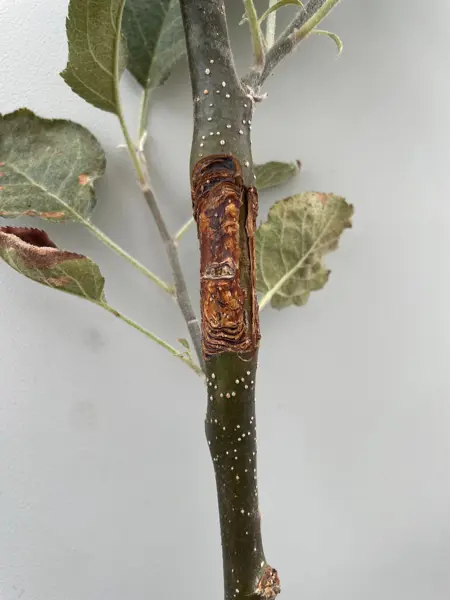
There are currently no chemical or biological plant protection products available against European apple canker. Instead, the disease is managed through careful monitoring and the removal of infected branches – and, in the worst cases, entire trees. Some apple varieties, such as Elise, are so severely affected that continuing to grow them is not economically viable.
After the Swedish apple industry highlighted the problems caused by European apple canker and the need to investigate rootstocks as well, SLU researchers launched a study to determine whether the choice of rootstock could strengthen trees’ resistance.
Repeated tests to ensure reliable results
In the project, funded by the Swedish Farmers’ Foundation for Agricultural Research, 23 rootstocks were tested over two years in inoculation experiments in a greenhouse.
“We wanted to test the established rootstocks that have traditionally been used in Sweden, including M.9. But we also included rootstocks used, for example, in northern Sweden, belonging to the Budagovsky B series. We also obtained rootstocks developed in the USA, Poland and New Zealand, which had been propagated in France, Poland and the Netherlands. Some of these are entirely new and are not yet commercially available.”
There are currently no completely resistant varieties, nor is there a clear dividing line between resistant and susceptible trees. Instead, varieties and rootstocks can show different degrees of resistance to European apple canker. There is also variation both between different rootstocks and between individual trees of the same rootstock. This means that many replicates are needed to distinguish genuine differences between rootstocks from natural variation.
“We grew up to 24 trees of each rootstock each year and randomly distributed them across four blocks. On each tree, we made small wounds at three buds and applied a defined quantity of spores of the canker fungus. We wanted to give all the rootstocks conditions that were as similar as possible.”
After inoculation, the researchers monitored the development of the disease for approximately six months. They measured the size of the canker lesions seven times at two-week intervals. This allowed them to determine not only whether a tree had become infected, but also how quickly and to what extent the disease developed.
The same rootstock can benefit one variety but disadvantage another
Overall, infection was very common: more than 89 per cent of all inoculated wounds developed lesions in the experiment. However, the severity of the disease differed considerably between rootstocks. The study also showed that the interaction between rootstock and scion variety can vary.
“It is complex. A rootstock that performs well in itself can have a negative effect on the susceptibility of the scion variety,” says Larisa Gustavsson. “In other countries that have problems with fire blight – which, fortunately, has not yet been found in Sweden – there are recommendations for specific variety-and-rootstock combinations. Something similar is needed for Swedish apple production when it comes to European apple canker.”
The study tested four common Swedish apple varieties – Aroma, Discovery, Frida and Ingrid Marie – on the different rootstocks.
“The G.935 rootstock benefited both Aroma and Discovery, but had a negative effect on Frida. It is important to test different varieties on different rootstocks and select the best combinations.”
One rootstock stands out
The American G.969 rootstock, developed in Geneva in the 1970s, stood out from the others.
“When we inoculated G.969, many of the wounds did not develop an infection. All the other rootstocks had disease incidence rates above 89 per cent, whereas G.969 had an incidence rate of just 54 per cent,” says Larisa Gustavsson. “G.969 also had a positive effect on the resistance of the scion variety. For example, the combination of this rootstock with Aroma produced very good results.”
G.969 is therefore considered particularly promising for Swedish apple production. In addition to the good results in the study, the rootstock is known to have resistance to fire blight and the rosy apple aphid, as well as good cold tolerance. However, it is more vigorous than M.9.
“It produces larger trees,” says Larisa Gustavsson. “This may mean that growers have to change their entire production system and, for example, use trees with two stems.”
Field conditions put the combinations to the test
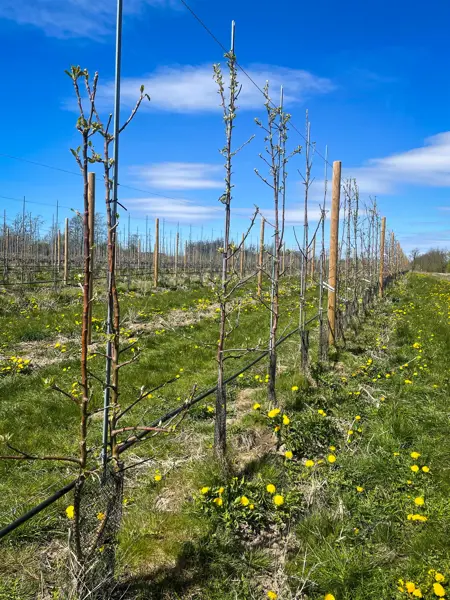
So far, the experiments with rootstock combinations have been carried out under controlled greenhouse conditions. Larisa Gustavsson and her colleagues are now continuing to investigate what happens under more realistic growing conditions.
“We have started a project with Norwegian colleagues this year in which rootstocks have been planted under field conditions in Norway. We will then compare what we have observed in the greenhouse with what they see in the field.”
A long-term field trial has also been established in Alnarp, where the researchers can monitor how rootstocks are exposed to and respond to naturally occurring Neonectria ditissima.
Together with Kiviks Musteri, the greenhouse experiments are being validated through new trials under real-world conditions at Solnäs Farm, as part of a project funded by SLU Partnership Alnarp. In the project, Larisa Gustavsson is also collaborating with colleagues in the Netherlands, Norway and Finland to assess how climatic conditions affect European apple canker in different variety-and-rootstock combinations.
“European apple canker is a treacherous disease that causes major problems. This summer, I visited many apple orchards and saw that as many as 60–70 per cent of the trees had an active infection. Through greater knowledge and by identifying the best combinations, we want to help growers find a solution.”
Contact
-
Person
-
PersonJohanna Grundström, Communication managerUnit for Collaboration and Development