
When aspen trees experience drought, their leaf cells change shape
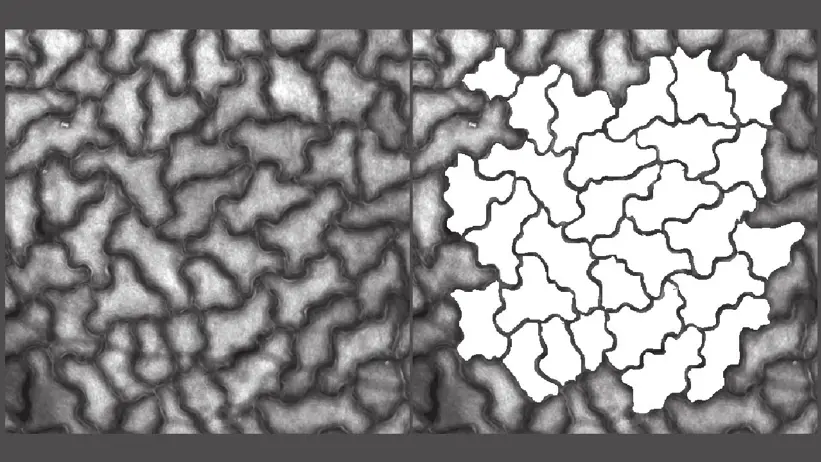
The surface of an aspen leaf looks like a jigsaw puzzle under the microscope. Researchers at Umeå Plant Science Centre have now identified a gene that helps shape these interlocking cells – and discovered that both the gene's activity and the cells' shape change when the tree experiences drought.
These cells, called pavement cells, are found in the outermost layer of leaves and vary in shape among plant species. Scientists still do not fully understand how these cells develop such intricate shapes in some species – or why. It is a question that Stéphanie Robert and her group at Umeå Plant Science Centre have long been interested in.
Much of their research has focused on puzzle-shaped pavement cells in the model plant Arabidopsis. But the researchers noticed that aspen forms similar puzzle-shaped cells in a different way. In their new study, published in New Phytologist, they set out to find what controls their shape.
“As a leaf grows, pressure builds up inside its cells and pushes against the cell walls,” explains Stéphanie Robert, professor at SLU, who led the study. “The puzzle shape helps to keep the tissue intact. But we still don't fully understand what controls this intricate pattern.”
A shape that is still puzzling
To find out, the researchers turned to the Swedish Aspen collection, which includes genetically distinct aspen trees originating from locations across Sweden. They took microscopy images of hundreds of leaves, traced the outlines of the pavement cells and used computer software to analyse their shapes.
The work took several years and revealed considerable variation in cell shape between the different aspen trees. By combining these measurements with genetic information from the trees, one gene stood out: MYB305a. The researchers tested the gene further and confirmed that it helps control pavement cell shape in aspen.
MYB305a carries the instructions for making a transcription factor, a protein that can control the activity of other genes. Other genes similar to MYB305a are known to be involved in how plants respond to drought. This prompted the researchers to investigate whether MYB305a might also respond when aspen trees experience drought.
“When we looked at leaves from drought-treated trees under the microscope, we saw very bright fluorescence. We used a fluorescent marker to track when MYB305a is active, so this strong signal showed us that the gene had become much more active. That was a really exciting moment,” says Siamsa Doyle, who shares first authorship of the article with Sijia Liu.
Drought also affected the shape of the pavement cells. In fully developed leaves, they became more rounded and developed fewer of the lobes that give them their characteristic puzzle-like appearance.
Changing shape as water becomes scarce
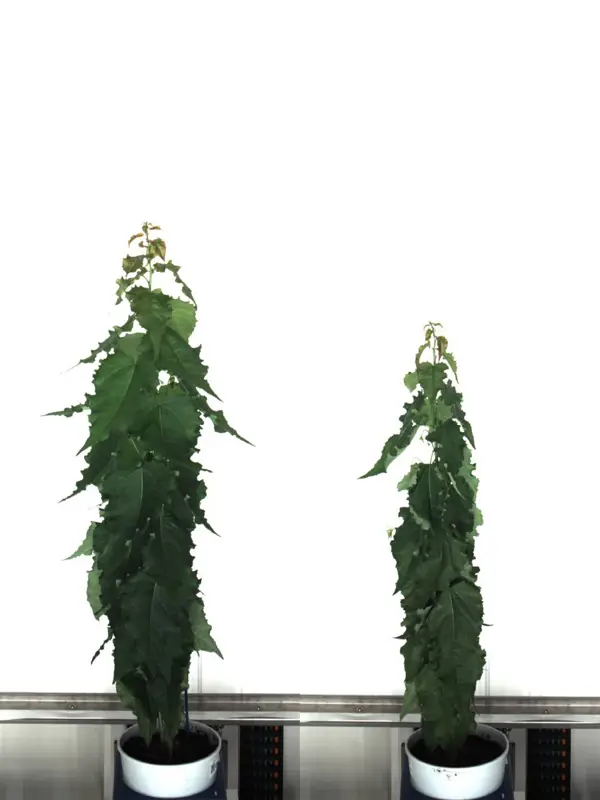
Why the cells change shape during drought is not yet clear, but it may be linked to the role of water in plant growth. Water entering a plant cell creates pressure against the cell wall, helping the cell expand. Changes in water availability can therefore alter the mechanical forces acting on growing cells.
“When water becomes scarce, the pressure inside the cells and the mechanical forces acting on them may change. Our results suggest that plants may adjust the shape of their pavement cells in response,” says Stéphanie Robert.
The researchers now want to understand more about how MYB305a influences pavement cell shape. They want to identify other genes involved in this process and understand how they work together with MYB305a. Ultimately, they hope to understand why pavement cells change shape when water becomes scarce – and what this change means for the plant.
More information
The study
Sijia Liu, Siamsa M. Doyle, Kathryn M. Robinson, Zahra Rahneshan, Nathaniel R. Street and Stéphanie Robert, A drought stress-induced MYB transcription factor regulates pavement cell shape in leaves of European aspen (Populus tremula), New Phytologist 2026, DOI: https://doi.org/10.1111/nph.71399.
Related study
Researchers from the same group recently published a study on pavement cell shape in Arabidopsis thaliana.
Sandeep Yadav et al., The primary beta-galactosidase BGAL10 modulates pavement cell shape acquisition in Arabidopsis, Journal of Experimental Botany 2026, DOI: https://doi.org/10.1093/jxb/erag320.
Contact
-
Person
-
PersonStéphanie Yvette RobertDepartment of Forest Genetics and Plant Physiology