
AI expertise to strengthen data-driven research within WIFORCE
How can AI help researchers gain more knowledge from large and complex datasets from forests? Over two days, experts from AI For Science and researchers within Wallenberg Initiatives in Forest Research met to explore how AI can contribute to research across the programme.
Modern forest research generates large and complex amounts of data – from long-term measurements of forests, soils, water and the atmosphere to genetic data, images and information about entire forest landscapes. Creating better ways to manage, combine and analyse such data is an important part of developing the WIFORCE Data Support Centre.
WIFORCE will now also have access to AI expertise from AI For Science, which provides expertise to research groups funded by Knut and Alice Wallenberg Foundation, Marcus and Amalia Wallenberg Foundation and Marianne and Marcus Wallenberg Foundation. Its experts work alongside researchers to apply AI methods to scientific questions.
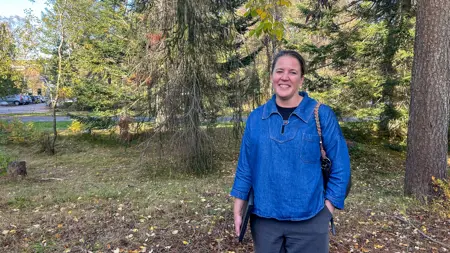
“I hope we can help accelerate important insights across all areas of WIFORCE. Everyone on our team has a PhD in computational science, but none of us are forest experts. The forest researchers bring their expertise, and together we can open up entirely new kinds of insights,” says Salla Franzén, CEO of AI For Science.
From measurements in the forest to large datasets
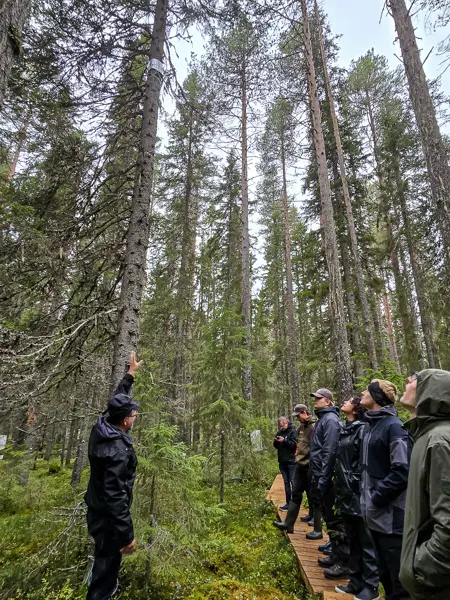
To give the AI experts an understanding of the research and where the data come from, the visit began at SLU’s Svartberget Research Station outside Vindeln. Large amounts of data are continuously collected there using advanced sensors and measuring instruments – from how forests exchange carbon dioxide and water with the atmosphere to what happens in soils, groundwater and streams.
The following day, the work continued in Umeå. During a workshop, researchers presented examples of data-driven research, the types of data they work with, and their needs for analysis and modelling. AI For Science, in turn, presented its expertise and examples of how the team works with researchers to solve scientific problems using AI.
AI expertise for WIFORCE
WIFORCE has access to expertise from AI For Science equivalent to 1.5 full-time positions. The expertise will be used, among other things, in projects with WIFORCE researchers while also contributing to the development of the WIFORCE Data Support Centre.
By working with datasets that researchers need, AI For Science can help develop approaches for how data can be used, combined, and structured to enable new analyses and modelling.
“AI For Science is an exceptionally skilled organisation supporting the strategic research initiatives funded by Knut and Alice Wallenberg Foundation. Their expertise will be extremely valuable to us, both in developing the Data Support Centre and in projects with our researchers,” says Ove Nilsson, Programme Director of WIFORCE.
AI For Science
AI For Science provides AI expertise to research groups with ongoing grants from Knut and Alice Wallenberg Foundation, Marianne and Marcus Wallenberg Foundation and Marcus and Amalia Wallenberg Foundation.
Research groups can apply for support through the KAW AI Consultancy Grant. Selected projects receive up to 700 hours of support from the team, which works alongside researchers to address scientific questions using AI techniques and methods.
Contact
-
PersonOve Nilsson, Programme Director WIFORCEDepartment of Forest Genetics and Plant Physiology
-
PersonNicolas Delhomme, Coordinator WIFORCE Data Support CentreDepartment of Forest Genetics and Plant Physiology
-
PersonSusanna Bergström, Communications Officer WIFORCEFaculty of Forest Sciences