
“Before, when we were poor”. Erik Karltun reflects on development in Ethiopia
For more than twenty years, SLU researcher Erik Karltun has worked with agriculture and forestry in Ethiopia. His experiences reveal how markets, knowledge and long-term collaboration can transform lives, and how fragile that progress can be.
A landscape that echoes the past
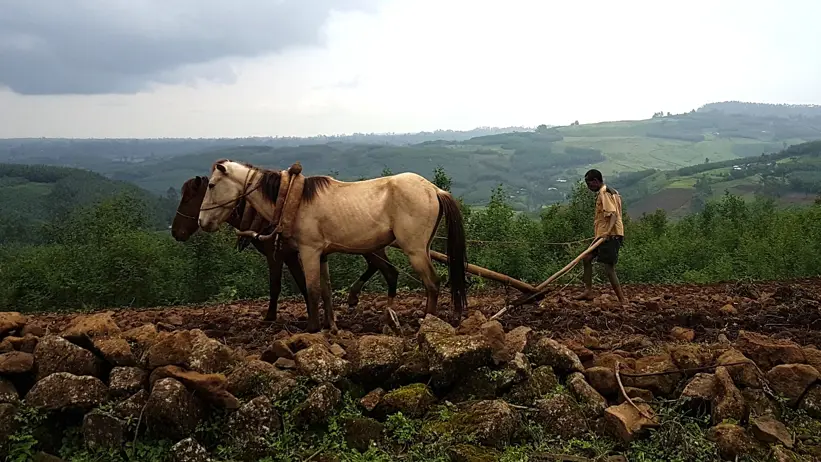
When Erik Karltun speaks about Ethiopia, he begins somewhere unexpected: with his grandfather, born in 1889 in rural Småland. A county in the south of Sweden that was exhausted, overgrazed, and poor — a place where families struggled to survive on depleted soils.
“He was born into a society that very much resembles the Ethiopian countryside.”
Erik’s grandfather lived long enough to have a villa and a colour TV. A lifetime of transformation. That possibility — that poverty is not a fixed condition — has shaped Erik’s work for more than twenty years.
Wondo Genet and the long road of collaboration
Erik’s first steps in Ethiopia came around the turn of the millennium, when he began supervising PhD students at Wondo Genet College of Forestry. Swedish involvement in the region stretched back decades, and older Ethiopian agronomists often mention one project in particular: CADU, the Chilalo Agricultural Development Unit.
“There are wheat varieties that are still in use today in Ethiopia and which were developed as part of CADU’s breeding programme.”
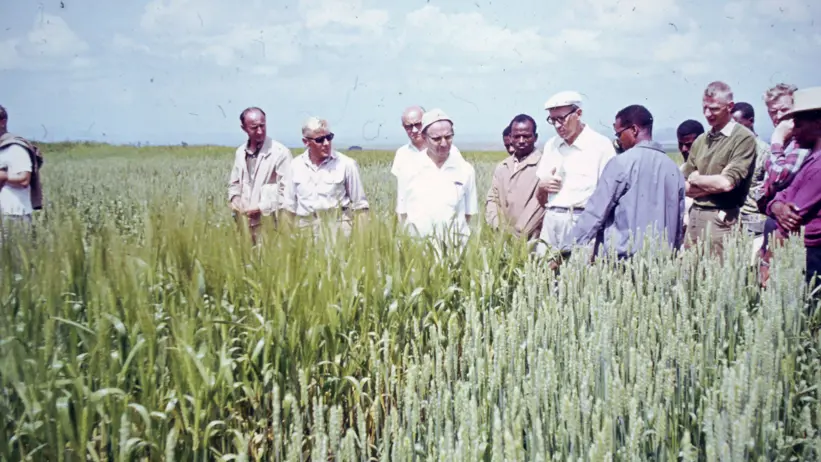
CADU was a massive undertaking by the standards of its time — staffed by Swedes and Ethiopians, equipped with resources, and designed to reform agricultural practices. It left behind improved crop varieties, new farming methods, and a memory of what coordinated development efforts could achieve. (Read more about CADU: Seeds that grew – tracing the SLU-Ethiopia partnership | slu.se)
“Back then, development aid was carried out in a very different way to how it is today. There was a large staff travelling from Sweden to Ethiopia in this case. They achieved a great deal, and together with their Ethiopian counterparts, essentially reformed agriculture and farming methods in the areas where they were working”, Erik says.
“Swedish support also helped establish forestry education, Erik continues. When Alemaya University, Ethiopia’s equivalent of SLU, an agricultural university, proved too far from actual forest, the programme was moved to Wondo Genet and later integrated into Hawassa University. It was a practical shift, but also symbolic: development had to be rooted in real landscapes, not abstractions. And there are quite a few trees in the area planted with the help of Swedish aid.”
Mapping a nation’s soil
In 2012, Karltun moved to Addis Ababa to work at the Agricultural Transformation Institute, a strategy and delivery-oriented government institute created to help accelerate the growth and transformation of Ethiopia’s agriculture sector. There he joined one of the most ambitious soil mapping efforts ever undertaken in Africa.
“Around 100,000 samples were analysed. One could say that this has resulted in a very comprehensive assessment of the state of arable land in Ethiopia. I would go so far as to say it is unique in Africa; there is no other country that carries out this kind of comprehensive sampling and assessment”
The project produced a detailed map of Ethiopia’s agricultural soils — a tool for understanding nutrient deficiencies, planning fertiliser use, and guiding national policy. It was a scientific achievement, but also a logistical one: teams travelling across regions, collecting samples, building a dataset that would shape agricultural decisions for years to come.
Energy forests and the charcoal economy
The project that left the deepest impression on Erik unfolded far from the capital, in the marginal landscapes of northeastern Amhara. Together with PhD student Getachew Tiruneh, he studied energy forests and charcoal production — a local economy that had emerged organically, without external funding or planning.
What struck him was how clearly it illustrated a fundamental principle:
“There has to be a market for agriculture to develop.”
When demand for charcoal rose in larger towns, farmers planted fast‑growing trees, harvested them, charred them, and sold the charcoal. The income allowed families to invest, diversify, and plan ahead.
Erik warmly remembers a boy, perhaps twelve years old, who followed the research team curiously. He had earned money carrying charcoal sacks. When asked if he would continue, he shook his head.
“No, I took that money and bought chickens, now I raise and sell them”, the boy said.
It was a simple story, but it captured something essential: the emergence of entrepreneurship when people gain even a small economic foothold.
Another moment stayed with him even more strongly. A woman described how life had changed thanks to the charcoal economy:
“Before, when we were poor”, she began her story.
She still lived in conditions most Swedes would call poverty. But she no longer saw herself as poor.
Erik sums the project up:
“I personally found that project very interesting because it gave me real insight into how agriculture and forestry can develop. What struck me was that the main challenge wasn’t poor land, but access to a market. In many parts of Africa, there simply aren’t sufficiently strong urban markets for agricultural products. When people could earn an income from growing energy forests and producing charcoal, you could clearly see how their lives improved. Once that opportunity was there, people found ways to solve the problems related to the production. That was very encouraging to see.”
When hope meets instability
But development is fragile. In recent years, the region has been hit by violence and instability. Transport routes became unsafe. Charcoal shipments were seized by armed groups. The local economy collapsed.
“We can’t even travel to that area anymore, much of the production has stopped”, Erik says.
What took a decade to build could be undone in months.
The untapped value of domestic wood production
Today, Erik collaborates with the Eco Innovation Foundation, which aims to strengthen Ethiopia’s domestic wood industry.
“The potential is enormous — and largely unrealised”, Erik says.
Ethiopia imports significant volumes of high‑quality timber from Europe and China for construction and interior finishing. This includes doors, window frames, flooring and panelling, thresholds and furniture components.
These products require wood that is straight, stable, and properly dried — qualities that Ethiopia could produce domestically but currently does not.
“You need to know how to dry wood, and how to saw it properly”, says Erik.
Drying is especially critical. Without controlled drying, wood warps, cracks, or twists — making it unusable for modern construction. Sawing techniques also matter in sawing along the grain, minimising internal stress, and maximising the usable volume.
Ethiopia has promising native species such as Cordia and Juniperus, which can produce high‑quality timber suitable for building materials. But the value chain is incomplete. There is limited expertise in kiln drying, precision sawing, grading and quality control, and producing standardised components.
The result is a paradox: a country with abundant forest potential imports expensive wood products that could be made locally.
A functioning domestic wood industry could reduce import costs, create rural employment, incentivise sustainable forestry, support urban construction and keep value within the country.
It is a vision rooted in the same principal Erik saw in the charcoal economy: when a market exists, development follows.
The quiet legacy of aid
Despite frequent criticism of aid in Sweden, Erik encounters a different narrative in Ethiopia. Almost every time he visits, someone approaches him and says:
“I want to thank the Swedish Government for financing the schools I attended.”
These are the quiet legacies of development work — the ones that rarely appear in political debates but shape lives across generations.
A future facing headwinds
Looking ahead, Erik is concerned. Cuts to development funding, political instability, and a generational shift in academia threaten future collaborations.
“It doesn’t look very promising right now. The natural funding is disappearing. Researchers with decades of experience are retiring, and younger scholars have fewer opportunities to gain field experience. Without active projects, the knowledge base erodes.”
“There is a possibility”
Yet Karltun remains hopeful. He returns to the image of his grandfather’s life — from poverty to prosperity in a single generation.
“There is a possibility to lift a population out of poverty — within a lifetime.”
Even in difficult times, he believes the seeds of development remain — in people’s drive, their ideas, their willingness to create something better.
Just like the boy with the chickens.