
Sniff the stress away – Francesca explores which nature smells could help reduce stress in cities
Measuring people’s brain activity in parking lots and asking them to smell flowers is not unfamiliar to PhD student Francesca Taufer. Her background in cognitive science and close connection to nature led her to explore a sense we tend to pay little attention to, and its potential to reduce stress.
Francesca Taufer is following the same route she has walked more than 150 times since her PhD project started. Each time, she has brought a new research participant along for a smell walk in the suitably named Garden of Knowledge at SLU’s campus in Uppsala.
The smells of nature are on Francesca’s mind on a daily basis. Not only because the forest happens to be her natural habitat – she grew up in the Italian Dolomites and competes in orienteering – but because she is researching how different smells from nature affect us human beings and our stress levels.
“There is growing evidence that nature is good for us, but there are so many kinds of environments. What kind of nature are we talking about? In our research, we explore how various types of nature affect human health and well-being through the sense of smell”, Francesca says, while putting on sunglasses to block out the surprisingly intense October sun that shines through the red coloured tree canopies in the Garden of Knowledge.
Despite the autumn’s arrival, the garden is flourishing. Bees are buzzing and the flowerbeds look as though someone has poured saturation on them. Francesca stops to smell a white daisy, which brings her back to the small mountain village in Italy where she grew up. Her close connection to nature, especially pine forests, has stayed with her since. But nature smells were not always something she paid much attention to.
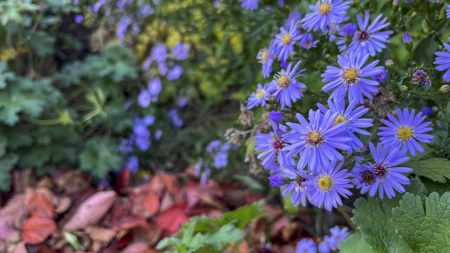
“It's funny, everyone asked me why I was interested in smells and, honestly, I wasn’t. I have a strong connection to nature in general and wanted to research human-nature relationships. But like most people, I didn’t really pay attention to the scents around me. I wasn’t specifically curious about that.”
It was rather the combination of fields in the PhD project application that caught her attention: environmental psychology, human-nature relationships and neuroscience. Her bachelor’s degree in cognitive sciences and master’s in applied psychology, alongside her lifelong interest in nature, fitted like a glove and off to Sweden she went.
“When I did my master’s, I didn’t know what to do with my life. I escaped to Australia for a year where I taught orienteering in schools and coached local clubs. But when I read the PhD application, I remember thinking; yes, this is what I want to do. It covers a bit of everything that I like.”
A neglected sense
Three years later, smells have become a central part of Francesca's working life. More specifically, she is researching what kinds of smells from nature that could be incorporated into urban environments to help reduce stress.
“It’s such a fascinating sense. It’s not very well understood, and it’s not considered as important as our other senses”, she says.
Despite having conducted parts of her research in the exact same spots more than 150 times, she hasn’t grown tired of them. The garden and surrounding forest are still where she goes for her daily lunch walks. The nearby parking lot is not as appealing, though. She has spent plenty of time there, measuring participant’s brain activity, heart rate and skin conductance, while blocking their noses.
“It was quite challenging. How do you block the sense of smell without making people uncomfortable? Smell is so intimate – I mean, it’s connected to our breathing. And it wasn’t as if I could ask them to stop breathing. So, there was a lot of overthinking and a long journey to figure out the study design.”
Her research looks at how people react to smells in different kind of environments, both psychologically and physiologically.
“The idea is to look at it on a subjective level – what people perceive and choose to talk about – as well as objectively, to see what actually happens in the body.”
During the smell walks, participants were asked to reflect on the emotions, associations and memories connected to the smells they encountered.
“I loved that part. It was nice to see how the participants thought about smells. I could see them becoming more aware of how scents were everywhere and how they affected them. Many became nostalgic when a scent reminded them of home, especially people who didn’t grow up here.”
Francesca’s own relationship with nature’s smells has changed, too. Nature has always been her go-to place – ‘a run in the forest’ is her ultimate answer to any question about her own ways of dealing with stress – but since she started researching smell, she has also begun to stop every now and then to consciously take in of her surroundings through the nose.
Positive reactions to unpleasant smells
When Francesca's legs solely move on their own accord through the garden, they carry her to a slightly more remote forest patch. When she sits down next to a fallen, decaying tree trunk and picks off a bit of moss, the fragrance of wet soil announces itself. Her shoulders drop.
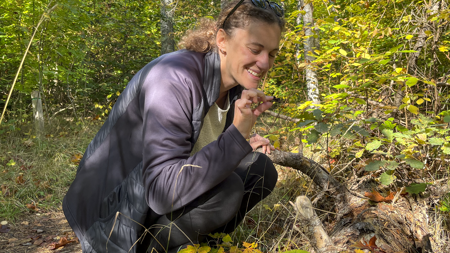
Through the research, Francesca and her colleagues have found that people tend to have positive associations with natural smells that might not immediately be considered pleasant.
“Take rotting leaves, for example. Maybe it’s not something people would say they like or prefer, but it can still be enjoyable because it’s a part of the process in nature.”
The research team now has a substantial collection of data to analyse. They will look at the similarities and differences between perception of smells and people’s physical reactions.
“Sometimes, our bodies react differently from our minds or what we like”, Francesca says, shrugging her shoulders slightly.
Once their upcoming analysis is complete, they – or rather, we – will be one step closer to figuring out how we can shape urban environments in ways that help reduce stress.
Read more about Francesca and her research here.
Five quick questions with Francesca
What is your favourite smell?
Forest smell after rain, it’s so nice!
Your favourite forest?
I love Lunsen forest in Uppsala (although less when orienteering in the dark in winter).
What was the last book you read?
I love Nordic crimes, I’m in the middle of a Jo Nesbø series.
A quote or motto that’s close to your heart?
“Success is going from failure to failure without losing your enthusiasm.”
What puts you in a good mood?
A run on a sunny day.
Contact
-
PersonFrancesca Taufer, PhD StudentDivision of Landscape Architecture
-
PersonClara Jonsson, Communications officerDivision of Environmental Communication