How characteristics of the forest affect the risk of spruce bark beetle damage
The proportion of spruce in a stand and the stand’s age are key factors in the risk of spruce bark beetle infestation, as well as in the extent of the resulting damage. This is shown by a new study from SLU.
This knowledge can help provide a better basis for decision-making when forest owners manage their forests.
In the study, the researchers analysed the probability of a spruce bark beetle attack and the extent of the damage by examining data on the forest’s characteristics and the amount of wood damaged by the spruce bark beetle.
The researchers found that stands with a higher proportion of spruce were at greater risk of infestation and suffered more extensive damage. They also identified a correlation between the average age of the stand and the likelihood of infestation, with older forests being more vulnerable.
“As far as we know, we are the first to show that stands with a higher risk of infestation also suffer more extensive damage. We also found that a higher proportion of deciduous trees did not reduce the risk of infestation, but it did reduce the extent of the damage,” says Maartje Klapwijk, senior lecturer at the Department of Ecology at SLU
An increased number of deciduous trees does not necessarily prevent an infestation but may influence the extent of the damage. However, the variation in the observations leaves some uncertainty as to what effect this actually has.
Previous research has suggested a link between stand density and susceptibility to infestation. However, when the researchers carried out this analysis, they found that the damage was more extensive in stands of medium density. One explanation for this difference may be that it is not known where the damage occurred within the stand.
“As infestations often start at the edges of stands, both stand density and the surrounding landscape may play a role, making it difficult to interpret the results with certainty,” says Maartje.
During the most recent major outbreak between 2018 and 2023, estimates suggest that the spruce bark beetle killed around 34 million cubic metres of standing timber. The outbreak began following the extreme drought of 2018. As extreme events such as storms and droughts are expected to increase, the need for forest management that can reduce the forest’s vulnerability to future outbreaks is becoming ever more important.
A susceptibility index
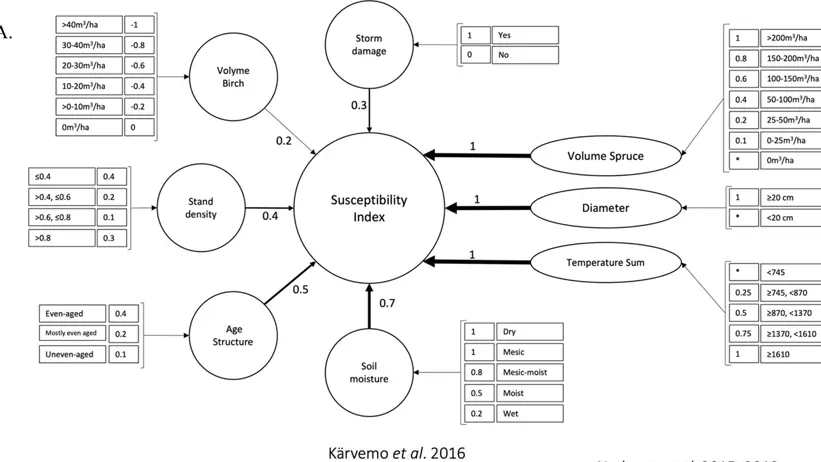
A previous susceptibility index, developed to assist forest owners in planning future forest management, was also tested in the study. A higher index value was linked to a greater likelihood of infestation and extensive damage. At the same time, it is important to emphasise that the index is not a prediction of where infestations may occur. Another important aspect is that once the spruce bark beetle population becomes large enough for them to start attacking healthy trees, forest characteristics are likely to be of lesser importance.
Can provide guidance when forest owners choose a management approach
The index, which is integrated into the Heureka planning tool, has been designed to enable comparisons between different management scenarios for a stand. It can be a useful tool for selecting an appropriate management strategy to reduce susceptibility to spruce bark beetle infestation, whilst balancing this against economic objectives and other values.
Forest owners should follow the Swedish Forest Agency’s recommendations on stand-adapted planting and plant spruce where appropriate. At the same time, it may be a good idea to spread the risk by choosing different tree species.
More about the study
In the study, the researchers analysed the probability of a spruce bark beetle attack and the extent of the damage by examining various forest characteristics, such as the proportion of spruce, the proportion of deciduous trees, soil moisture, stand density and age, as well as the volume of spruce bark beetle-damaged timber.
The information used in the study consists of stand data from Holmen Skog in south-western Sweden, covering an area of 100,000 km² stretching from Gävle in the north to Kalmar in the south.
Publication: Forest characteristics determining probability and magnitude of spruce bark beetle damage in forest stands
Contact
-
PersonMaartje Klapwijk, Researcher and analyst at SLU Forest Damage CentreS, Forest entomology unit
-
PersonTheres Svensson, Communicator, SLU Forest Damage CentreFaculty of Forest Sciences