
Insect biomass can be higher here than in the tropics during summer
There are more insect species in the tropics than at our latitudes. But during summer, the total weight of insects can be greater here. This is one of the findings in a doctoral thesis by Johanna Orsholm, who has studied insects worldwide and developed new methods to analyse them.
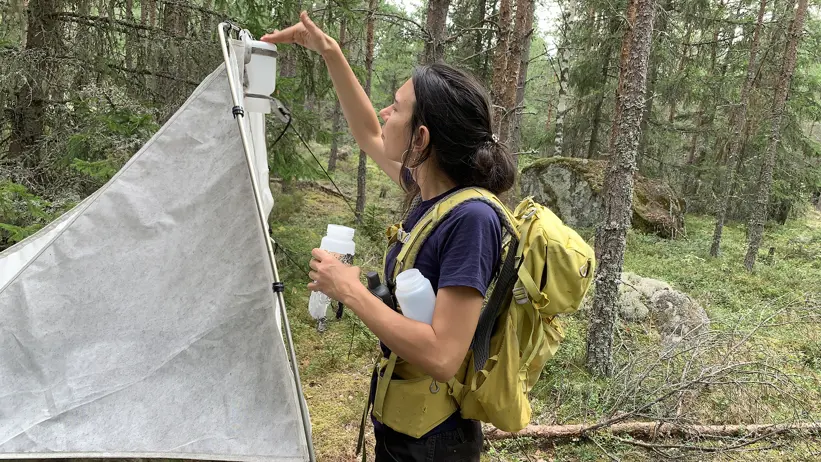
Johanna Orsholm, a doctoral student at the Department of Ecology, has used data from the Lifeplan research project, which collected insects weekly for five years at almost 200 sites around the world. The data make it possible to study insect diversity and biomass – the total weight of insects – on a larger scale than before.
Large seasonal differences
One of the findings is that insect biomass varies greatly between seasons at high latitudes. There is also some seasonal variation in the tropics, but the differences between seasons become smaller closer to the equator.
‘Many people are surprised when I tell them that at higher latitudes, such as here in Sweden, insect biomass can be greater than in the tropics during summer. It is hardly surprising that so many birds migrate here,’ says Johanna Orsholm.

In fact, there is no clear difference in mean annual insect biomass across latitudes. Our short, intense summer can therefore compensate for the low insect activity during the rest of the year. However, the number of insect species is higher in the tropics.
Temperature matters
Temperature was also important for insect biomass and species richness. Warmer sites or unusually warm years had more insects than colder sites and years. However, this relationship only held up to a certain temperature. Beyond that point, higher temperatures did not appear to benefit insects and could even have negative effects. This is particularly interesting in light of ongoing global warming.
Surprising results on human influence
Another finding was that insect biomass was not always lower in landscapes affected by human activity.
‘Contrary to our expectations, we found that biomass was higher in landscapes with greater human influence at high latitudes.’
At lower latitudes, however, there was no clear positive or negative relationship.
One possible explanation is that agriculture adds nutrients that increase food availability for insects. Buildings and infrastructure can also raise local temperatures, potentially benefiting insects in cold climates. However, the researchers have not investigated whether these factors explain the relationship.
‘Higher biomass does not mean that there are more species in an area. It could also mean that a few species have become more abundant.’
Training AI to detect insects
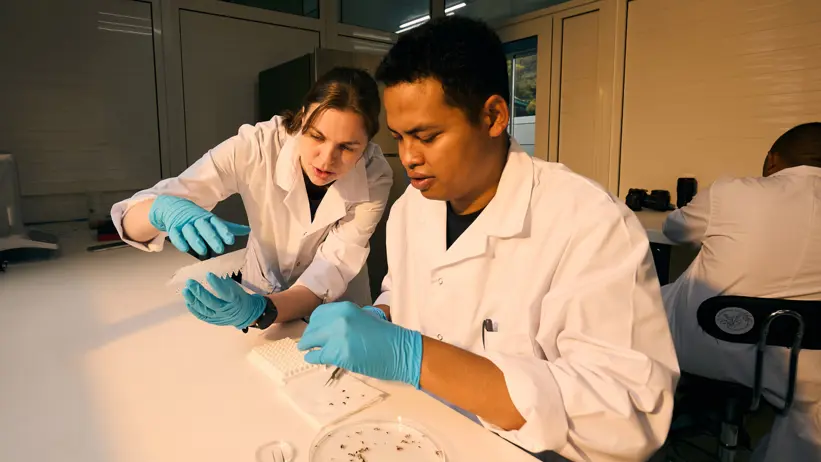
Collecting large numbers of insects is not enough – researchers also need methods to analyse them. Johanna's thesis is based on approximately 15,000 insect samples, each of which may contain hundreds of insects. In addition, around 80 per cent of the world's estimated five million insect species have yet to be formally described. To handle these samples, Johanna has therefore developed methods for analysing large numbers of insects, including undescribed species.
One method involves using artificial intelligence (AI) to analyse photographs of collected insects. The insects from each sample were spread out so that as many as possible were visible.
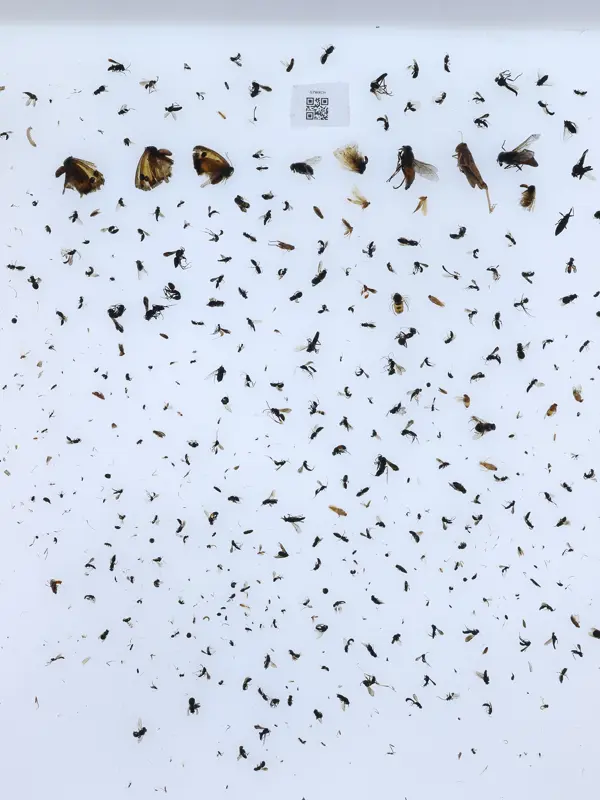
AI models that had not been specifically trained for the task struggled to detect insects in the images. Johanna and her colleagues therefore created a training dataset in which they outlined and identified almost 18,000 insects.
"The models can now estimate the total number of insects and their body sizes. However, further training is needed before they can recognise different groups of insects."
The aim is for the models to distinguish between groups such as beetles and flies. By combining images with DNA analyses, researchers could then determine both which insects are present in the samples and how many there are.
Phylogenetic trees provide insights into unknown species
Modern DNA methods make it possible to quickly investigate which species are present in an insect sample. But because so many insect species remain unknown, it is also important to understand how they are related to one another.
‘One of my most important conclusions is that building phylogenetic trees gives us more and better information about species. When we know which other species an unknown species is related to, it tells us more about what it might look like and how it lives than simply knowing that it is a new species,’ says Johanna Orsholm.
She has compared different methods for building phylogenetic trees from DNA and started developing a method that makes it possible to add new species to an existing tree without having to reconstruct the entire tree. This makes it possible to rapidly build trees containing large numbers of species.
By combining new analytical methods with insect sampling across large geographical areas and over long periods of time, researchers can gain a better understanding of how insect communities vary naturally. This is essential for detecting long-term changes and understanding how insects are affected by climate change and human activity.
Avhandling
High-throughput approaches to global insect biodiversity
Disputation
Johanna Orsholm defends her thesis 28 October 2026 09:00, Hall L, Educational Building Ultuna and zoom.
Contact
-
Person
-
PersonAnna Lundmark, Kommunikatör, SciFest-ansvarigDepartment of Ecology , joint staff/department office