
New Associate Senior Lecturer explores how microbes can shape plant evolution
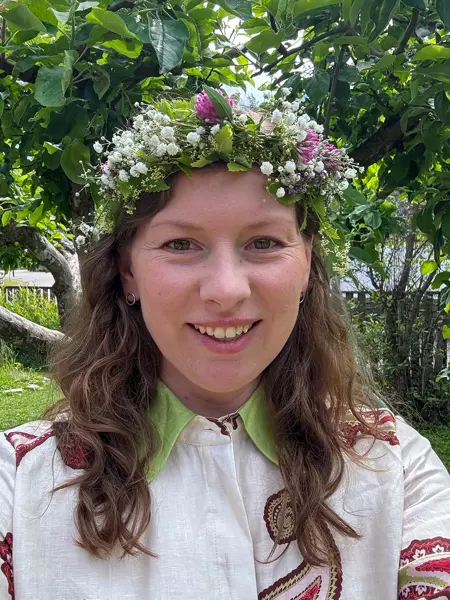
Monique Smith is a new Associate Senior Lecturer at the Department of Forest Mycology and Plant Pathology. Her research explores how interactions between plants and microorganisms can affect plant health, stress tolerance and even evolution.
Much of Monique’s time in her new position will be devoted to research. She recently received a Starting Grant from the Swedish Research Council for the project Eco-evolution of rye and its microbial allies, which investigates how rye and its associated microorganisms influence each other over time.
– I am really looking forward to collaborating with others at the department and having good scientific discussions. There is a lot of expertise here that I can learn from,” says Monique Smith.
From plant ecology to sustainable agriculture
Monique’s interest in plant-microbe interactions goes back to her PhD at the University of Adelaide in Australia, where her research included restoration management, weed ecology and plant-soil interactions.
Her path to SLU began when her husband received a postdoctoral position at Uppsala University. They moved to Sweden in 2017, fell in love with the country and decided to stay. Monique later joined the Department of Ecology at SLU as a postdoctoral researcher.
– Working with agroecology opened my eyes to sustainable agriculture. I began incorporating my interest in plant-microbe interactions into this area, which eventually led to a Formas mobility project on the topic.
Plants have microbiomes too
To explain why microorganisms are so important to plants, Monique often makes a comparison with the human gut microbiome.
– Just like us, plants have bacteria and fungi that can help them obtain nutrients and stay healthy. These microbial communities can also become unbalanced when the plant is under stress.
Her research focuses particularly on microorganisms around plant roots and how they can help plants cope with different types of stress. Understanding these relationships could ultimately contribute to more sustainable agriculture and new ways of supporting crop health with less reliance on agrochemicals.
Can microbes influence plant evolution?
One area that particularly fascinates Monique is eco-evolution, the interplay between ecological and evolutionary processes.
– I am really interested in how microbiota can drive plant evolution. I think it is really cool.
In Eco-evolution of rye and its microbial allies, she will investigate the mechanisms behind this relationship. By studying rye and its microbiota over multiple plant generations under stress, the project aims to better understand how plants and their microbial partners can shape each other over time.
Teaching the next generation
Teaching will also be an important part of Monique’s new role. She particularly enjoys teaching and supervising PhD students, where she can follow their development over several years.
– For me, one of the most important things is to be approachable. Students should feel comfortable asking questions and coming to you when they have problems.
Outside work, Monique has plenty of interests, although life with two young children does not always leave much time for them.
– I love hiking, baking, gardening and camping, and spending time with friends and family.
Read more
Contact
-
PersonMonique Ellie Smith, Researcher