
Old pea varieties grown in a traditional way can be the protein crops of the future
There is a great deal of interest in old pea varieties, but they are often difficult to grow. A new-old solution may be to intercrop the pea with faba bean. Several older varieties can then yield at least as much grains and biomass as modern varieties, according to a new thesis from SLU.
Before the industrialisation of agriculture, it was common for Swedish farmers to grow different crops together in the same field – a farming practise today referred to as intercropping. Pea was often grown with oats or barley, which provided support for the pea, but in some areas the pea was intercropped with another legume: faba bean.
In his doctoral thesis, Dylan Wallman at SLU's Department of Biosystems and Technology has investigated how old varieties works with this almost forgotten cultivation method.
– In gene banks and seed saver organisations, we have found varieties with characteristics that we did not think existed, and that match or complement each other in terms of, for example, growth habit and ripening time. It is a valuable green cultural heritage with many varieties that have flavours and textures that can make people eat more domestic protein crops and organic food. Our experimental cultivation shows that old varieties can work at least as well as modern ones in this type of intercropping, says Dylan Wallman.
Traditional varieties surprised
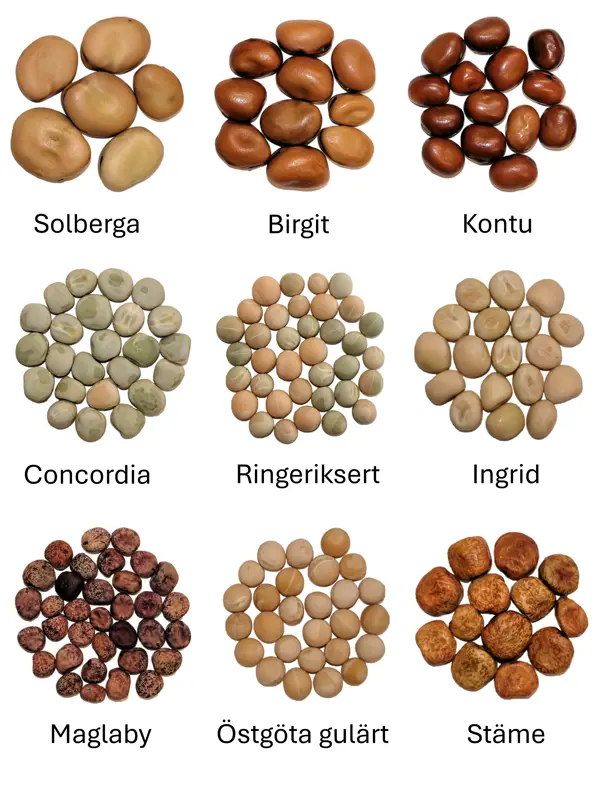
In the studies, ten varieties of pea and three varieties of faba bean were tested in many combinations. These are old varieties as well as landraces from the time before plant breeding started at the beginning of the 20th century.
The thesis shows that intercropping can reduce one of the biggest problems with many older pea varieties: lodging, i.e. when the plants lie down and make both growth and harvest difficult. The more stiff-stemmed faba beans act as a natural support for the pea and help to keep the crop upright.
In addition, intercropping of older varieties of pea with faba bean often yielded equal or even larger total yields of both seed and biomass, compared to modern varieties grown in pure stands.
High protein levels and strong nitrogen effect
The studies also showed that several of the traditional pea varieties had a higher protein content than the modern reference variety. In addition, high nitrogen balances were measured in both intercrops and pure stands, between 61 and 113 kg of nitrogen per hectare. This means that the crops can leave behind significant amounts of plant nutrients for the subsequent crop in the crop rotation if the biomass is left behind after grain harvest. This is particularly valuable in organic farming, where the availability of nitrogen is often a limiting factor.
– Co-cultivation of pea with faba bean also means that you can produce more legumes in one crop rotation than if you intercrop with cereals. Legumes should not be grown more often than every six to eight years in a field – as they are susceptible to soil-borne diseases – and then it is an advantage that the companion crop is also a legume.
The right combination is crucial
The varieties and seed proportions of the two species greatly affect the outcome. Wallman emphasises that these factors must be adapted together to maximise yield, weed suppression and nutrient utilisation.
One challenge with the intercropping method is how to separate pea and faba bean grains after harvest.
– We tested so many varieties that we could find combinations that indicate that you can separate by colour and size, Dylan Wallman continues.
In his thesis, he has also identified which plant traits are particularly valuable in intercropping systems and developed proposals for how future organic plant breeding can develop varieties that are better adapted for intercropping with other crops.
May pave the way for future cultivation systems
The thesis provides new knowledge about how traditional crops and old varieties can contribute to the development of modern, resource-efficient cropping systems. At the same time, the studies provide valuable insights into a wide range of pea and faba bean varieties that can be used not only in intercropping with each other but also in combination with other crops such as oats and barley.
What was once a natural part of Swedish agriculture can thus take on a new role in the transition towards a more sustainable and climate-adapted food system.
– Some of these varieties are very interesting for reintroduction to farmer fields and our food plates. One problem, however, is that there is a lack of seed for farmers to grow them. We are in the process of propagating seeds of a selection of varieties and have already started on-farm trials in collaboration with farmers in Halland and Skåne county, Dylan Wallman concludes.
The thesis
Dylan Wallman defended his thesis "Intercropping traditional pea varieties with faba bean in organic farming: Legume diversification for sustainable agriculture" at SLU in Alnarp on 2 October 2026.
Watch the film about co-cultivation of faba bean and pea in organic cropping systems (in Swedish).
Contact
-
PersonDylan Wallman, PhDDepartment of Biosystems and Technology
-
PersonLill Eriksson, Communications OfficerDepartment of Biosystems and Technology