
A toolbox for more sustainable farming
Less intensive tillage can benefit spiders and reduce diesel consumption, while organic fertilisation can benefit springtails but require more work from farmers. A new doctoral thesis shows that different cropping practices come with different benefits and drawbacks.
Valeria Carini has examined ecological aspects and crop yields, as well as the time farmers spend working in their fields and how much diesel they use.
'I have great respect for the work farmers do. I have an allotment myself, so I know how difficult growing crops can be. There are so many things trying to eat your crops, and the weeds are always trying to take over,' says Valeria Carini, a doctoral student at the Department of Ecology.
Agricultural fields are ecosystems where biodiversity and natural processes play an important role in crop growth. For example, natural enemies can help keep insect pests under control, while soil organisms play an important role in nutrient cycling.
Farmers can influence these processes through their choice of cropping practices. At the same time, they need to achieve good yields without using excessive resources.
Valeria Carini has therefore investigated how different cropping practices are related to ecological aspects, crop yields, labour requirements and diesel consumption. This is a broader perspective than that taken in many previous studies.
'We cannot point to one practice in the study and say that it will save the world. But if you know what you want to achieve, my results can help you decide which practices to use,' says Valeria Carini.
Different practices offer different benefits
In one of the studies, Valeria Carini investigated 50 winter wheat fields on 24 farms in Skåne, southern Sweden. She compared cropping practices such as different crop rotations, whether leys were included in the rotation, tillage intensity and the types of fertilisers used. She also examined the use of chemical pesticides.
The results show that different cropping practices can have both benefits and drawbacks.
For example, less intensive tillage was associated with more spiders, which can help control crop pests, more organic matter in the soil and better soil structure. It also required less labour and diesel. However, there were fewer rove beetles, a group of beetles that can also act as natural enemies of crop pests.
In fields where mineral fertilisers were supplemented with organic fertilisers, such as animal manure, there were approximately twice as many springtails and almost 40 per cent fewer aphids. The grain also had a 6 per cent higher protein content. However, these fields required approximately twice as much labour and diesel as fields receiving only mineral fertilisers.
What had been grown in the field the previous year also mattered. Winter wheat grown after a non-cereal crop had a 17 per cent higher yield than wheat grown after another cereal crop. There were also more rove beetles.
The results can be seen as a toolbox, with different tools suited to different situations. Farmers may need to choose different combinations of cropping practices depending on their priorities. Is the main goal to achieve high yields, support soil life, reduce diesel consumption or control weeds?
Studying life above and below ground
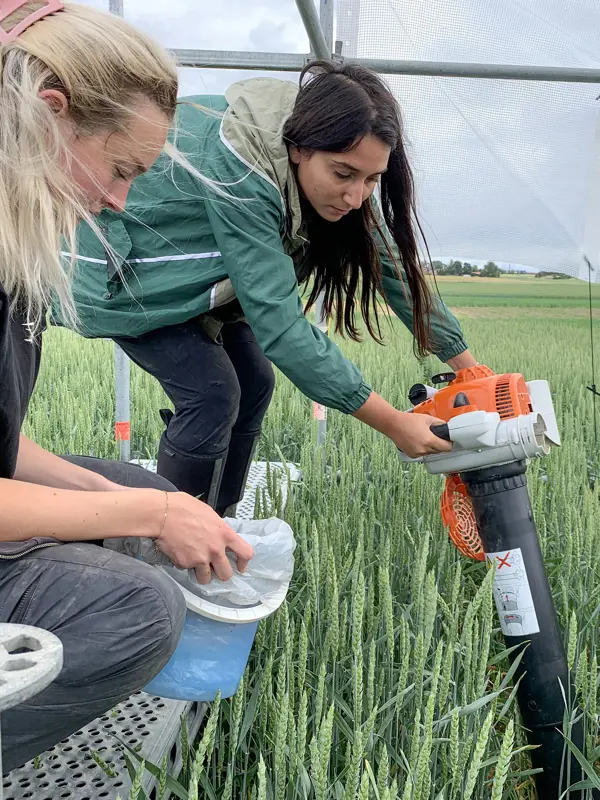
Valeria Carini's doctoral research has involved a great deal of fieldwork. Among other things, she has surveyed aphids and their potential natural enemies, including ground beetles, rove beetles and spiders, as well as small animals living in the soil. Other groups she has studied include mites and springtails, which play important roles in soil food webs, including the decomposition of organic matter.
She has also investigated weeds, soil properties and crop development, including wheat yields and grain protein content.
Anne Dietrich, a doctoral student at the Department of Economics, interviewed farmers in Skåne to find out how much labour and diesel were used in crop production. This allowed them to take resource use into account when evaluating the different cropping practices.
This is an important consideration if cropping practices that benefit ecological processes are to become more widely adopted. The results show that such practices do not necessarily require more resources, but neither do they automatically lead to lower resource use.
Simulating a dry spell
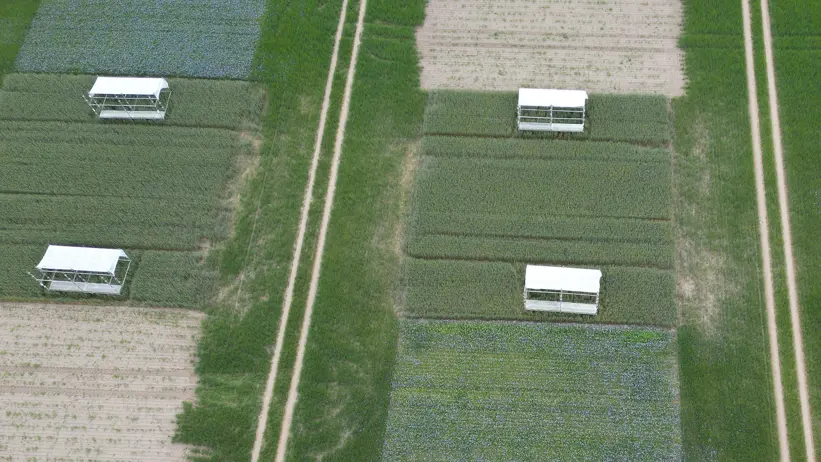
Valeria Carini also worked in a long-term field experiment in Uppsala. There, she compared cropping systems with different crop rotations and tillage practices. She also simulated a dry spell to investigate whether a more diverse cropping system with less intensive tillage could be more resistant to drought.
'I put roofs over the experimental plots, and some plots received water while others did not. Things got particularly exciting during the first week when the roofs blew away, and we had to go out, collect them and put them back in place,' Valeria recalls.
The dry spell affected both crop growth and several groups of soil-dwelling animals, but the researchers found no statistically significant reduction in grain yield. Nor did the diverse cropping system with less intensive tillage provide any clear improvement in resistance to drought.
These findings further illustrate how complex the interactions between cropping practices, crops and other organisms in agricultural fields can be.
Dissertation
Valeria Carini defends her thesis 13 November at Ultuna Campus.
Thesis
More information
The study was part of TRANSECO – Transforming the food value
chain based on ecologically and economically sustainable crop production
duction
Contact
-
Person
-
PersonAnna Lundmark, Kommunikatör, SciFest-ansvarigDepartment of Ecology , joint staff/department office