
Beneficial insects could help control aphids in lettuce
Researchers at SLU are developing a method that uses scent signals to attract beneficial insects to lettuce fields while making it more difficult for aphids to establish themselves. As the availability of effective insecticides declines, new ways of protecting Swedish vegetable crops are needed.
Swedish open-field vegetable production faces major challenges when it comes to crop protection. The availability of effective insecticides is declining due to the development of resistance and stricter regulations. At the same time, aphids and thrips remain difficult pests to control.
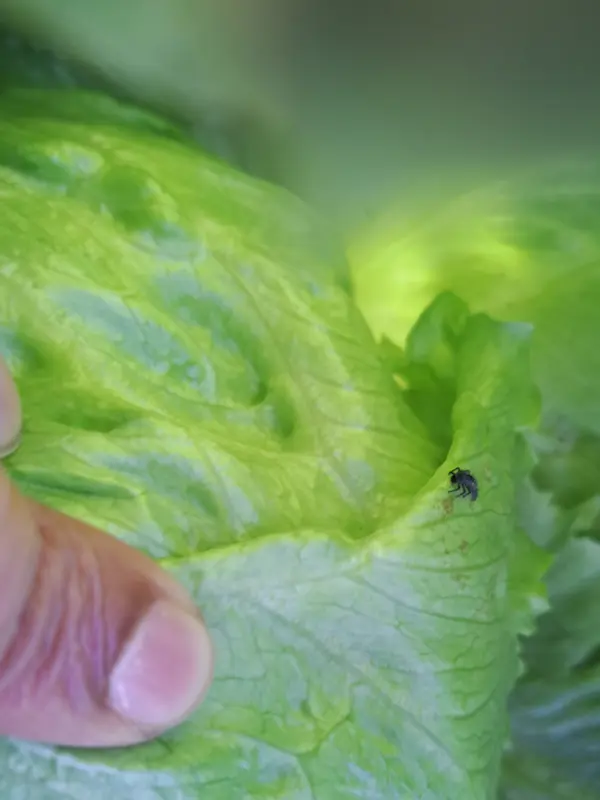
In lettuce, the presence of aphids can make the crop unmarketable. The situation has become so serious that several Swedish lettuce growers have announced plans to reduce production towards the latter part of the growing season, when the risk of insect infestations becomes too high. Aphids are particularly difficult to control because they tend to hide deep inside the lettuce heads.
“They are very good at hiding. Even when you treat the crop, it can be difficult to reach them because the treatment only reaches the outside of the lettuce head,” explains Tibebe Dejene Biasazin, a researcher at the Department of Plant Protection Biology at SLU.
Using scent signals to attract beneficial insects
Tibebe Dejene Biasazin is investigating a method based on the chemical communication between plants and their surroundings.
When a plant is attacked by insects, it releases various volatile compounds. These act as signals for insects such as ladybirds, hoverflies and lacewings, which are natural enemies of crop pests and are collectively known as beneficial insects.
Tibebe Dejene Biasazin has investigated which volatile compounds beneficial insects respond to. By identifying compounds that several species have in common, he has developed a scent blend designed to attract different types of natural enemies to crops.
“The aim is not to attract just one species. We have focused on compounds that several different beneficial insects can detect and respond to. The idea is to attract an entire group of natural enemies to the crop,” he explains.
The scent blend acts as a kind of chemical anchor. It mimics herbivore-induced plant volatiles (HIPVs), which signal that a plant is under attack by herbivores. By deploying the blend in the field, the hope is that beneficial insects will not only be attracted to the area but also remain there, as the scent gives them the impression that prey is readily available.

Helping beneficial insects stay in the crop
The scent blend could help address a key challenge in biological pest control using beneficial insects. It is not enough for beneficial insects simply to be present near a crop. They also need to find the pests and remain in the area long enough to make a difference.
Green lacewings (Chrysoperla carnea) are already used for biological pest control. They can be released into crops as eggs, but once they hatch, the larvae may disperse from the crop if there is not enough prey available where they emerge.
This is where Tibebe Dejene Biasazin's scent blend comes in.
“If we have a scent in the crop that signals the presence of prey, it could help keep beneficial insects in the area. That is what I mean by a chemical anchor: attracting more beneficial insects to the crop and encouraging them to stay,” says Tibebe Dejene Biasazin.
The scent compounds could also deter aphids from flying into the crop and establishing colonies on the plants, as the scent signals that the plant is already under attack.
Promising results from apple orchards
The method has previously been tested in apple orchards, where research has shown that more beneficial insects are present in areas where the scent blend has been deployed.
“The most exciting thing is finding out whether it also works in other cropping systems. We know it has worked in apple orchards, but the question is whether we can achieve similarly good results in lettuce.”
During the most recent growing season, the method was also tested in an open-field lettuce crop. However, aphid numbers were considerably lower than expected this season, making it difficult to draw firm conclusions about the method's effect on the pests. Beneficial insects were nevertheless observed in the crop.
Combining several methods
The scent signals are part of a broader development project in which SLU is collaborating with HIR Skåne to identify effective crop protection strategies for Swedish open-field vegetable production.
During 2026 and 2027, pilot trials are being conducted at eleven commercial growing sites. Different combinations of biological pest control, insect-proof nets and contact-acting treatments are being tested.
The aim is to investigate which methods work in practice and how they can be combined to reduce pest infestations without compromising crop quality or causing unreasonably high production costs.
The scent-based method will be evaluated in more detail in a dedicated trial comparing the conventional release of lacewings with releases combined with scent signals.
Further research needed before the method can be used
Although the results from apple orchards are promising, considerably more research is needed before the scent-based method can be recommended to vegetable growers.
“The first step is to find out whether the method works. We then need to investigate factors such as how long the scent compounds remain effective in the field, how far the scent travels and when different beneficial insects are available during the growing season,” says Biasazin.
In the long term, the hope is that this research will contribute to more reliable biological pest control and reduce reliance on chemical plant protection products in Swedish vegetable production.
About the poject
The project Precision biocontrol strategies to secure Swedish outdoor vegetable production under reduced insecticide availability (PA1676) runs from 2026 to 2027 and is financed by SLU Partnership Alnarp.
Contact
-
Person
-
PersonJohanna Grundström, Communication managerUnit for Collaboration and Development