
Can dairy farms help insects thrive?
How can dairy farms support biodiversity while remaining productive and profitable? This is one of the questions driving researcher Ilaria Laterza, who is exploring how farming practices affect beneficial insects and the ecosystem services they provide.
For Ilaria Laterza, a fascination with insects began long before her research career. Growing up in southern Italy, she loved spending time outdoors, exploring nature and imagining herself as a scientist. When she discovered entomology (the scientific study of insects) in a university course catalogue, she knew she had found something worth pursuing.
Today, Ilaria is a post doctoral researcher at SLU, working with Mattias Jonsson at the Department of Ecology and SLU Centre for Biological Control. She studies the relationship between agricultural practices, biodiversity and the natural processes that help farming systems function.
Finding the balance between biodiversity and farming
In the DairyPathS project (Agriecological pathways for sustainable diary), Ilaria investigates how different farming practices influence biodiversity and the benefits it provides, including pollination and natural pest control. The aim is to identify ways of managing dairy farms that benefit wildlife without compromising farm productivity or profitability.
– Biodiversity plays a fundamental role in agriculture because it supports ecological functions that farming itself depends on. But protecting biodiversity is not necessarily as simple as adopting one particular practice, Ilaria explains.
A practice that benefits one group of organisms may have little effect on another, or even cause harm. And what works well from an ecological perspective may not always be practical or economically viable for farmers.
– One of the biggest challenges is translating scientific knowledge into practical recommendations. We need to understand how different practices interact and find solutions that work for both biodiversity and farmers.
Giving nature's pest controllers a helping hand
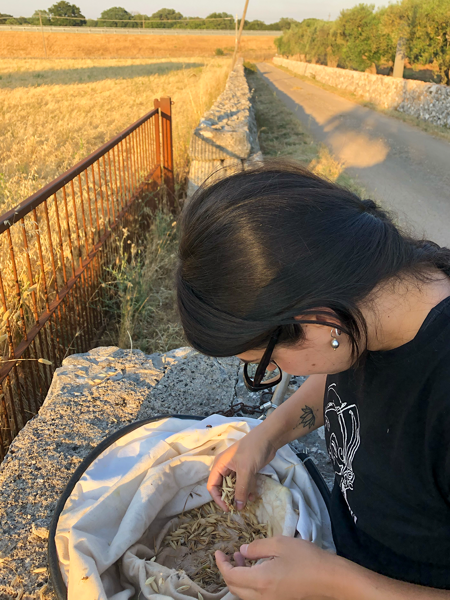
Before joining DairyPathS, Ilaria mainly studied insects and other arthropods in crop production systems, focusing on how agricultural practices affect beneficial species such as ground beetles, spiders and parasitoids. Her research has explored how removing vegetation can affect natural enemies of crop pests, and how pesticide residues can influence beneficial arthropods even when exposure is not lethal.
These organisms play an important role in biological control by helping keep pest populations in check.
– Pest management is not just about controlling pests directly. It is also about creating conditions that allow their natural enemies to survive and perform their ecological functions.
Moving from crop production to dairy farming has opened up new possibilities – and brought Ilaria closer to her family roots. Her grandparents were livestock farmers, so studying dairy farming systems is also a way of reconnecting with her family's past, but from a scientific perspective.
– I'm now exploring how livestock production, grassland management and other farming activities interact with biodiversity. It's exciting to apply ecological questions I've worked on for years to a completely different agricultural context.
Curiosity, challenges and new discoveries
Ilaria studied at the University of Bari in Italy, where her passion for research grew during her Master's thesis. Despite experiments that repeatedly failed, she was determined to find solutions.
– Research is not just about finding answers, but also about learning how to deal with unexpected challenges.
Today, she particularly enjoys exchanging ideas with other researchers and exploring new perspectives. However, she also believes that good research needs time.
– Sometimes I feel that research is moving so fast that we don't always give ideas enough time to develop and mature.
A passion for pollinators – at work and at home
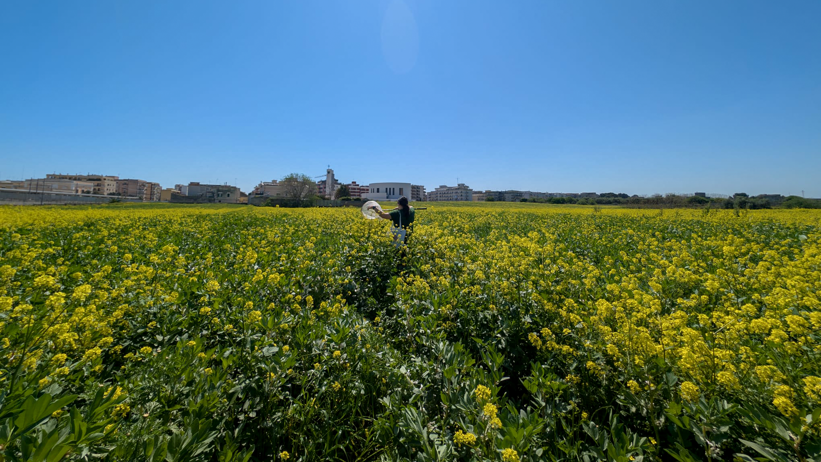
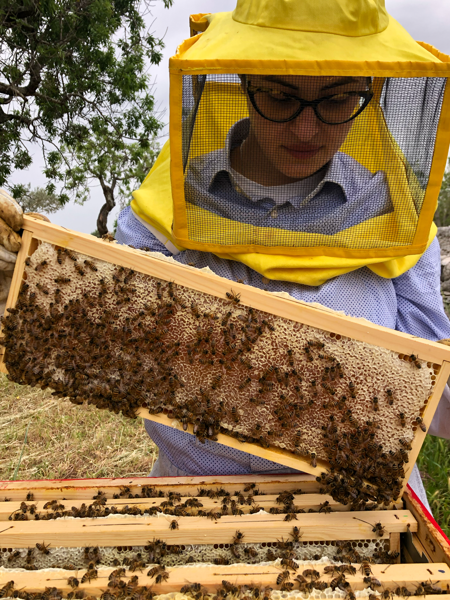
Looking ahead, Ilaria hopes to continue exploring how agricultural landscapes affect beneficial arthropods, particularly predators and pollinators. She is especially interested in connecting laboratory studies with observations in the field to better understand how insects respond to agricultural practices and environmental pressures. Her interest in pollinators extends beyond her professional life: she is also a beekeeper.
– I've always found the world of pollinators particularly fascinating. I'd like to better understand the challenges these organisms face in agricultural environments and how we can support their conservation.
Outside work, Ilaria enjoys travelling, drawing, painting and spending time in nature. One of her favourite summer activities is snorkelling in the sea around Puglia, her home region in southern Italy. Recently, she has also taken up knitting again. Whether she is observing insects in a field, exploring the underwater world or learning a new creative skill, curiosity remains a constant.
And perhaps that is what she enjoys most about research, too.
– Even when you think you've answered a question, several new ones appear.
Read more
The DairyPathS project (Agroecological pathways for sustainable diary)
Text by Cajsa Lithell.
Contact
-
Person