
When foxes declined, their prey became more – and less – abundant
Using 50 years of data, researchers have investigated how red fox reproduction is related to prey, disease and apex predators. The relationship between fewer fox litters and the abundance of hares and woodland grouse varied over time – sometimes there were more prey, sometimes fewer.
Research projects are often short, spanning only a few field seasons, but different animal species have been monitored at Grimsö Wildlife Research Area for a long time. A great deal has happened over those more than 50 years. At first, foxes were abundant, then sarcoptic mange struck. The Eurasian lynx returned, followed later by the wolf – both of which can kill foxes. Meanwhile, researchers continued to count fox litters, trap voles and survey droppings from hares, capercaillie, hazel grouse and black grouse. Together, these changes create a natural experiment in which interactions in the ecosystem can be studied.
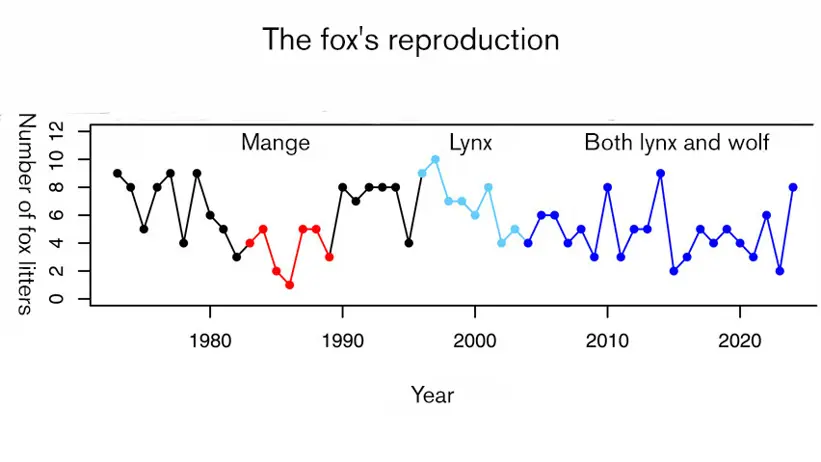
Fox reproduction
Fox reproduction increased when voles were abundant. The number of fox litters decreased during the sarcoptic mange outbreak in the 1980s and was also lower after both lynx and wolves had re-established in the research area – lynx in the 1990s and wolves in the 2000s. The densities of the fox's prey increased during the mange outbreak, but declined following the return of the apex predators, even though the number of fox litters had also declined. In addition, the relationship between vole abundance and the densities of the fox's prey weakened after the return of the apex predators.
During the mange period, the results fit the intuitive picture: fewer foxes coincided with more hares and woodland grouse. But when the apex predators returned, this simple explanation no longer held. Both fox litters and the secondary prey – hares and woodland grouse – was then less abundant.
'One explanation may be that the apex predators do not only affect foxes, but also take some of the same prey. When lynx and wolves returned, several relationships in the food web changed at the same time. The pattern was clearer for hares than for woodland grouse, probably because hares are more important prey for both lynx and wolves,' says Camilla Wikenros, researcher at Grimsö Wildlife Research Station at the Swedish University of Agricultural Sciences (SLU).
Both food and predators are important
In ecology, populations are often described as being regulated from the bottom up through food availability or from the top down through factors such as predation and disease. Both processes appear to operate simultaneously for foxes in the Grimsö area.
Sarcoptic mange and the period when both lynx and wolves were present were associated with fewer fox litters. At the same time, there was a stable relationship in the other direction: more voles coincided with more fox litters throughout the study period, although at different levels. However, the researchers found no evidence that variation in the abundance of hares and woodland grouse explained the number of fox litters.
Long time series reveal relationships between species
The study shows why it is difficult to understand changes in a single wildlife population by looking at just one species. Species are not part of a simple chain, but of a food web in which a change can have effects in several directions.
'With long time series, we can follow the same ecosystem before, during and after both disease outbreaks and changes in the species community, such as the return of apex predators. This allows us to detect relationships that cannot be documented over a short period of time,' says Camilla Wikenros.
The study was recently published in Ecography.
Facts about the study
Annual wildlife monitoring has been carried out at SLU Grimsö Wildlife Research Station since the 1970s. Today, the wildlife monitoring forms part of SITES, a national infrastructure for terrestrial and limnological field research.
Red fox: Fox reproduction has been monitored by surveying known fox dens since 1973. Field staff check whether the dens are occupied and whether the foxes have produced kits.
Voles: Vole populations have been monitored using standardised trapping, also since 1973. The researchers use a density index based on the number of voles caught.
Mountain and European hares, capercaillie, hazel grouse and black grouse: Population status has been assessed by surveying droppings in permanent plots. The researchers use the proportion of plots containing hare droppings and woodland grouse droppings as density indices. This monitoring began in 1977.
Eurasian lynx and wolf: The researchers divided the time series according to when the apex predators re-established in the area. Lynx were considered present from 1996 and wolves from 2004. As there is no period with wolves but without lynx, it is not possible to separate out the specific effect of wolves.
Scientific article
Contact
-
PersonCamilla Wikenros, ForskareS, Wildlife Ecology Unit
-
PersonAnna Lundmark, Kommunikatör, SciFest-ansvarigDepartment of Ecology , joint staff/department office