
Extreme winter weather killed brown trout eggs – but the populations recovered quickly
How long does it take for a species to recover from a disaster? A study from the Swedish University of Agricultural Sciences (SLU) shows that trout populations can recover in just a few years after a winter when streams froze to the riverbed – even though an entire cohort was wiped out.
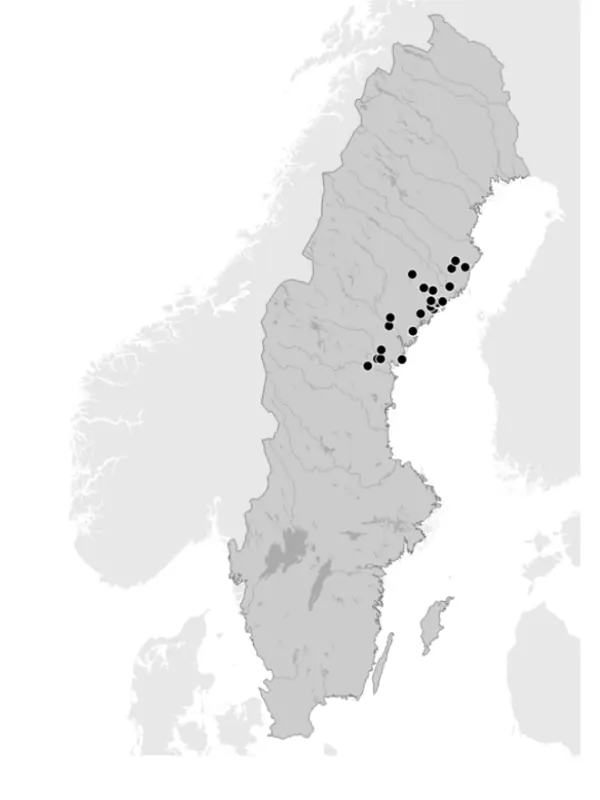
The winter of 1995/1996 in Sweden was marked by highly variable weather with heavy snowfall and cold temperatures. However, before the snow had settled along the northern coast, there was a cold spell that led to anchor ice formation in shallow streams, causing parts of streams and rivers to freeze all the way to the riverbed. Researchers have now investigated how trout coped with the extreme situation in several of the affected streams.
The study analysed fish sampling data from 22 trout populations, collected between 1989 and 2023, spanning both before and after the cold spell. Both migratory and resident trout populations were studied, as migration strategy can affect recovery capacity.
Anchor ice wiped out an entire cohort
The researchers found that the cold spell and anchor ice that formed on the riverbed wiped out almost all the eggs in the trout populations included in the study, regardless of migration type. This was evident from the lack of fry in the following season.
– Despite the cold weather causing almost all the eggs to die, the streams suddenly filled with young trout the following year. This was probably because adult trout were able to move and seek shelter either in deeper water or in the sea, which allowed them to survive and later recolonise the streams. We also saw that migratory trout, such as sea trout, produced more offspring than resident trout, probably because migratory trout are often larger and can lay more eggs, says Carl Tamario, researcher and main author of the study.
Important to preserve open migration routes
When a cohort was wiped out, this led to fluctuations in the number of young fish, with alternating stronger and weaker cohorts lasting 4-5 years. This was because the competition between the age classes changed when a cohort died during the extreme winter weather.
After these fluctuations, the populations returned to pre-disturbance conditions, without human intervention. The researchers conclude that measures such as stocking trout to help the species recover after such an isolated event may be unnecessary. Instead, it is better to wait and see if the population recovers naturally.
– Our results show that trout populations are resilient as long as adult trout survive and their habitat remains suitable and accessible. The results point to the importance of preserving open migration routes between different parts of a water system, both between spawning grounds and the sea, but also between different areas within a river system and its lakes where fish can seek shelter. This reduces the risk of adult fish dying and promotes the natural recovery capacity of trout, says Joacim Näslund, researcher and co-author of the study.
Other disturbances may have different consequences
The researchers point out that the study only covers one of several possible types of disturbances that challenge the resilience of trout. Floods and droughts can also cause populations to collapse, and the researchers recommend caution in assuming that trout are equally capable of recovering from all types of disturbances.
– We have only investigated the effects of a relatively short-term disturbance. If disturbances are repeated several times, or when changes driven by, for example, climate or land use creep in over time, it is more difficult to predict the effects. However, the risks of more serious impacts are likely to be greater in these cases. Trout populations are already negatively affected in many areas, especially in smaller streams in southern Sweden where water temperatures can become very high, as our previous research shows. It remains to be seen whether the species' resilience will be sufficient to cope with future challenges, says Serena Donadi, researcher and project manager.
Scientific article
Oikos journal: Winter wipeout? Post-disturbance recovery of brown trout indicates strong population resilience to harsh winter conditions Carl Tamario, Joacim Näslund, Erik Degerman, Erik Myrstener, Duncan Philpott, Serena Donadi.
The study is part of the COAST-LAND project, which focuses on the habitats of migratory fish species. It is funded by Formas.
Summary of results
The study shows that brown trout can recover after a single extreme winter with anchor ice formation in streams, provided that adult individuals survive and that the habitat is available for natural recolonisation. At the same time, the researchers warn that changes in, for example, climate and land use can be a major challenge. Therefore, the importance of preserving habitats and open migration routes is emphasised in order to reduce the risk of local trout populations being wiped out.
Contact
Carl Tamario, Researcher, Department of Wildlife, Fish and Environmental Studies
carl.tamario@slu.se +46735424278
Joacim Näslund, Researcher, Department of Aquatic Resources
joacim.naslund@slu.se +46761268124
Serena Donadi, Researcher, Department of Aquatic Resources
serena.donadi@slu.se +46104784209