
A new European study paves the way for more reliable monitoring of crayfish and crayfish plague using eDNA
Crayfish plague and invasive species threaten freshwater crayfish across Europe. In a comprehensive study, researchers from 13 European countries show that eDNA can improve monitoring, but that the choice of method is crucial for how reliable the results are.
Although crayfish release relatively small amounts of DNA into their surroundings, eDNA has proven to be an effective way to detect their presence.
– In this study, we wanted to test how well different laboratories actually succeed in detecting crayfish and crayfish plague when everyone uses their own methods for collecting water samples, says Patrik Bohman, environmental assessment analyst at the Department of Aquatic Resources at the Swedish University of Agricultural Sciences (SLU) and one of the authors.
All participating research teams were able to detect DNA from both the native noble crayfish and the invasive signal crayfish in controlled environments with relatively high densities, despite major differences in equipment and protocols. In more natural settings with low crayfish densities, however, the results were less certain. Detecting the crayfish plague pathogen itself proved to be the most difficult.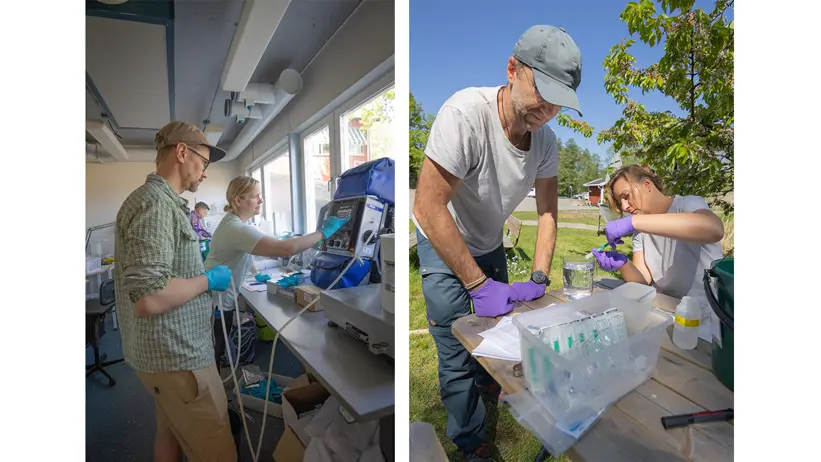
– The results demonstrate the strength of eDNA and why we need common methods. This is extremely important for future environmental monitoring, where authorities and managers must be able to trust that eDNA results are comparable between countries and laboratories. Today, eDNA surveys are carried out by many different companies and agencies using different methods and equipment, which makes this study highly relevant, says Patrik Bohman.
The study shows that international comparisons and methodological harmonisation are essential for making sound decisions on the protection of threatened species and the control of invasive species. This represents a step forward towards more robust and quality-assured methods for monitoring crayfish in Europe.
The study has been published in the scientific journal Environmental DNA. Read more about the study and how eDNA can contribute to improved conservation and monitoring.
More detailed image description
Both images show two different teams of researchers filtering freshly collected water samples from the experiment, but using slightly different methods and equipment. The image on the right shows the German team (Kathrin Theissinger & Jean-Yves Georges from the Senckenberg Nature Research Institute & CNRS/IPHC lab). They use a Vampire pump and Sterivex filter (0.45 µm pore size) to collect waterborne samples. The image on the left shows the Finnish team (Timo Ruokonen & Terhi Iso-Touru from the Natural Resources Institute LUKE). They use a more advanced eDNA pump: a Smith-Root eDNA sampler together with a Smith-Root filter (1.2 µm pore size).
This is eDNA
- eDNA stands for “environmental DNA”.
- The term eDNA refers to the mixture of genetic material from different organisms obtained directly from environmental samples (water, soil, air, etc.). This can include material from living organisms or body parts such as eggs, sperm and larvae, as well as dead material like urine, faeces, mucus or fish scales.
- By analysing the eDNA present in lakes and rivers, it is possible to detect which species of fish, mussels and crayfish occur in an area.
Contact
-
PersonPatrik Bohman, Environmental Assessment Analyst and Deputy Head of DivisionInstitute of Freshwater Research