
Get me up to moose speed
Have you just happened upon the Swedish moose and its migration? We have gathered some information to provide a quick introduction.
For thousands of years, the moose has followed the same route between its winter and summer ranges. The moose even disappeared from Sweden for a long period of time, but returned and now walks the same paths as its ancestors.
We know this because there are pitfall traps and rock carvings in the area that tell us where the very important moose was hunted. The landscape around these moose moulds their path through the millenias'.
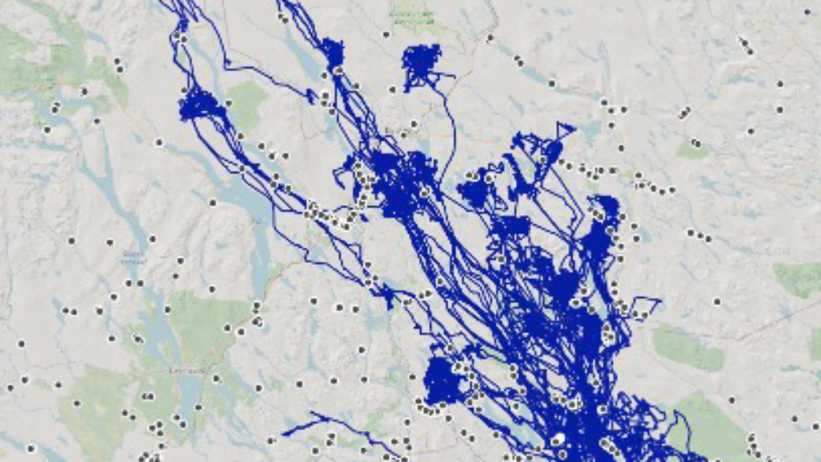
In spring, there is a hurry to reach the summer grazing grounds so the migrations takes 1-3 weeks. Especially the females are in a hurry, they give birth in May–June. In winter, however, there is no such urgency and the moose are more spread out. They want to conserve their energy, so they move at a calmer pace taking their time, 6-8 weeks in November - January.
More about the Swedish moose
The moose is the largest wild land-living animal in Sweden and is a ungulate mammal. It has a thick grey, grey-brown, or black coat, large ears, and long greyish-white legs. Male moose also have antlers, which they shed after the mating season ends in October–November. The antlers then grow back during late spring and summer. The offspring are called calves and are born in May–June, eight months after the mating season. An adult moose can weigh between 200 and 800 kg. Moose are largest in northern Sweden. A female moose can live to almost 30 years of age, but males rarely live beyond the age of 10. The moose has existed in Sweden for at least 8,000–10,000 years.
More about pitfalls and carvings in the Moose cult in Kullberg
Learn more about the migration in The Great Moose Migration
Where in Sweden are we talking about? Kullberg in Google maps