
Lanna Research Station
We perform field experiments and environmental monitoring for different universities and organisations.
What we do
Lanna experimental station, located on the cereal dominated plain in the county Västergötland is one of four field research stations for crop experiments run and owned by SLU. Here, field experiments are conducted within research projects and variety testing on behalf of researchers and companies. There are several long-term experiments for studies of soil and plant nutrient issues as well as leaching. These experiments are used both by the researchers responsible for them by other researchers from different institutions, universities and countries who come and take samples and use data from selected treatments. We also help with various types of assignments regarding soil, water and crop sampling in the surrounding area.
There are also several leaching facilities here that are available to researchers both within and outside SLU. The machinery includes, among other things, a combi drill for plot sowing, slurry spreader for plot-wise application, a camera-controlled inter-row hoe suitable for experimental plots and irrigation equipment for block-wise irrigation. We have several facilities for leaching measurements that are open to hire for different projects and there is also a portable equipment for measuring nitrous oxide emissions. The University of Gothenburg has equipment located at Lanna that measures carbon dioxide using Eddy-covariance technique.
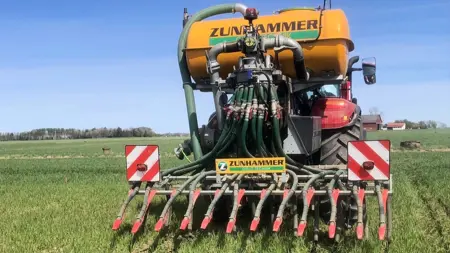
Specialized spreader for liquid manure. Photo: Sofia Delin.
At Lanna there is equipment for plot-wise sowing, fertilizing and harvesting. Our newest experimental seeder can handle combi-drilling and different row spacings and sowing depths. We have a specialized spreader for liquid manure that can dose more precisely in plots up to three meters wide and is equipped with both trailing hose and trailing shoes for shallow incorporation. We also have equipment for mechanical weed control with hoeing in plots with a width of 1.9 or 3 m. There is a plot spreader for mineral fertilizer with adjustable plot width (1.9-3m) and flexible boom height to be able to fertilize at different crop stages. We have a drone that can take regular RGB photos of the trials, and with the help of our colleagues in Skara also one that can take multispectral images for e.g. vegetation index calculations.
At Lanna there is a tractor held hydraulic auger for soil sampling to about one meter depth and an RTK-GPS for autosteering with high precision positioning. Through our strong connection to the research group at the department of soil and environment in Skara, we also have access to several different soil sensors, including Veris P4000 that measures near infrared reflectance (NIR), electrical conductivity and penetration resistance in 10 cm intervals in the soil profile. With an EM38-MK2 that measures electrical conductivity over two depths simultaneously. Through cooperation with the Hushållningssällskapet (Skaraborg Agricultural Society), we can offer measurements with a handheld Yara N sensor. We have irrigation equipment that irrigates to a width of 24 meters that we have used for block-wise irrigation of trials, so that the effects of the experimental measures under different water regimes can be evaluated.
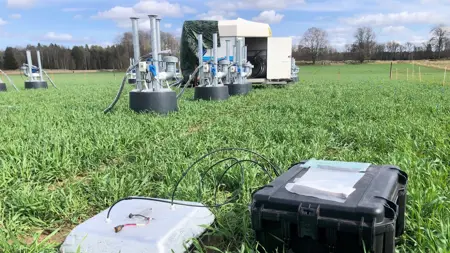
In the foreground, a chamber and equipment for measuring nitrous oxide emissions, and in the background, wind tunnels for measuring ammonia emissions. Photo: Sofia Delin.
During the period 2012-2020, measurements of greenhouse gas emissions were carried out at Lanna in collaboration with the University of Gothenburg within the European collaboration project, ICOS- Integrated Carbon Observation System. The measurements showed very low emissions of nitrous oxide on Lanna, often below the detection limit for the measurement method used. Because of this, ICOS has decided to end its measurements at Lanna. Nitrous oxide emissions have also been measured with chamber technique in field trials at Lanna. Emissions were found in the order of 0.4-0.5 kg N2O-N/ha in plots without nitrogen fertilizer and in plots with normal levels of mineral fertilizer. In plots with organic fertilizer and in plots with excess amounts of nitrogen fertilization with mineral fertilizer, the emissions were approximately 1.2-1.4 kg N2O-N/ha.
During the period 2023-2024, samples were taken manually in four experiments and sent for analysis in the lab. Since 2024, Lanna has had a portable instrument for measuring nitrous oxide that is used in several experiments in various research projects.
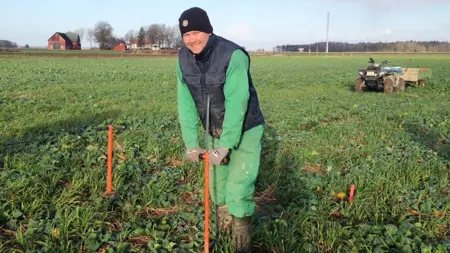
Johan Fredriksson takes soil samples in the crop rotation experiment. Photo: Sofia Delin.
Here are the plan numbers and starting years for long-term field experiments at Lanna.
Leaching
• R0-0646: Organic farming with animal husbandry, starting year 1997
• R0-0746: Organic farming without animal husbandry, starting year 1997
• R0-8419-1: Different soil cultivation systems. and extensive pasture, start year 2002
• R0-8410: Leaching, autumn and spring crops, start year 1992
Soil cultivation
• R2-4010: Different cultivation systems, straw treatment, start year 1974
• R2-4017: Direct sowing, start year 1982
Plant nutrition
• R3-0020: Humus balance - cereals, start year 1981
• R3-0021: Humus balance - pasture, start year 1981
• R3-0130-1: Soil biological conditions, start year 1996
• R3-1001: Lime - phosphorus, start years 1936 and 1941
• R3-9001: Fertility experiments, start year 1966
More information about the plant nutrition experiments: SLU Agricultural Long-Term Experiments
Crop succession
• R4-1103: Crop rotations with or without ley, starting in 1964
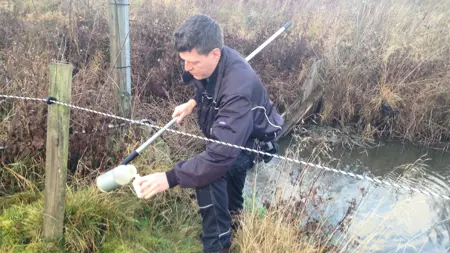
Mattias Gustafsson taking water samples. Photo: Sofia Delin..
Lanna carries out water sampling on a regular basis at two locations for environmental monitoring led by the Department of Soil and Environment in Uppsala. The results are published in annual reports in the publication series Ekohydrologi (in Swedish).
We also do sampling for other environmental monitoring in the area, including ground-level ozone for IVL.
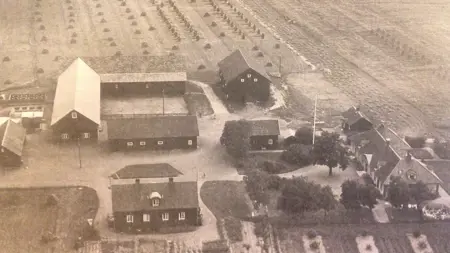
Lanna Research Station in the mid-1930s.
Lanna became an experimental station in 1929, at a time when we wanted to learn how to install covered drainage on the clayey plain. Lanna met the requirements with the justification "The proper management of clay soils requires greater insight and more developed technology than any other soil type". Among other things, liming, drainage and manure management were important issues at the start.
Contact
-
PersonSofia Delin, research leader at the department of soil and environmentSoil nutrient cycling