
Scenarios for future Agro-Silvo-Pastoralist food systems were discussed during a Science Policy Lab in Addis Abeba.
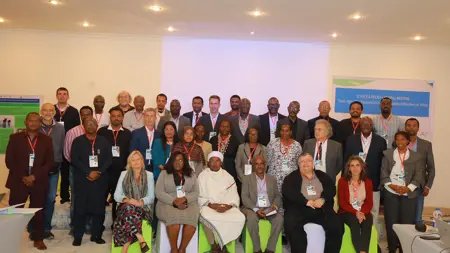
Thirty-eight participants participated in the second Science Policy Lab (SpoL) in Addis Abeba, where the transformation of agro-silvo-pastoralism (ASP) food systems in the Horn of Africa was discussed. This event is a key milestone in a thematic ASP study conducted by SASi-SPi.
Stakeholders – including government decision-makers, representatives of funding agencies, pastoralists, producers, scientists and NGOs – were present.
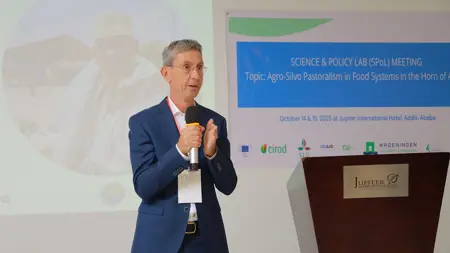
The first day featured a presentation on the ASP food system by SASi-SPi Director, Professor Kostas Karantininis from the Swedish University of Agricultural Sciences (SLU), followed by a presentation of the ASP study results by Bart de Steenhuijsen Piters from Wageningen University & Research. A world café group session then addressed three of the five deep dive topics: governance, social class differentiation, and gender inequality. Three stakeholder groups – civil society, academia, and decision makers – participated in discussions on these subjects.
Deep dive discussions
On governance, stakeholders emphasized the importance of polycentrism in Africa and the need for customary systems to have a legal status as well as for community rights to be institutionalized. The disconnect between traditional knowledge and modern governance systems highlights the need to link public policies to local structures, while national polices must remain flexible enough to adapt to local community contexts.
Stakeholders also discussed weakness in monitoring, evaluation and learning systems, the need for improved coordination of public services and the importance of protecting collective land rights.
On the topic on social class differentiation, the following key levers were identified as possible interventions
- targeting poor agro-pastoralist households and shepherds;
- securing access to land and resources;
- strengthening the institutional recognition of pastoralism;
- integrating the pastoralists into local governance mechanisms;
- supporting solidarity mechanisms, governance, and equitable infrastructure.
Discussions among the three stakeholder groups on gender inequality highlighted challenges related to patriarchal norms and women’s limited access to resources such as livestock, land, and income. Participants emphasized that transforming gender relations in the agro-pastoral sector requires targeted training of women agricultural technicians, enabling them to mentor other women with strong technical skills.
The lack of integration between local, national, and regional gender policies and programs was identified as a barrier to achieving results. Participants also stressed the need to create networks of women’s organizations at different levels to strengthen their collective voice in governance. Finally, stakeholders recognized that behavioral and normative dynamics lie at the core of the problem: without changes in male mindset and the support of customary structures, progress will remain limited.
The next session focused on drivers of change in the food system and the identification of critical uncertainties shaping the future of ASP in the Horn of Africa. The day concluded with a well-received cultural event in the evening.
Future scenarios
The second day started with a discussion on scenarios for the future of ASP food systems. Four scenarios had been developed:
- Shared future
- Concentrated growth
- Living apart together
- Adaptive spaces
This was followed by a roundtable discussion on the interventions and policies required for the different options emerging from the earlier discussions. In conclusion, participants converged on several priorities: securing pastoral lands, improving regional policy coordination, strengthening climate change adaptation, building local capacities, promoting pastoral systems within regional value chains and recognizing the central role of pastoralists – including women and young people – in the governance of resources and food security.
Key takeaways of the SPoL were:
- ASP represents a global gateway to sustainable food systems in dryland Africa
- The private sector can and should engage, contribute and benefit from a high-performing ASP
- National and regional consultation platforms involving all relevant stakeholders are needed to streamline policies and support systems
Contact
-
PersonKonstantinos Karantininis, ProfessorDepartment of People and Society