From Washington to the future: Advancing global agrifood collaboration through GCUA 2030
In this reflection, Paul Egan, Programme Coordinator for the GCUA 2030 shares perspectives from a recent visit to Washington, D.C., where SLU and GCUA 2030 partners gathered at the Embassy of Sweden to discuss the future of collaboration in agrifood systems and innovation.
This blog post is written by Paul Egan, programme coordinator at GCUA 2030 and research advisor at SLU Global.
In late March, I travelled to Washington, D.C. together with Ylva Hillbur, SLU’s Pro Vice-Chancellor for International Relations, to convene a meeting of U.S.-based partners in the Global Challenges University Alliance (GCUA 2030) at the Embassy of Sweden.
The Embassy provided not only a venue, but an active and engaged partnership in shaping the discussions. I would like to extend particular appreciation to Dr. Nils Roos, Agricultural Counselor at the Embassy of Sweden in Washington, D.C., and his professional team for hosting and facilitating the engagement. The re-establishment of the Agricultural Counselor role after several decades is itself a strong signal of the renewed priority placed on agricultural diplomacy, food systems collaboration, and science-based international cooperation.
The Embassy event featured a networking reception, including a panel discussion which I moderated, and brought together a multisectoral diversity of participants from organisations including the World Bank, UN FAO, USDA, IKEA U.S., the Green Transition Initiative (co-founded by Business Sweden and partners), think tanks, NGOs, and diplomatic and policy representatives from the U.S. Senate Committee on Agriculture, Nutrition, and Forestry and several EU embassies.
What stood out most to me was not only the diversity of perspectives in the room, but also the shared recognition that international cooperation remains essential in a period marked by geopolitical uncertainty, shifting priorities, and increasing pressure on global development and research collaboration.
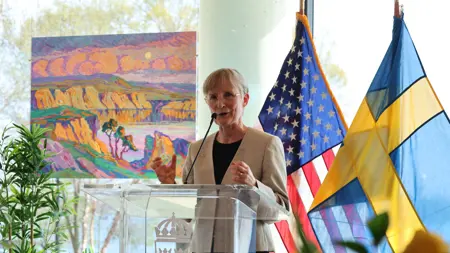
Quote:
“What made this visit especially valuable was the opportunity to strengthen relationships across universities and sectors at a time when international cooperation cannot be taken for granted. There was a clear sense that partnerships like GCUA 2030 matter not only for research collaboration, but for maintaining long-term trust, shared learning, and collective capacity to respond to global challenges.” - Ylva Hillbur, Pro vice-chancellor for International Relations, SLU
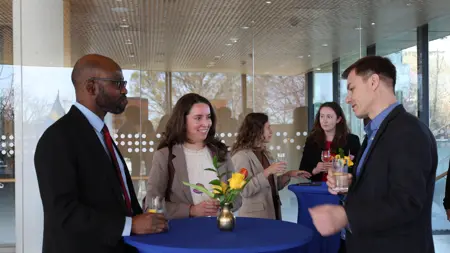
The discussions focused heavily on agriculture and food systems, and the challenges are familiar across both Sweden and the United States: supply chain disruptions, climate pressures, antimicrobial resistance, rising costs, labour shortages, and the need to produce more with fewer resources. Yet there was also a strong sense of possibility. Conversations highlighted how research, innovation, and cross-sector partnerships can help move sustainable solutions from universities into practice.
During the panel discussion that I moderated, Dr. Deanna Behring, Assistant Dean and Director for Ag Sciences Global at Penn State University, and Professor Titus Awokuse, Vice Provost and Dean of International Studies and Programs at Michigan State University, reflected on the structures their institutions have developed to support innovation. We heard inspiring examples of partnerships and hubs dedicated to connecting researchers with communities, industry, and policymakers. Deanna also emphasised the value of international university partnerships, including between Sweden and the United States, in helping transform food systems research into scalable and practical solutions.
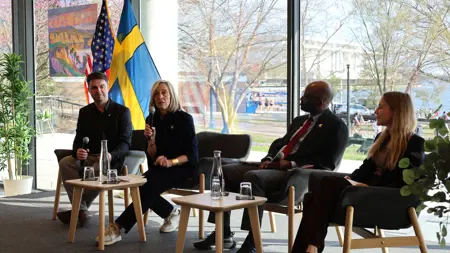
Titus spoke about the importance of designing agricultural research agendas that integrate sustainability and market viability from the outset, and how universities can move beyond simply describing food systems transitions to actively shaping them in practice. Johanna Eklund, Senior Advisor at the Green Transition Initiative, shared examples of how Swedish actors are working to accelerate sustainable technology partnerships in the U.S., including opportunities connected to forestry, energy, and green innovation.
For me personally, one of the most important outcomes of the visit was the strengthening of relationships. Networks such as GCUA 2030 are valuable not only because they create opportunities for joint projects or exchange, but also because they build trust over time. And so in times when international collaboration can feel more fragile or politically complicated, long-term university partnerships help provide continuity, stability, and shared direction.
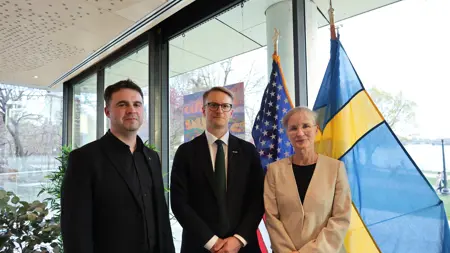
I also left Washington with a renewed sense that universities have an important responsibility beyond producing research alone. In cooperation with the Embassy, GCUA 2030 here acted as conveners – bringing together academia, public institutions, civil society, and industry around common challenges on food system innovation that no single actor can tackle independently.
All pictures are taken by Liliana Silvestrova, Intern, Department of Trade and Economic Affairs, Embassy of Sweden
Contact
-
PersonPaul Egan, Programme coordinator GCUA 2030