Lessons from a bus driver
A season of fieldwork in Mozambique’s Manica province revealed how caterpillars, honey and baobab travel from remote forests to markets across international borders. Here’s what six months of unpacking that trade taught me, and what that means for the future of sustainable forest-based livelihoods.
Found within the Miombo woodlands, a dry, open forest ecosystem that stretches across much of Southern and Central Africa, including Angola, the Democratic Republic of the Congo (DRC), Malawi, Mozambique, the United Republic of Tanzania, Zambia, and Zimbabwe. Unlike the dense evergreen canopy of a tropical rainforest, Miombo woodlands are shaped by long dry seasons. Dominant tree species like Brachystegia, Julbernardia, and Isoberlinia shed their leaves to conserve water, giving the landscape a lush appearance during the rainy season and a sparser, more open look for the rest of the year. You might not have heard about this giant, but its scale and importance cannot be overstated. Around 100 million rural poor and 50 million urban people across the region depend on these woodlands for fuelwood, charcoal, timber, wild foods and medicine.
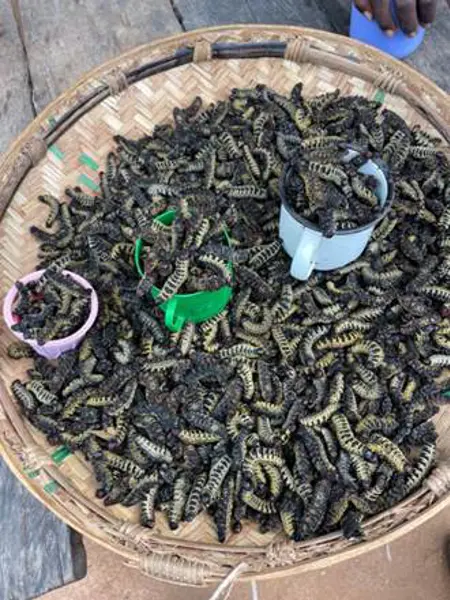
Non-timber forest products (NTFPs) are key contributors to local livelihoods, and harati - edible caterpillars scientifically known as Cirina forda - are among them. Their host tree is Burkea africana, one of the native species in the Miombo woodlands. The harati lifecycle is closely tied to that tree: the caterpillars hatch and feed on its foliage each year before being collected by hand. They are a traditional and seasonal source of protein, often gathered by women, and prepared by removing the gut contents, salting and boiling them, and then drying them in the sun. Their whole existence depends on the health of that same landscape.
From Manica province to Zimbabwe
Back at the market, what struck me even more than the quit precision of the pricing was who was buying them. “So, who are your customers?” I asked. “Mostly people from Zimbabwe,” came the answer from the woman standing behind the stall. “From Zimbabwe?” I asked again to confirm, as harati aren’t a registered export commodity. There’s no customs code for it, no trade statistics, nothing in any formal export record. It’s sold in a small local market, and yet it somehow crosses an international border.
Unable to let go of the thought of harati and Zimbabweans, I made my way to the place where all the movement happens - a bustling bus station in Chimoio, capital of Mozambique’s mountainous Manica province. There, I met a driver who moves passengers between Mozambique and Zimbabwe, and the answer to my questions began to unfold. He told me that, as a side business, sacks of caterpillars travel with him on the bus alongside his passengers. What I now wanted to understand was how something this informal could be moving so reliably across a border, and what that means for the future of sustainable forest-based livelihoods.
By the time I had more of an answer, I had spent months trying to understand something that sounds pretty simple on paper: mapping a value chain, how NTFPs move from forests to consumers. In practice, it was one of the more interesting and complex things I’ve done, and it became the subject of my master’s thesis: Unpacking the Trade Systems of Non-Wood Forest Products (NWFPs) and its Implications for Rural Livelihoods. This minor field study was conducted in collaboration between the Swedish University of Agricultural Sciences (SLU) and the Food and Agriculture Organization of the United Nations (FAO) Mozambique. The fieldwork was carried out in connection with FAO’s Zimbabwe-Mozambique Transboundary Integrated Sustainable Management of Miombo Woodlands project, which works to protect, restore and sustainably use the Miombo woodlands through community-led governance, evidence-based planning and capacity development in Mozambique and Zimbabwe. The project is funded by the Ministry of Foreign Affairs and International Cooperation (MAECI) through the Italian Agency for Development Cooperation (AICS) and implemented by the Government of Mozambique with technical support from FAO, as part of a larger effort to protect the natural resources of Mozambique and the region.
Why the trade is important to battle poverty and malnutrition
Despite its scale, the Miombo woodlands are increasingly threatened by deforestation from illegal logging, forest fires and the effects of climate change. Against this background, NTFPs such as honey, wild fruits, medicinal plants, and edible insects have received growing attention as a way of linking forest conservation to livelihoods - generating income without requiring the forest to be converted into something else.
At times when the world is struggling to find the golden pathway for halting deforestation, tackling climate change and pollution, Africa is also facing a critical youth unemployment and underemployment crisis. It’s a lot to hold at once. For that reason, I wanted to study what is already happening on the ground, focusing on the interactions between formal and informal trade systems, how these systems relate to cross-border trade and mobility, and what implications they have for rural livelihoods, with a focus on three products: caterpillars, honey and baobab.
I spent 2 months in Manica province, travelling between four districts – Chimoio, Guro, Machaze and Mossurize, - trying to unpack how a caterpillar, a jar of honey, or a baobab fruit is sold, to whom, and how it actually gets from a collector’s hands to a customer. I travelled with a team of national FAO officers, and every interview passed through at least one layer of translation, from English to Portuguese, and sometimes from Portuguese to a local language. The effort to understand the development of these value chains was extensive.
At one point I had planned to physically follow a single product from collection site to the final buyer, from start to finish. But I abandoned that plan within the first few weeks: the trade didn’t move in a line. It moved more like a mycelium: threads branching and reconnecting, surfacing wherever there was an opportunity, a relationship or a bus with room for one more sack of caterpillars.
Informal trade is well organised and part of a sustainable future
More than anything, this is the finding I kept coming back to: these informal trade systems are already remarkably well organised, a reality that is difficult to see from the outside. A sustainable future here isn’t about reinventing the wheel, but recognising and building on the creativity that already exists.
Take a few examples. A bus driver coordinates cross-border caterpillar orders over WhatsApp, taking a list from his boss in Zimbabwe and delivering roughly 80 kilograms of caterpillars from Chimoio in Mozambique to buyers in Zimbabwe on a single trip. Women gather and sell baobab with little formal support structure at all - some are organised into an association that supplies a certified export company, while others sell to whoever arrives first from Malawi after harvest. A seasonal caterpillar trade moves quietly across three countries without a single export record. And honey reaches both roadside stalls and supermarket shelves, sometimes from the very same producer through entirely different channels.
The informal economy is often discussed as something to be replaced or fixed. Yet there’s a strong case for taking it seriously on its own terms. In Mozambique, the informal economy accounts for over 80% of employment and generates up to 40% of GDP,. Much of this activity iscarried out by women and agricultural workers, who remain among the most poorly compensated and least formally educated in the labour market. Meanwhile, Africa has the world’s youngest population, with more than 60% of people under 25. Millions enter the labour market every year, but formal job creation isn’t keeping up the pace; a large share of working youth are un- or underemployed. Many of those who do work are still living in poverty because of low wages. The Miombo woodlands are also among the most biodiverse forests left on the continent, and the economic systems already operating within them will only grow in importance.
Upholding and restoring healthy Miombo woodlands is ultimately about ensuring that millions of people, plants and animals can continue to live and thrive. If sustainably managed, the woodlands will remain a crucial source of resilience - helping communities recover from food insecurity, climatic stress and poverty. The woodlands are life, environment, nutrition, and production - all at once, for the millions who depend on them.
That sustainable future for the Miombo woodlands won’t be built from the top down. It will come from paying closer attention to the people who already sustain it - the bus drivers coordinating orders over WhatsApp, the women drying caterpillars in the sun, the roadside sellers providing honey. Recognising and strengthening these systems, rather than replacing them, may be the most realistic path towards forests that stay standing and livelihoods that stay resilient. In a region where millions of young people enter the labour market each year with very few jobs in sight - let alone formal ones - strengthening job opportunities in rural areas and conserving the forest can’t be treated as separate goals; they need to be pursued together. So, the questions to ask isn’t just “what do we build?” but rather “what’s already working, how do we learn from it, and what future do we envision based on that?”
It’s encouraging then to follow that FAOs project is already moving in that direction on the ground: enhancing the production of NTFPs at the community level, integrating smallholders into commercial value chains in Mozambique and Zimbabwe. Something you can read more about here.
If you’re curious what bus drivers, baobab collectors, and honey traders can teach us about the future of sustainable forest management, the full thesis is available here.
This blog post was first published at the SIANI website.
Lovisa Hast
Lovisa Hast is a recent graduate with a MSc in Rural Development and Natural Resource Management at the Swedish University of Agricultural Sciences (SLU), with experience spanning agriculture in Thailand, sustainable tourism in Nepal, and rural development in Sweden. Her work focuses on rural livelihoods related to natural resource governance and she is currently doing an internship at FAO in Mozambique, focused on forest-based value chains and inclusive rural development.
This research was conducted as a minor field study collaboration between SLU and FAO within the framework of FAO’s Zimbabwe-Mozambique Transboundary Integrated Sustainable Management of Miombo Woodlands project.