
Swedish forest growth is becoming increasingly variable – researchers seek to understand why
In a new study researchers have identified five periods of increase and decline in Swedish forest growth over the past 30 years. They now present hypotheses about the factors driving these changes and call for a better understanding of the processes that regulate forest growth in a changing climate.
In the mid-2010s, forest growth in Sweden declined sharply. The decline was the longest and most severe recorded in the history of the Swedish National Forest Inventory, raising concerns that Swedish forests may have passed a critical threshold. Since then, growth has recovered. However, the recent recovery and decline are only part of a broader pattern.
Long-term forest growth in Sweden continues to increase, but fluctuations around this trend have become much larger. Compared with earlier periods, growth now shifts more rapidly between increases and declines, and the magnitude of these fluctuations has also increased. By analysing data from the Swedish National Forest Inventory, researchers at the Swedish University of Agricultural Sciences (SLU) identified five distinct phases during which forest growth accelerated, slowed down or recovered over the past three decades.
“We are seeing forest growth becoming increasingly variable over time. This makes it more difficult to predict how forests will develop in the future and places greater demands on our understanding of what drives these changes,” says Hjalmar Laudon, Professor of Forest Landscape Biogeochemistry at SLU and Deputy Programme Director of Wallenberg Initiatives in Forest Research.
Increasing variability in forest growth could affect future timber production, carbon sequestration and the ability to meet climate and environmental targets.
Five phases of increasing and declining growth
Since the mid-1990s, Swedish forests have experienced several marked shifts in growth. A period of rapid growth in the late 1990s was followed by a decline after Storm Gudrun, the hot and dry summer of 2006, and subsequent bark beetle outbreaks. Growth then increased again and reached the highest levels ever recorded in the Swedish National Forest Inventory.
Around 2014, the longest and most severe decline in forest growth in the Swedish statistical record began. A combination of drier conditions, rising temperatures and widespread bark beetle infestations is believed to have contributed to this development.
“A few years ago, there was considerable discussion about whether forests had crossed a critical threshold beyond which growth would continue to decline. The data from recent years suggest that this is not the case. Growth has recovered, but the fluctuations remain large and we need to understand why if we are to act in time to reduce society’s vulnerability,” says Hjalmar Laudon.
Temperature and water identified as key factors
Similar patterns have been observed in Norway, Finland and parts of Central Europe. The researchers therefore argue that the combination of temperature and water availability is likely the most important explanation for the large fluctuations in forest growth. At the same time, they emphasise that each phase is characterised by its own combination of long-term changes and short-term extreme events. Storms, bark beetle outbreaks, nitrogen deposition and changes in forest management can either amplify or reduce these effects, depending on their strength and interaction.
What makes the situation particularly complex is that the same factor can affect forests in several ways. Higher temperatures, for example, can extend the growing season and promote growth, but can also increase the risk of drought and water stress.
From correlations to understanding
Current knowledge is largely based on statistical relationships between climate and forest growth. To understand why growth varies, the researchers argue that more research is needed on the biological and hydrological processes underlying these changes.
They therefore call for a combination of long-term observational data, large-scale experiments and process-based models to provide a better understanding of how different factors interact.
“The trees planted today will grow under conditions that differ from those experienced by previous generations of forests. If forest management is to adapt to future climate conditions, we need a much better understanding of what controls forest growth,” says Hjalmar Laudon.
FACTS: Five phases of forest growth in Sweden
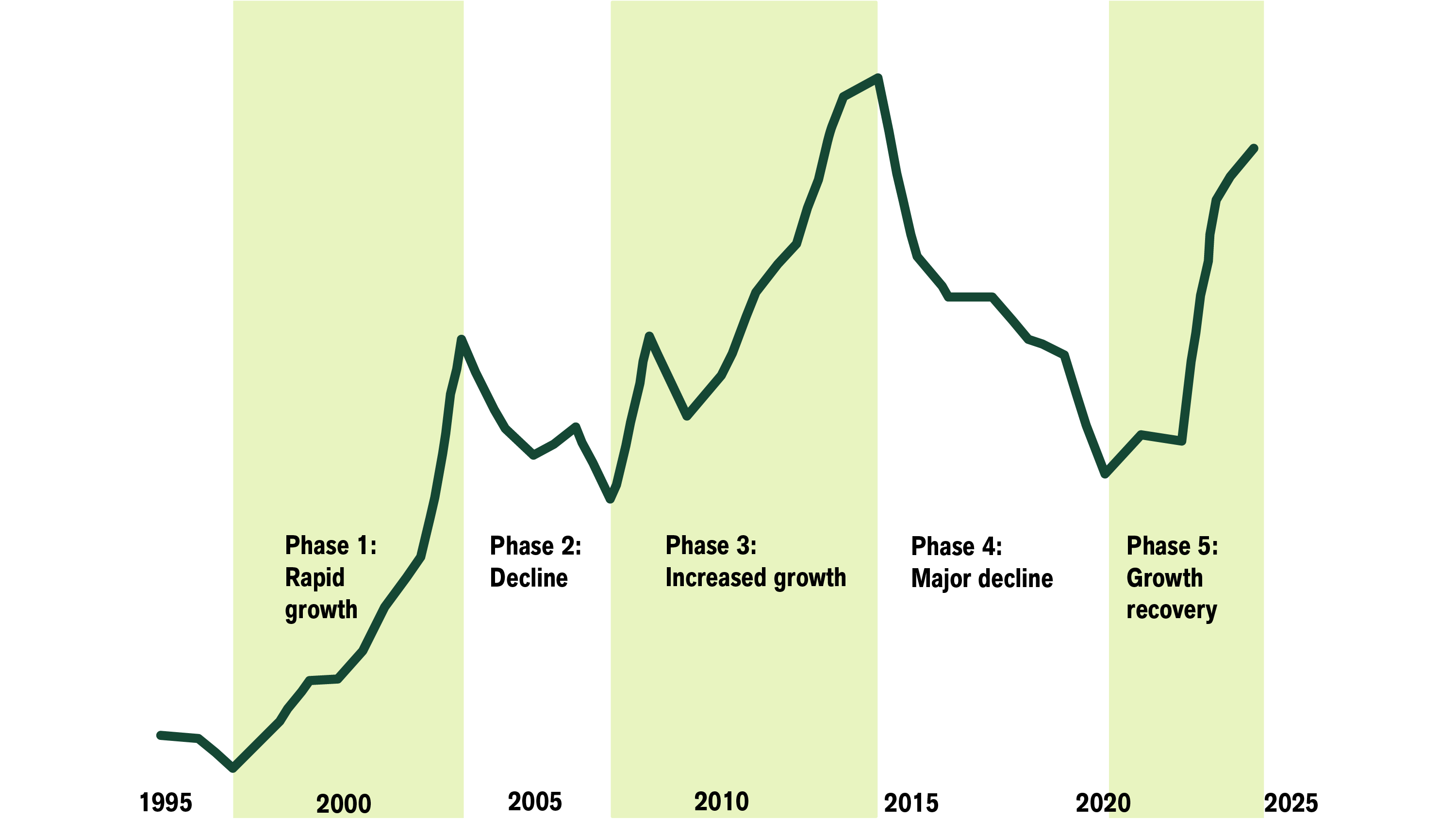
Since the mid-1990s, forest growth has alternated between periods of increase and decline. The researchers identified five distinct phases and present hypotheses about the factors that may explain these changes.
Phase 1 (c. 1997–2004): Rapid growth
Unusually warm years are believed to have contributed to growth increasing faster than the long-term trend.
Phase 2 (c. 2005–2009): Decline
Storm Gudrun, the hot and dry summer of 2006 and subsequent bark beetle outbreaks are believed to have reduced growth, particularly in southern Sweden.
Phase 3 (c. 2010–2014): Increased growth
Forests began to recover from storm and insect damage. At the same time, favourable temperature and water conditions contributed to record-high growth rates.
Phase 4 (c. 2014–2021): Major decline
Reduced precipitation, higher temperatures and extensive bark beetle infestations are believed to have contributed to the largest and longest decline in forest growth recorded in the history of the Swedish National Forest Inventory.
Phase 5 (2022–): Growth recovery
Improved water availability and longer growing seasons are believed to have contributed to growth increasing again and approaching previous record levels.
Scientific article
Laudon, H., Näsholm, T., Fridman, J., Appiah Mensah, A., Lim, H., Jämtgård, S. and Nilsson, O. (2026). Increasing temporal variations in growth of Swedish forests call for better mechanistic insights. Forest Ecology and Management. DOI: 10.1016/j.foreco.2026.123996
Read more
About The Swedish National Forest Inventory
The Research Programme Wallenberg Initiatives in Forest Research
Contact
-
PersonHjalmar Laudon, ProfessorDepartment of Forest Ecology and Management, joint staff
-
PersonSusanna Bergström, Communications Officer WIFORCEFaculty of Forest Sciences