
Run free: For pigs with soil on the snout and stronger legs – one step at a time
Despite Sweden’s goal for thirty percent organic food production by 2030, only one percent of pigs in Sweden are kept organically – with access to outdoor areas and, in some cases, soil on their snouts. Why is that, and what solutions can be found? Step into the project where pigs run free!
Life as a pig in Sweden
From indoor life in enclosed pens to outdoor life with daily mud baths – life as a pig in Sweden can look very different.
But to understand this paradox, one needs to understand the different ways in which pigs live in Sweden. Today, there are three approved ways of keeping pigs for food production, all regulated by the Swedish animal welfare legislation:
Conventional pig production. The pigs live indoors in pens or in larger groups with access to enrichment such as straw.
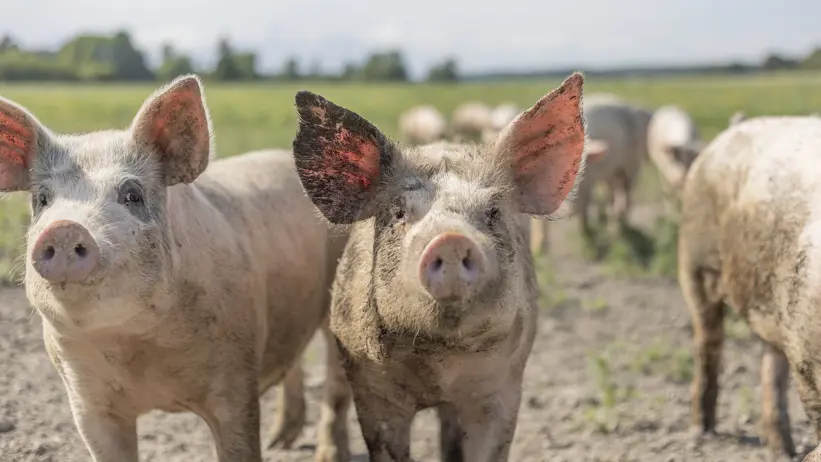
Organic production is then divided into two different standards. EU-organic is based on a European standard for organic production, stricter than conventional, which states among others that pigs must have access to outdoor areas in a run or other suitable land all year round. However, this does not specify what type of outdoor access the pigs must have, which may mean that, for practical reasons, the outdoor area takes the form of a concrete slab.
For pigs to be guaranteed grass under their feet and soil to root in, the national organic label KRAV – Sweden’s strictest organic standard – is required. EU-organic farmers may provide access to pasture, but under KRAV it is mandatory. During the four summer months, pigs must have the opportunity to root, graze and move freely over large areas. For the rest of the year, they must be able to go out into an outdoor run where they have the opportunity to root and lie comfortably on a deep-litter bed.
The paradox: a better environment – but painful problems?
Since 2019, there has been a stated goal that thirty percent of food production in Sweden should be organic. But only one percent of the pigs slaughtered in Sweden today are actually organic. In addition to the practical and financial aspect that larger areas and meeting pigs’ natural behavioural and movement needs entail there seem to be further reasons why farmers are holding back from developing pig farms into organic or KRAV-certified production.
So can pigs be kept outdoors, healthy and protected?
Consumers rightly expect animal welfare to be especially good in organic animal husbandry, which in many respects is also correct: when pigs have more space and access to outdoor areas in runs or on pasture, they are given a more stimulating environment and greater opportunity for movement. When more natural needs are met, behavioural disorders and injuries between pigs decrease.
However, by breeding and adapting pigs for commercial production, new challenges have arisen. There are indications through previous studies on inspection of pigs at slaughter that organic pigs run a higher risk of developing joint and leg problems than pigs from conventional production – despite the same breeds being used. Problems of this kind can be influenced by many factors – but increased activity among organic pigs may be part of the explanation.
However, it is not known how common or how serious these problems are in Sweden today. This is where this research takes over.
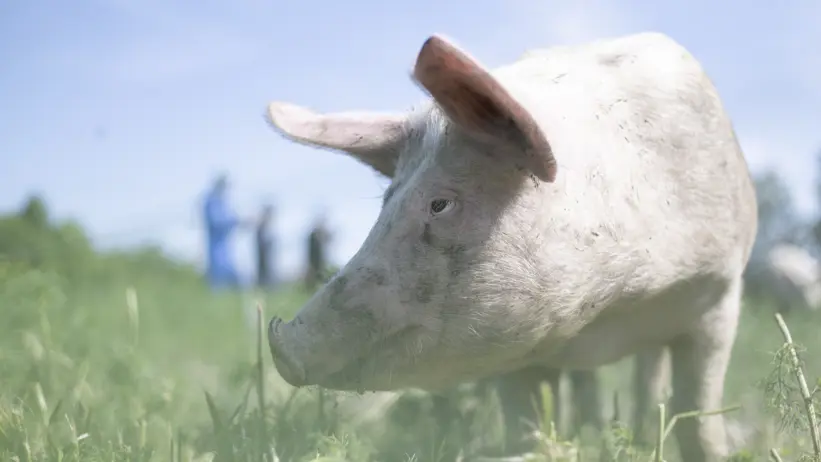
To get the facts straight the research group has been investigating how common the problem with leg and joint injuries in organic pigs really is today, what it may be due to and whether it can be prevented through increased activity for young piglets.
One step at a time over the threshold for pigs running free
The research project reached its halfway point in the summer of 2026, and some results are available.
This also changes the picture of what the threshold for more organic and KRAV-certified pigs actually is. The doctoral student continues:
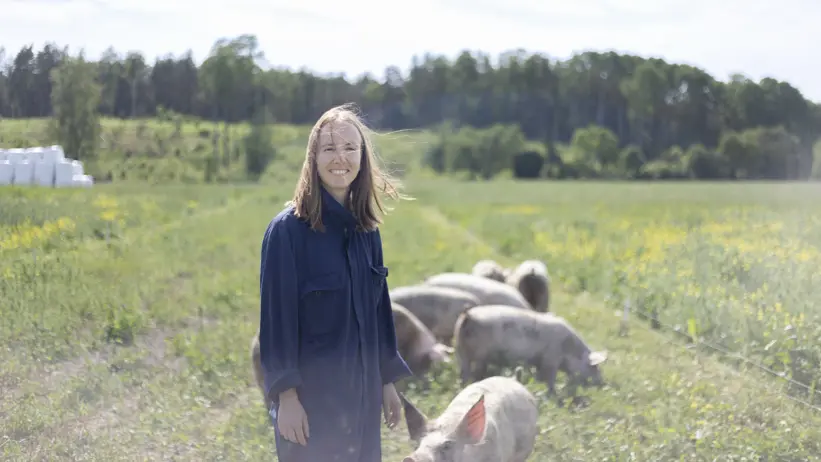
The researchers believe that the project’s close collaboration with pig farmers is key to gaining clearer insights and jointly finding ways forward towards the desired change.
Support research at SLU
Facts: More about this project
- Goes under the official name: “Run free: Assessing leg health and preparing pigs for organic production”
- It is expected to run during the period 2024–2028 and is funded by SLU through government funding earmarked for research on organic production in the field.
- Doctoral student in the project is Lise Pinaqui, agronomist, together with a research group consisting of:
- Main supervisor Katja Nilsson, associate professor in applied animal genetics
- Torun Wallgren, researcher in applied animal science and welfare at SLU
- Stefan Gunnarsson, veterinarian and professor in One Health at SLU
- Lotta Rydhmer, professor emeritus of animal genetics at SLU, former main supervisor of the project
As well as a reference group consisting of: - Farmers from Jord på trynet
- Ingela Löfquist, organic pig farmer and advisor at Hushållningssällskapet, the Rural Economy and Agricultural Societies
- Elin Karlsson, PhD student at SLU and formerly production advisor at Gård och djurhälsan
- as well as collaboration with technicians at SLU and students who are also involved in the project
The project can broadly be divided into four parts, simply described as follows:
- In the first study, a survey was sent to all organic pig farmers in Sweden, with questions about various injuries – focusing on leg problems such as lameness, stiffness after rest, joint inflammation, abscesses and leg wounds. In addition, the farmers were asked what they believed caused the problems, for example the pigs’ sex, breed, outdoor/indoor environment, feed or activity. With this information about the animals, the frequency of injuries and the design of the farms, the researchers were able to make an initial mapping of the perceived problem and possible causes – and to follow up with in-depth interviews with the pig farmers.
- In the second study, the research group follows pigs throughout their lives, in order to identify early on which pigs show some kind of leg problem early in life and to follow these through possible environmental influence and treatment interventions, as well as the effect of these – in order to understand why injuries arise: Are they genetic, due to the environment, trauma or something else?
- In the third sub-study, piglets are trained early in life in an attempt to see whether a more active environment can prepare them to withstand more activity later in life. This intervention, if it proves effective, may be particularly important for piglets born during the winter and therefore without direct access to outdoor areas on uneven terrain, such as pasture.
- In the fourth and last study, the research group aims to place pigs’ leg health in a broader perspective. To do this, sustainability, pig welfare and farmer well-being are assessed on organic pig farms around Sweden using sustainability and animal welfare assessment protocols. They cover aspects such as the environment from a sustainability perspective, working conditions, pig behaviour and health – both during the winter half of the year and during the grazing period.

Read more interviews with researchers
Contact
-
Person